Search
Invitrogen
c-Met Polyclonal Antibody
{{$productOrderCtrl.translations['antibody.pdp.commerceCard.promotion.promotions']}}
{{$productOrderCtrl.translations['antibody.pdp.commerceCard.promotion.promocode']}}: {{promo.promoCode}} {{promo.promoTitle}} {{promo.promoDescription}}. {{$productOrderCtrl.translations['antibody.pdp.commerceCard.promotion.learnmore']}}
{{$ctrl.translations['antibody.pdp.skuNotes.additionalInformation']}}:
产品信息
PA5-47585
应用
建议稀释比
已发表文章
产品规格
种属反应
Dog
宿主/亚型
Goat
/ IgG
分类
Polyclonal
类型
Antibody
抗原
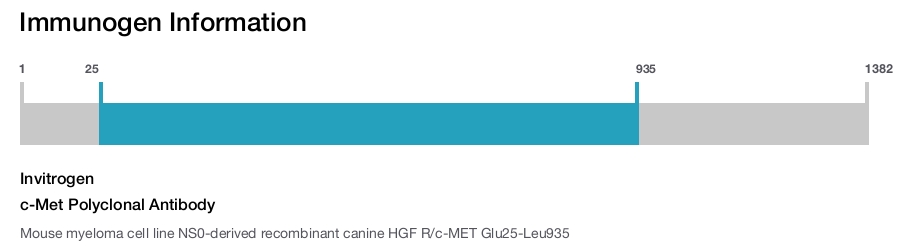
Mouse myeloma cell line NS0-derived recombinant canine HGF R/c-MET Glu25-Leu935
偶联物
Unconjugated
Unconjugated
Unconjugated
形式
Lyophilized
浓度
0.2 mg/mL once reconstituted
规格
100 µg
纯化类型
Antigen affinity chromatography
保存液
PBS with 5% trehalose
内含物
No Preservative
保存条件
-20°C, Avoid Freeze/Thaw Cycles
运输条件
Ambient (domestic); Wet ice (international)
RRID
产品详细信息
In sandwich ELISAs, less than 0.2% cross-reactivity with recombinant human HGF R and remombinant mouse HGF R is observed.
Reconstitute at 0.2 mg/mL in sterile PBS.
Endoxin level is <0.10 EU per 1 µg of the antibody by the LAL method.
靶标信息
MET (cMET) is a receptor-like tyrosine kinase whose dysregulation has been linked to many types of human malignancies. After activation of the ligand, MET interacts with the PI3-kinase subunit PIK3R1, PLCG1, SRC, GRB2, and STAT3. There interactions lead to the activation of signaling cascades including RAS-ERK, PI3, kinase-AKT, and PLCgamma-PKC. MET plays a role in embryonic development including gastrulation, development of muscles and neurons, angiogenesis, and kidney formation. It also plays a role in adults including wound healing, organ regeneration, and tissue remodeling. MET has been linked to cancers including gastric, renal, and breast; therefore, making it a target for cancer therapeutics and diagnostic testing.
仅用于科研。不用于诊断过程。未经明确授权不得转售。
篇参考文献 (0)
您是否在文献中引用过该产品?请点击下方按钮邮件告知我们。
生物信息学
蛋白别名: cMet; EC 2.7.10.1; HGF receptor; HGF-SF receptor; HGF/SF receptor; met proto-oncogene (hepatocyte growth factor receptor); met proto-oncogene tyrosine kinase; Met; protein tyrosin kinase; oncogene MET; proto-oncogene c-Met; sc MET; scatter factor receptor; SF receptor; soluble c met; tyrosine-protein kinase Met
基因别名: c-Met
UniProt ID: (Dog) Q75ZY9
Entrez Gene ID: (Dog) 403438
Disclaimer

Clicking the images or links will redirect you to a website hosted by BenchSci that provides third-party scientific content. Neither the content nor the BenchSci technology and processes for selection have been evaluated by us; we are providing them as-is and without warranty of any kind, including for use or application of the Thermo Fisher Scientific products presented.

