Search
GenScript
cAMP Monoclonal Antibody (4H2B6), THE™
{{$productOrderCtrl.translations['antibody.pdp.commerceCard.promotion.promotions']}}
{{$productOrderCtrl.translations['antibody.pdp.commerceCard.promotion.viewpromo']}}
{{$productOrderCtrl.translations['antibody.pdp.commerceCard.promotion.promocode']}}: {{promo.promoCode}} {{promo.promoTitle}} {{promo.promoDescription}}. {{$productOrderCtrl.translations['antibody.pdp.commerceCard.promotion.learnmore']}}
Additional Information:
{{banner.description}}
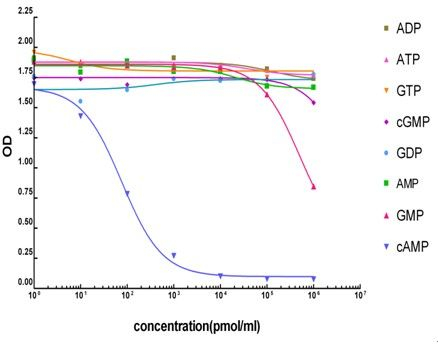
图: 1 / 1
cAMP Antibody (A01509-100) in ELISA
cAMP Competitive ELISA 1.ELISA plate was coated with goat anti mouse IgG antibody 2. Anti-cAMP monoclonal antibody (Cat. No. A01509) at appropriate dilution and cAMP standards or testing compounds were added into appropriate reaction wells. 3.After a period of incubation, cAMP-HRP conjugate (Cat. No. M01059) was added followed by proper period of incubation. 4.ELISA plate was washed with ELISA washing buffer, then TMB substrate was added and developed at room temperature. 5.Stop the reaction with 1.0 N HCl and read the plate at 450nm.

产品信息
A01509-100
产品规格
种属反应
Chemical
宿主/亚型
Mouse
/ IgG2a, kappa
分类
Monoclonal
类型
Antibody
克隆号
4H2B6
抗原
3', 5'-cyclic AMP-8-KLH
偶联物
Unconjugated
Unconjugated
Unconjugated
形式
Lyophilized
规格
100 µg
纯化类型
Protein A
保存液
PBS, pH 7.4
内含物
0.02% sodium azide
保存条件
-20°C, Avoid Freeze/Thaw Cycles
运输条件
Ambient (domestic); Wet ice (international)
产品详细信息
Reconstitute the lyophilized powder with deionized water (or equivalent) to an antibody concentration of 0.5 mg/mL.
Adenosine 3, 5-cyclic monophosphate (cyclic AMP; cAMP) is one of the most important intracellular secondary messengers for transduction events. cAMP is also involved in regulating neuronal, glandular, cardiovascular, immune, and other functions and actions. A number of hormones, such as ACTH, TSH, FSH, and LH, are known to activate cAMP through the action of the enzyme adenylate cyclase, which converts ATP to cAMP. There remains considerable interest in the measurement of intracellular cAMP in tissues and cell cultures, and this may help to provide an understanding of the physiology and pathology of many disease states. Due to the involvement of cAMP in amplifying the response of ligand binding, the second messenger cAMP has been largely employed to monitor the activation of GPCR to facilitate therapeutic drug discovery.GenScript THE™ cAMP Antibody, mAb, Mouse is developed using 3, 5-cyclic AMP-8-KLH as immunogen.
Upon reconstitution, it can be stored for 2-3 weeks at 2-8 °C or for up to 12 months at -20 °C or below.
靶标信息
LL-37 is a cationic antimicrobial peptide derived from the precursor protein hCAP18, which is encoded by the CAMP gene. It is produced by epithelial cells and immune cells such as neutrophils and plays an important role in innate immunity. LL-37 exhibits broad antimicrobial activity against bacteria, viruses, and fungi, and also functions as an immunomodulatory molecule by influencing inflammation, chemotaxis, and wound healing. In addition to host defense, dysregulated LL-37 expression has been associated with inflammatory diseases and certain cancers.
仅用于科研。不用于诊断过程。未经明确授权不得转售。
篇参考文献 (0)
您是否在文献中引用过该产品?请点击下方按钮邮件告知我们。
Disclaimer

Clicking the images or links will redirect you to a website hosted by BenchSci that provides third-party scientific content. Neither the content nor the BenchSci technology and processes for selection have been evaluated by us; we are providing them as-is and without warranty of any kind, including for use or application of the Thermo Fisher Scientific products presented.

