Search
Proteintech
mNeonGreen Polyclonal Antibody
{{$productOrderCtrl.translations['antibody.pdp.commerceCard.promotion.promotions']}}
{{$productOrderCtrl.translations['antibody.pdp.commerceCard.promotion.viewpromo']}}
{{$productOrderCtrl.translations['antibody.pdp.commerceCard.promotion.promocode']}}: {{promo.promoCode}} {{promo.promoTitle}} {{promo.promoDescription}}. {{$productOrderCtrl.translations['antibody.pdp.commerceCard.promotion.learnmore']}}
Additional Information:
{{banner.description}}

产品信息
29523-1-AP
产品规格
种属反应
Tag
宿主/亚型
Rabbit
/ IgG
分类
Polyclonal
类型
Antibody
抗原
Recombinant protein
偶联物
形式
Liquid
纯化类型
Antigen affinity chromatography
保存液
PBS with 50% glycerol
内含物
0.02% sodium azide
保存条件
-20°C
运输条件
Wet ice
靶标信息
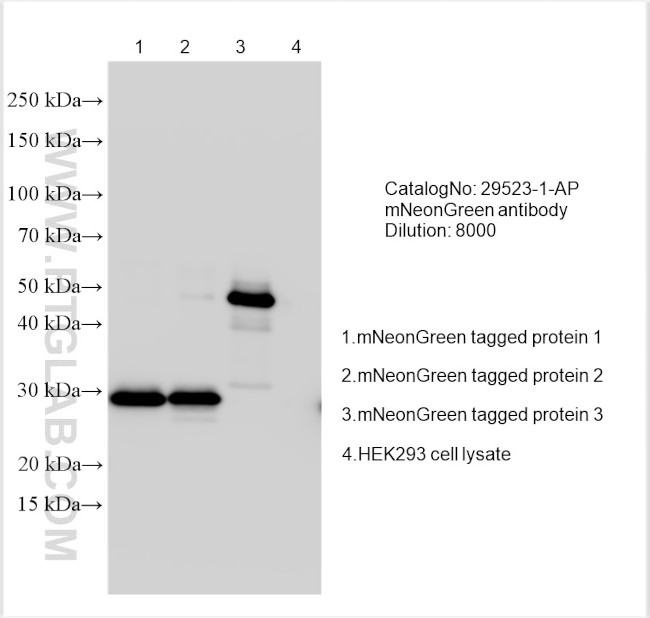
mNeonGreen is derived from the lancelet Branchiostoma lanceolatum multimeric yellow fluorescence protein. Hence, mNeonGreen is evolutionarily distant from jellyfish-derived fluorescent proteins. At sequence level, mNeonGreen shares just 20-25% sequence identity with common GFP derivatives. Due to the low sequence similarity to mNeonGreen, it is expected that in general affinity tools for GFP variants, i.e. antibodies, should not bind to mNeonGreen and vice versa. mNeonGreen consists of 237 amino acids, which translates into 26.6 kDa molecular weight. This size, but not sequence, is very similar to EGFP that comprises 239 amino acids and is 26.9 kDa. Furthermore, mNeonGreen has an excitation maximum at 506 nm and an emission maximum at 517 nm (Shaner et al., 2013). mNeonGreen is compatible with most GFP filter sets. Apparently, it is 3 times brighter than GFP when using GFP filters; optimization of filters may increase its brightness further. In addition, mNeonGreen seems to be more stable and less sensitive to laser induced bleaching than EGFP. Therefore, mNeonGreen is particular suitable for confocal and super resolution microscopy, especially when fusion proteins are investigated, which are expressed at low levels.
仅用于科研。不用于诊断过程。未经明确授权不得转售。
篇参考文献 (0)
您是否在文献中引用过该产品?请点击下方按钮邮件告知我们。
生物信息学
蛋白别名: mNeonGreen; mNG
Disclaimer

Clicking the images or links will redirect you to a website hosted by BenchSci that provides third-party scientific content. Neither the content nor the BenchSci technology and processes for selection have been evaluated by us; we are providing them as-is and without warranty of any kind, including for use or application of the Thermo Fisher Scientific products presented.

