Search
Invitrogen
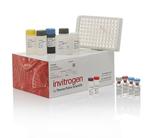
Human GAPDH ELISA Kit
{{$productOrderCtrl.translations['antibody.pdp.commerceCard.promotion.promotions']}}
{{$productOrderCtrl.translations['antibody.pdp.commerceCard.promotion.promocode']}}: {{promo.promoCode}} {{promo.promoTitle}} {{promo.promoDescription}}. {{$productOrderCtrl.translations['antibody.pdp.commerceCard.promotion.learnmore']}}
{{$ctrl.translations['antibody.pdp.skuNotes.additionalInformation']}}:

产品规格
检测灵敏度
0.94 ng/mL
测定范围
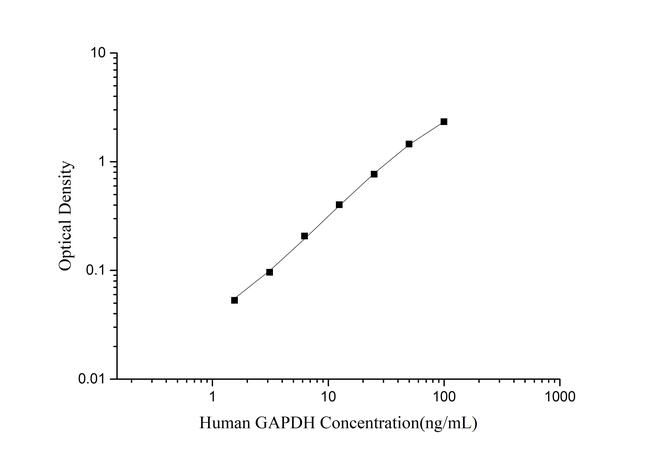
1.56-100 ng/mL
检测样本类型/体积
{Plasma=100 µL, Serum=100 µL}
手工操作时间
1 hr 20 min
总时间
3 hr 30 min
均相(无需洗涤)
No
批间差异
<10%
批内差异
<10%
检测仪器
Absorbance Microplate Reader
产品规格
96 Tests
产品成分
Pre-coated 96 well plate, Standard, Biotinylated Detection Antibody, HRP Conjugate, Standard & Sample Diluent, Biotinylated Detection Antibody Diluent, HRP Conjugate Diluent, Wash Buffer, TMB Substrate, Stop Solution, Plate Sealer
运输条件
Wet ice
储存
Refer to product documentation for component specific storage temperature.
蛋白名称
GAPDH
蛋白家族
Glyceraldehyde-3-phosphate dehydrogenase
均相(无需洗涤)
Human
检测试剂盒格式
Sandwich ELISA Kit
检测抗体结合物
Biotin
标签或染料
HRP
关于本试剂盒
The Human GAPDH ELISA quantitates GAPDH in serum, plasma, and other biological fluids
The Human GAPDH (Glyceraldehyde-3-Phosphate Dehydrogenase) solid-phase sandwich ELISA (enzyme-linked immunosorbent assay) is designed to measure the amount of the target bound between a matched antibody pair. A target-specific antibody has been pre-coated in the wells of the supplied microplate. Samples are then added into these wells and bind to the immobilized (capture) antibody. The sandwich is formed by the binding of the second (detector) antibody to the target on a different epitope from the capture antibody. An antibody conjugated with enzyme binds the formed sandwich. After incubation and washing steps to rid the microplate of unbound substances, a substrate solution is added that reacts with the enzyme-antibody-target complex to produce measurable signal. The intensity of this signal is directly proportional to the concentration of target present in the original specimen.
Rigorous validation:
Each manufactured lot of this ELISA kit is quality tested for criteria such as sensitivity, specificity, precision, and lot-to-lot consistency. See manual for more information on validation.
靶标信息
GAPDH (Glyceraldehyde-3-phosphate dehydrogenase) is a catalytic enzyme commonly known to be involved in glycolysis. GAPDH exists as a tetramer of identical 37-kDa subunits and catalyzes the reversible reduction of 1,3-bisphosphoglycerate to glyceraldehyde 3-phosphophate in the presence of NADPH. Apart from playing a key role in glycolysis, GAPDH is ubiquitously expressed and displays other activities unrelated to its glycolytic function. GAPDH is reported to be involved in the processes of DNA replication, DNA repair, nuclear RNA export, membrane fusion and microtubule bundling. Studies provide evidence of GAPDH playing an essential part in gene expression observed in apoptosis and as part of the cellular phenotype of age-related neurodegenerative diseases. Further, GAPDH is involved in other cellular processes ranging from membrane fusion, and neuronal apoptosis in cancer. GAPDH is reported to bind to a variety of other proteins, including the amyloid precursor protein, mutations in which cause some forms of Alzheimer's disease (AD), and the polyglutamine tracts of Huntingtin, the protein product aberrant forms of which are causative of Huntington's disease. Associations between GAPDH, actin and tubulin have also be reported. Since GAPDH is expressed at high levels in most tissues, it is useful as protein loading control in Western Blot analysis.
For Research Use Only. Not for use in diagnostic procedures. Not for resale without express authorization.
篇参考文献 (0)
您是否在文献中引用过该产品?请点击下方按钮邮件告知我们。
生物信息学
基因别名 : G3PD, GAPD, GAPD2, GAPDH-2, GAPDS, HEL-S-162eP, HEL-S-278, HSD-35
基因ID : (Human) 2597, (Human) 26330
基因符号 : GAPDH, GAPDHS
蛋白别名 : AAG9, aging-associated gene 9 protein, EC 1.2.1.12, HGNC:4141, MGC88685, epididymis secretory protein Li 278, epididymis secretory sperm binding protein Li 162eP, GAPD, glyceraldehyde 3-phosphate dehydrogenase (EC 1.2.1.12), glyceraldehyde-3-phosphate dehydrogenase (EC 1.2.1.12), OCAS, p38 component, Oct1 coactivator in S phase, 38 Kd component, peptidyl-cysteine S-nitrosylase GAPDH, similar to Homo sapiens glyceraldehyde-3-phosphate dehydrogenase (GAPDH) mRNA with GenBank Accession Number M33197.1, spermatogenic cell-specific glyceraldehyde 3-phosphate dehydrogenase 2, spermatogenic glyceraldehyde-3-phosphate dehydrogenase, unnamed protein product
UniProt ID (Human) P04406, (Human) O14556

