Search
Invitrogen
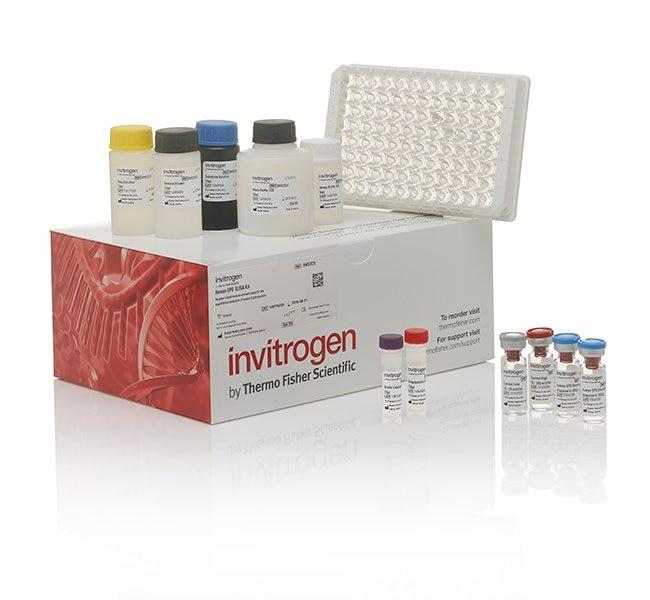
Monkey IgE ELISA Kit
{{$productOrderCtrl.translations['antibody.pdp.commerceCard.promotion.promotions']}}
{{$productOrderCtrl.translations['antibody.pdp.commerceCard.promotion.promocode']}}: {{promo.promoCode}} {{promo.promoTitle}} {{promo.promoDescription}}. {{$productOrderCtrl.translations['antibody.pdp.commerceCard.promotion.learnmore']}}
{{$ctrl.translations['antibody.pdp.skuNotes.additionalInformation']}}:

产品规格
检测灵敏度
37.5 pg/mL
测定范围
62.5-4,000
检测样本类型/体积
{Serum=100 µL, Plasma=100 µL}
手工操作时间
1 hr 20 min
总时间
2 hr 30 min
均相(无需洗涤)
No
批间差异
<10%
批内差异
<10%
检测仪器
Absorbance Microplate Reader
产品规格
96 Tests
产品成分
Pre-coated microwell plate
Standard
Biotinylated Detection Antibody
Streptavidin-HRP
Standard and Sample Diluent
Biotinylated Detection Antibody Diluent
HRP Conjugate Diluent
Wash Buffer Concentrate
Stop Solution
Substrate Solutio
Adhesive Plate Covers
Standard
Biotinylated Detection Antibody
Streptavidin-HRP
Standard and Sample Diluent
Biotinylated Detection Antibody Diluent
HRP Conjugate Diluent
Wash Buffer Concentrate
Stop Solution
Substrate Solutio
Adhesive Plate Covers
运输条件
Wet ice
储存
At 2-8°C for one year. Protect from light. Do not freeze.
蛋白名称
Monkey IgE
均相(无需洗涤)
Non-human primate
检测试剂盒格式
Sandwich ELISA Kit
检测抗体结合物
Biotin
标签或染料
HRP
关于本试剂盒
The Monkey IgE (Immunoglobulin E) ELISA quantitates IgE in serum, plasma, and other biological fluids.
靶标信息
The IgE gene in monkeys, particularly in cynomolgus monkeys, has garnered significant interest due to its similarities with human IgE. IgE antibodies play a critical role in allergic reactions and are involved in several allergic conditions including asthma and atopic dermatitis. Studies have shown that IgE in cynomolgus monkeys binds to receptors with an affinity similar to human IgE, suggesting these primates as a valuable model for preclinical studies of anti-IgE therapies. This binding capability is crucial for examining therapeutic antibodies that aim to obstruct IgE interactions with receptors on immune cells, thus offering insights into treatment strategies for IgE-mediated allergic responses. The use of monkey models helps in understanding the mechanisms of IgE synthesis and function, providing a bridge in research from mouse models to human clinical applications. Such studies are essential in advancing the development of therapies targeting IgE production and action in allergic diseases.
For Research Use Only. Not for use in diagnostic procedures. Not for resale without express authorization.
篇参考文献 (0)
您是否在文献中引用过该产品?请点击下方按钮邮件告知我们。

