Search
Invitrogen
Multispecies S6 In-Cell ELISA Kit, Colorimetric
{{$productOrderCtrl.translations['antibody.pdp.commerceCard.promotion.promotions']}}
{{$productOrderCtrl.translations['antibody.pdp.commerceCard.promotion.promocode']}}: {{promo.promoCode}} {{promo.promoTitle}} {{promo.promoDescription}}. {{$productOrderCtrl.translations['antibody.pdp.commerceCard.promotion.learnmore']}}
{{$ctrl.translations['antibody.pdp.skuNotes.additionalInformation']}}:
产品规格
检测样本类型/体积
{Supernatant=10,000 cells}
手工操作时间
1 hr 20 min
总时间
24 hr
均相(无需洗涤)
No
检测仪器
Absorbance Microplate Reader
产品规格
96 Tests
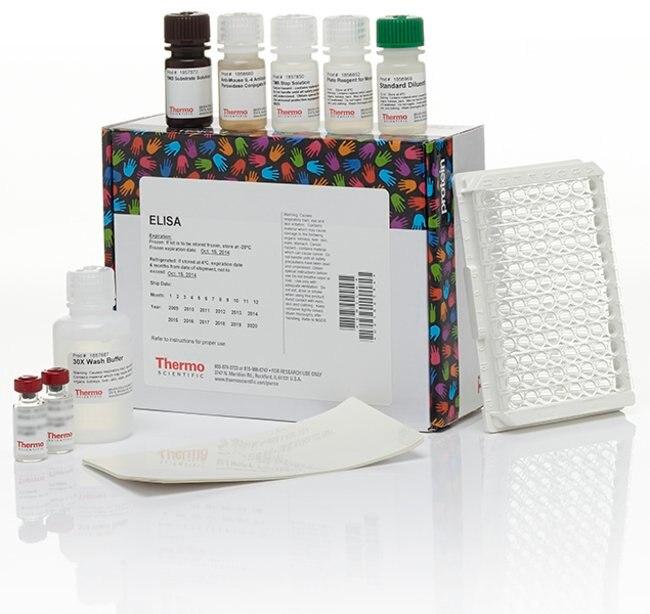
产品成分
Blocking Buffer
20X Tris Buffered Saline
Surfact-Amps 20
Surfact-Amps X-100
HRP Conjugate
TMB Substrate
TMB Stop Solution
Janus Green Whole-Cell Stain
Elution Buffer
Thin Plate Seal Assembly
Components included only in the target-specific kits: Antibody #1 and Antibody #2
20X Tris Buffered Saline
Surfact-Amps 20
Surfact-Amps X-100
HRP Conjugate
TMB Substrate
TMB Stop Solution
Janus Green Whole-Cell Stain
Elution Buffer
Thin Plate Seal Assembly
Components included only in the target-specific kits: Antibody #1 and Antibody #2
运输条件
Wet ice
储存
2-8°C
蛋白名称
S6
Target site-specificity
蛋白家族
Other Proteins
检测试剂盒格式
In-cell ELISA Kit
检测抗体结合物
HRP
标签或染料
HRP
关于本试剂盒
The S6 Multispecies In-Cell ELISA Colorimetric Detection Kit is a simple method for quantifying intracellular proteins in whole cells.
原理方法
To perform the assay, cells are first plated, treated and fixed. Expression of the protein(s) of interest is monitored in wells of a microplate using target-specific primary antibodies (see the Important Product Information section for antibodies included in each kit) and a horseradish peroxidase (HRP)-conjugated detection reagent. The kit is supplied with a whole-cell stain to control for differences in cell plating, which is important when measuring relative levels of a protein with different treatments or assessing its post-translational modification (PTM) form. After staining, the results are analyzed by normalizing the absorbance (HRP activity) values to cell number, which adjusts for the cell plating differences among the wells.
严格验证
Each manufactured lot of this ELISA kit is quality tested for criteria such as sensitivity, specificity, precision, and lot-to-lot consistency. See manual for more information on validation.
靶标信息
Ribosomes, the organelles that catalyze protein synthesis, consist of a small 40S subunit and a large 60S subunit. Together these subunits are composed of 4 RNA species and approximately 80 structurally distinct proteins. This gene encodes a cytoplasmic ribosomal protein that is a component of the 40S subunit. The protein belongs to the S6E family of ribosomal proteins. It is the major substrate of protein kinases in the ribosome, with subsets of five C-terminal serine residues phosphorylated by different protein kinases. Phosphorylation is induced by a wide range of stimuli, including growth factors, tumor-promoting agents, and mitogens. Dephosphorylation occurs at growth arrest. The protein may contribute to the control of cell growth and proliferation through the selective translation of particular classes of mRNA. As is typical for genes encoding ribosomal proteins, there are multiple processed pseudogenes of this gene dispersed through the genome.
For Research Use Only. Not for use in diagnostic procedures. Not for resale without express authorization.
篇参考文献 (0)
您是否在文献中引用过该产品?请点击下方按钮邮件告知我们。
生物信息学
蛋白别名 : Phosphoprotein NP33

