Search
Nucleic Acid Purification Solutions

Improving the purification of mRNA and plasmid DNA
The increasing number of approved nucleic acid therapeutics drives the demand for efficient platform technologies to manufacture these new therapeutic modalities. We have built a toolbox of high-performing chromatography resins to help address your needs and help you increase efficiency and productivity in the purification of mRNA and plasmid DNA.
Simplify your mRNA purification process
One challenge we can help you overcome is obtaining larger quantities of synthetic mRNA to support clinical manufacturing. POROS™ Oligo (dT)25 Affinity Resin has been designed for the purification and isolation of mRNA from in vitro transcription (IVT) manufacturing processes. This affinity chromatography resin offers high selectivity and allows for easy mRNA purification. Through the AT-base pairing mechanism, the resin effectively separates mRNA from components of the IVT process, such as enzymes, unreacted nucleotides, partial transcripts, and plasmid DNA.

Figure 1. Mechanism of action of the POROS Oligo (dT)25 affinity resin. The Poly-dT ligand allows binding with poly-A tailed mRNA molecules through AT base pairing.
Why choose the Oligo (dT)25 affinity resin?
- Easy mRNA purification from crude transcription mix
- High dynamic binding capacity and high recovery
- Ease of use – load in NaCl and elute in water or low salt buffers
- Simplified workflow helps maximize efficiency and reduce the complexity of subsequent polish steps
- Excellent scalability, enabling purification from benchtop to commercial manufacturing
- Enables a single platform purification solution to all mRNA products holding a Poly-A tail

Figure 2. Chromatogram showing efficient separation of a 2000nt mRNA from an IVT mixture at a load concentration of 2 mg/mL. Elution was performed using H2O and yielded in >95% recovery.
Ordering information
Resins and reagents for the purification of mRNA
Related products
Efficient and scalable purification of mRNA using affinity chromatography
Optimize your plasmid DNA purification process
The rapid growth of the gene therapy pipeline as well as genetic vaccination for various infectious diseases, requires larger scale production of plasmid DNA (pDNA) at high quality. POROS AEX resins are ideally suited for the purification of larger molecules such as plasmids and will help you overcome the common challenges of plasmid purification.

Plasmid DNA dynamic binding capacity study
During a design of experiments (DoE) study, POROS AEX resins where tested using various process conditions to determine dynamic binding capacities for plasmid DNA binding. Download the article below to learn more about the complete study.
| POROS Resin | Plasmid DBC10% (mg/mL resin) |
| POROS HQ | 2.8 |
| POROS D50 | 15.6 |
| POROS XQ | 9.0 |
Table 1. Dynamic Binding Capacity Determination using process conditions from DoE study. Process conditions: residence time 2.5 min, 1 mL column, 45 mS/cm conductivity
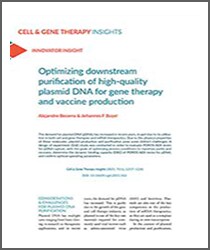
Optimizing downstream purification of high-quality plasmid DNA for gene therapy and vaccine production
A design of experiment (DoE) study was conducted in order to evaluate POROS AEX resins for pDNA capture, with the goals of optimizing process conditions to help maximize purity and recovery, determine the dynamic binding capacity (DBC) of POROS AEX resins for pDNA,and confirm optimal operating parameters.
Plasmid Purification Resins
mRNA and pDNA polishing
For subsequent polishing steps after mRNA or plasmid DNA capture, we recommend our suite of differentiated novel Hydrophobic Interaction Chromatography resins.
Bioprocess Resin Selection Tool
Use this interactive decision-making tool to determine the right chromatography resin for your purification process.


Chromatography Learning Lab
Check out the new Chromatography Learning Lab from Thermo Fisher Scientific, providing a robust range of webinars, articles, eBooks, infographics, and other digital resources to help you optimize the use of our purification products in your process.
Related resources
生物工艺资源
点击以下链接获取产品手册、培训视频、手机App和更多资源。
Pharmaceutical Grade Reagent. For Manufacturing and Laboratory Use Only