Search
Five Clone Screening Methods for Every Scientist

You have been successful in cloning your target DNA sequence and shuttling it into a host organism. Things have gone well, but how do you know that your experiment yielded the correct recombinant clones? The clones must be screened for positive results and then selected for downstream experiments.
Recombinant clones: Screening vs selection
Clone screening is the process of identifying and isolating specific clones that exhibit desired characteristics or contain the target gene of interest from a larger population. It involves testing or analyzing multiple clones to determine which ones have the appropriate genetic modification or gene expression levels. Various techniques can be used for screening, such as polymerase chain reaction (PCR), colony hybridization, reporter gene assays, and enzyme activity assays.
On the other hand, clone selection involves choosing clones from the population of screened clones. The clones are selected based on optimal characteristics such as growth rate, expression levels, enzyme activity, and productivity, in addition to the desired genetic trait.
Clone screening helps verify that your gene of interest was successfully cloned. Pick your favorite method from these 5 ways to verify that your gene of interest was successfully cloned—the classic way, the powerful way, the precise way, the quick way, or the most accurate way.
Classic way: Blue–white screening

Blue-–white screening is a classical method to screen clones. The blue–white screening method is a negative selection system which uses bacterial lactose metabolism as an indicator of successful cloning. It helps distinguish between the bacterial colonies that contain recombinant plasmids (with an insert) and those that contain non-recombinant plasmids.
The plasmid vector used in this method contains a gene for β-galactosidase (lacZ), which is involved in the metabolism of lactose. This lacZ gene has a multiple cloning site (MCS) where a DNA fragment of interest (insert) can be ligated. When the DNA of interest is inserted into the plasmid, the gene is disrupted, and the bacterial colony becomes white in color. The absence of DNA insert in the vector produces blue colonies because the vector does not contain the insert.
How does blue–white screening work?
The plasmids are introduced into competent E. coli cells through the process of transformation. The transformed E.coli are plated on agar plates containing an antibiotic (to select for bacteria that have taken up the plasmid) and X-gal, a lactose analog that turns blue when hydrolyzed by β-galactosidase substrate for β-galactosidase (Figure 1).
Insert absent: If the plasmid does not have an insert, the lacZ gene remains intact and produces functional β-galactosidase. This enzyme cleaves X-gal, producing a blue product. Thus, colonies containing non-recombinant plasmids will appear blue.
Insert present: If the plasmid has an insert, the lacZ gene is disrupted and does not produce functional β-galactosidase. As a result, X-gal is not cleaved, and these colonies remain white. Colonies containing recombinant plasmids will appear white.

Created with Biorender.com
Figure 1. Illustration of cloning workflow and blue-white screening.
In summary, if DNA insert is present, the colonies will appear white. If the DNA insert is not present, the colonies will appear blue. Since it is possible to obtain false positives, it’s always best to follow up using one of the other methods (PCR, restriction digest, or DNA sequencing).
Powerful way: Positive selection system

An effective method to simplify screening is to use the positive selection system, which is a twist on the blue–white system mentioned above. Positive selection vectors conditionally express a lethal gene, such as a restriction enzyme that digests the genomic DNA of the bacterial host. When your DNA is successfully inserted in the plasmid, the lethal gene can no longer be expressed. As a result, only cells with recombinant plasmids can grow. Positive selection system can save time and cost since the typical yield is >99% recombinant clones.
Precise way: Clone screening with restriction enzymes
Using restriction enzymes to check the presence and direction of the insert is a precise and easy method for screening colonies. This approach uses restriction mapping to verify the presence of target DNA insert within the plasmid. Recombinant plasmid DNA is isolated from an overnight culture of transformed bacterial cells. The plasmid DNA from recombinant clones is then digested with restriction enzymes. The plasmid digests are run on an agarose gel to verify that the vector backbone and insert are of the expected sizes (Figure 2).
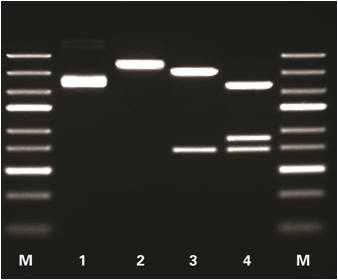
Figure 2. Five-minute plasmid DNA digestions with M: Thermo Scientific GeneRuler Express Ladder, 1: Control, undigested plasmid DNA, 2: FastDigest EcoRI, 3: FastDigest EcoRI and FastDigest KpnI, 4: FastDigest EcoRI, FastDigest KpnI and FastDigest SmaI.
Quick way: Clone screening with colony PCR
Colony screening with polymerase chain reaction (PCR) is the most rapid initial screen to determine the presence of the DNA insert. Colony PCR involves lysing the bacteria and amplifying a portion of the plasmid with either insert-specific or vector-specific primers. To determine the orientation of insert, it is recommended to use both types of primers for analysis.
When selecting restriction enzymes for screening, design your experiment so that restriction digestion would produce distinct and easily distinguishable fragment sizes when the plasmid is digested, allowing for clear differentiation between plasmids with and without the insert.
Use enzymes that flank the insertion site and, if necessary, an additional enzyme that cuts within the insert can provide confirmation of the insert's presence and orientation.

Colony screening by PCR is well suited for inserts shorter than 3 kb. Some PCR enzyme master mixes allow direct amplification of DNA from intact cells. A portion of an individual colony is directly added to a PCR master mix for amplification. The PCR products can then be analyzed by agarose gel electrophoresis, E-gels, or capillary electrophoresis methods.
Accurate way: Sanger sequencing
The most accurate way to verify recombinant colonies is by Sanger sequencing. Plasmid DNA is first isolated from an overnight bacterial culture. The insert is then identified using sequencing primers appropriate for the selected vector. The entire insert is sequenced and compared with the exact sequence of the insert.
Regardless of the method you have selected to use, identification of the correct recombinant will bring your cloning workflow to a successful end!
For time-saving tips, read Five cloning workflow shortcuts

仅供科研使用,不可用于诊断目的。
Stylesheet for Classic Wide Template adjustments