Search
Invitrogen
Human VEGF-121 Recombinant Protein
{{$productOrderCtrl.translations['antibody.pdp.commerceCard.promotion.promotions']}}
{{$productOrderCtrl.translations['antibody.pdp.commerceCard.promotion.viewpromo']}}
{{$productOrderCtrl.translations['antibody.pdp.commerceCard.promotion.promocode']}}: {{promo.promoCode}} {{promo.promoTitle}} {{promo.promoDescription}}. {{$productOrderCtrl.translations['antibody.pdp.commerceCard.promotion.learnmore']}}
Additional Information:
{{banner.description}}

产品信息
RP-8646
产品规格
Expression System
E. coli
分类
Recombinant
类型
Protein
偶联物
形式
Lyophilized
浓度
0.1 mg/mL
Amount
10 µg
保存条件
-20°C, Avoid Freeze/Thaw Cycles
运输条件
Wet ice
产品详细信息
Recombinant human VEGF-121 is a non-glycosylated homodimer, containing two 121 amino acid chains , with a total molecular weight of 28.4 kDa. Purity is typically greater than 95% and endotoxin level less than 1 EU/ug.
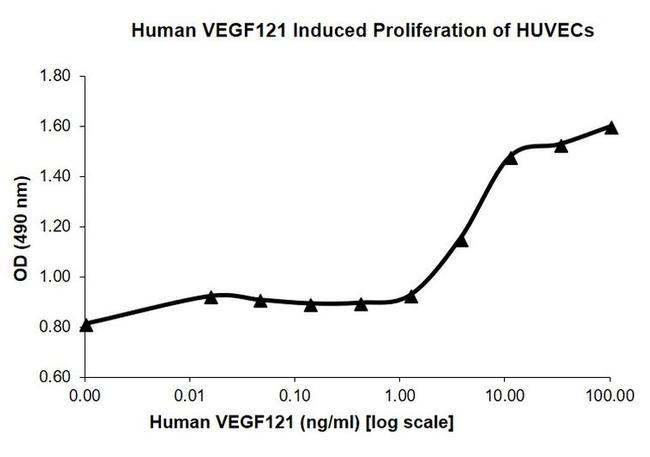
The expected biological activity (ED50) is determined by the dose-dependent proliferation of HUVECs and is typically 1-6 ng/mL. The specific activity of this protein is 1x10^6 units/mg.
Reconstitute using sterile water at 0.1 mg/mL and centrifuge prior to opening vial. Gently pipet solution down the sides of the vial. DO NOT VORTEX sample. Store reconstituted material at -20°C and add 0.1% BSA for additional stability.
Amino acid sequence: APMAEGGGQN HHEVVKFMDV YQRSYCHPIE TLVDIFQEYP DEIEYIFKPS CVPLMRCGGC CNDEGLECVP TEESNITMQI MRIKPHQGQH IGEMSFLQHN KCECRPKKDR ARQENCDKPR R.
靶标信息
Vascular Endothelial Growth Factor-A (VEGF-A) was originally isolated from tumor cells and is produced by a wide variety of cell types. In addition to stimulating vascular growth and vascular permeability, VEGF-A may play a role in stimulating vasodilation via nitric oxide-dependent pathways. Mouse VEGF-A has several variants, one being VEGF-120. Rat and bovine VEGF are one amino acid shorter than the human factor, and the bovine and human sequences show a homology of 95%.
仅用于科研。不用于诊断过程。未经明确授权不得转售。
篇参考文献 (0)
您是否在文献中引用过该产品?请点击下方按钮邮件告知我们。
Disclaimer

Clicking the images or links will redirect you to a website hosted by BenchSci that provides third-party scientific content. Neither the content nor the BenchSci technology and processes for selection have been evaluated by us; we are providing them as-is and without warranty of any kind, including for use or application of the Thermo Fisher Scientific products presented.
