Search
Invitrogen
Basic Human CRP ELISA Kit
{{$productOrderCtrl.translations['antibody.pdp.commerceCard.promotion.promotions']}}
{{$productOrderCtrl.translations['antibody.pdp.commerceCard.promotion.promocode']}}: {{promo.promoCode}} {{promo.promoTitle}} {{promo.promoDescription}}. {{$productOrderCtrl.translations['antibody.pdp.commerceCard.promotion.learnmore']}}
{{$ctrl.translations['antibody.pdp.skuNotes.additionalInformation']}}:
产品规格
检测灵敏度
<10 pg/mL
测定范围
18.75-1,200 pg/mL
检测样本类型/体积
{Plasma=5 µL, Serum=5 µL}
手工操作时间
1 hr 20 min
总时间
4 hr
均相(无需洗涤)
No
检测仪器
Absorbance Microplate Reader
产品规格
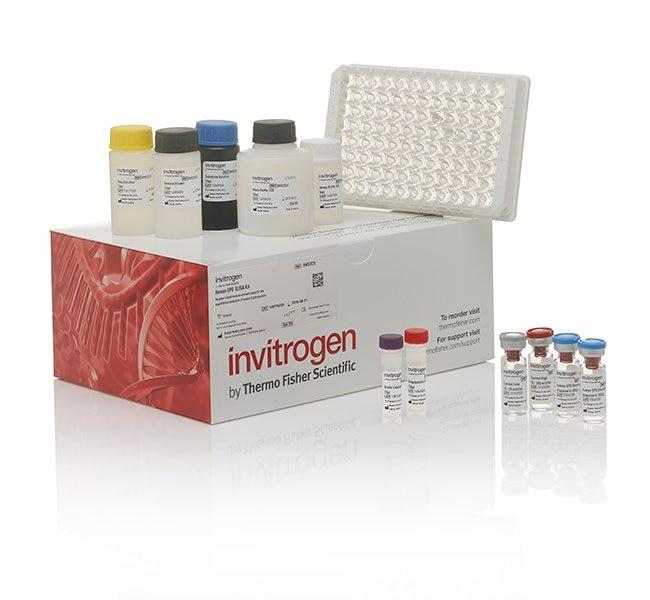
96 Tests
产品成分
Pre-coated 96 well plate
Standard
Standard Dilution Buffer
Biotinylated Detection Antibody
Streptavidin-HRP
HRP Diluent
Wash Buffer
Chromogen
Stop Solution
Adhesive Plate Covers
Standard
Standard Dilution Buffer
Biotinylated Detection Antibody
Streptavidin-HRP
HRP Diluent
Wash Buffer
Chromogen
Stop Solution
Adhesive Plate Covers
运输条件
Wet ice
储存
2-8°C
蛋白名称
CRP
均相(无需洗涤)
Human
检测试剂盒格式
Sandwich ELISA Kit
检测抗体结合物
Biotin
标签或染料
HRP
关于本试剂盒
Kit Overview
The Human CRP ELISA kit enables the quantification of Human CRP in various biological samples, including human serum, plasma, buffered solutions, and cell culture medium. This assay is specifically designed to exclusively detect both natural and recombinant forms of Human CRP.
Principle of the assay
The Human CRP solid-phase sandwich ELISA (enzyme-linked immunosorbent assay) follows a unique approach to measure the amount of the target molecule. It utilizes a matched pair of antibodies to capture the target and form a sandwich complex. The first antibody is pre-coated on the microplate wells, where samples, standards, or controls are added and bind to the immobilized antibody. The second antibody, acting as the detector, is then introduced, followed by the addition of a substrate solution that generates a measurable signal upon interaction with the enzyme-antibody-target complex. The intensity of this signal directly correlates to the concentration of the target present in the original specimen.
For Research Use Only. Not for use in diagnostic procedures. Not for resale without express authorization.
靶标信息
CRP (C-reactive protein) is a major cyclic, pentameric acute phase protein compound consisting of five identical, noncovalently bound, nonglycosylated subunits. Eeach subunit is made up of 206 amino acids, and has a molecular weight of 24 kDa. CRP is produced by the liver, and its plasma levels rise dramatically during inflammatory processes occurring in the body. CRP is an initiator of classical complement cascade, binds to several nuclear components (chromatin, histones, etc.), plays an important role in innate immunity, and mediates activities associated with pre-immune nonspecific host resistance. Specifically, there is a 100-1000 fold increase of CRP in response to injury, infection or inflammation. CRP is opsonic, an initiator of the classical complement cascade, and an activator of monocytes/macrophages. CRP also binds to several nuclear components including chromatin, histones and snRNP, suggesting that it may play a role as a scavenger during cell necrosis. CRP is involved in several host defense related functions based on its ability to recognize foreign pathogens and damaged cells of the host, and initiates pathogen elimination by interacting with humoral and cellular effector systems in the blood. Patients with elevated basal levels of CRP have been shown to be an increased risk for hypertension and cardiovascular disease.
For Research Use Only. Not for use in diagnostic procedures. Not for resale without express authorization.
篇参考文献 (0)
您是否在文献中引用过该产品?请点击下方按钮邮件告知我们。
生物信息学
基因别名 : PTX1
基因ID : (Human) 1401
基因符号 : CRP
蛋白别名 : c reactive, CRP1, CSRP, CYRP, D1S181E, DKFZp686M148, DKFZp686M149, MGC149895, MGC88244, RP11-419N10.4, c-reactive protein coding sequence (partial), C-reactive protein precursor, C-reactive protein, pentraxin-related, pentraxin 1, unnamed protein product
UniProt ID (Human) P02741

