Search
{{$ctrl.translations['antibody.pdp.skuNotes.additionalInformation']}}:
产品规格
检测灵敏度
<0.01 ng/mL
测定范围
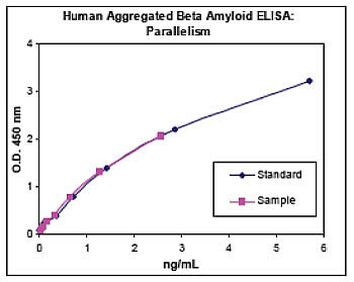
0.09-5.7 ng/mL
检测样本类型/体积
{Cerebrospinal fluid=100 µL, Supernatant=50 µL, Tissue homogenate=50 µL, Ventricular fluid=100 µL}
手工操作时间
1 hr 20 min
总时间
4 hr
均相(无需洗涤)
No
批间差异
7.4%
批内差异
7.4%
检测仪器
Absorbance Microplate Reader
产品规格
96 Tests
产品成分
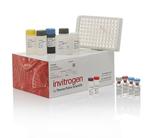
Pre-coated 96 well plate
Standard
Standard Dilution Buffer
Biotinylated Detection Antibody
Streptavidin-HRP
HRP Diluent
Wash Buffer
Chromogen
Stop Solution
Adhesive Plate Covers
Standard
Standard Dilution Buffer
Biotinylated Detection Antibody
Streptavidin-HRP
HRP Diluent
Wash Buffer
Chromogen
Stop Solution
Adhesive Plate Covers
运输条件
Wet ice
储存
2-8°C
蛋白名称
beta Amyloid
Target sub-specificity
Aggregated
均相(无需洗涤)
Human
检测试剂盒格式
Sandwich ELISA Kit
检测抗体结合物
Biotin
标签或染料
HRP
关于本试剂盒
The Human Aggregated Amyloid Beta ELISA quantitates Hu aggregated Aβ in human tissue homogenates, ventricular fluid, CSF, tissue culture supernatant, and buffered solution. The assay will exclusively recognize both natural and recombinant Hu aggregated Aβ.
原理方法
The Human aggregated Aβ solid-phase sandwich ELISA (enzyme-linked immunosorbent assay) is designed to measure the amount of the target bound between a matched antibody pair. A target-specific antibody has been pre-coated in the wells of the supplied microplate. Samples, standards, or controls are then added into these wells and bind to the immobilized (capture) antibody. The sandwich is formed by the addition of the second (detector) antibody, a substrate solution is added that reacts with the enzyme-antibody-target complex to produce measurable signal. The intensity of this signal is directly proportional to the concentration of target present in the original specimen.
严格验证
Each manufactured lot of this ELISA kit is quality tested for criteria such as sensitivity, specificity, precision, and lot-to-lot consistency. See manual for more information on validation.
靶标信息
Amyloid beta peptide (Abeta/Beta-amyloid) is the major constituent of amyloid plaques in the brains of individuals afflicted with Alzheimer's disease. Abeta peptide is 40-43 amino acids long and generated from the beta-amyloid precursor protein (beta APP) in a two-step process. The first step involves cleavage of the extracellular, amino-terminal domain of beta APP. Protein cleavage is performed by an aspartyl protease, beta-secretase (BACE) which is synthesized as a propeptide and must be modified to the mature and active form by the prohormone convertase, furin. Beta APP cleavage by the mature form of BACE results in the cellular secretion of a segment of beta APP, and a membrane-bound remnant. The remnant protein is processed by another protease, gamma-secretase. Gamma-secretase cleaves an intra-membrane site in the carboxyl-terminal domain of beta APP, thus generating the amyloid beta peptide. Gamma-secretase is believed to be a multi-subunit complex containing presenilin-1 and 2 as central components. The transmembrane glycoprotein, nicastrin, is associated with presinilins and has been found to bind to the carboxyl-terminus of beta APP and helps to modulate the production of the amyloid beta peptide. Abeta is an extracellular filamentous protein component of amyloid cores, neuritic plaques and is also found as a deposit in neurofibrillary tangles. Alzheimer's disease, the most common cause of senile dementia, is characterized by abnormal filamentous protein deposits in the brain. Beta amyloid deposits are also detected in Lewy body dementia, Down's syndrome, amyloidosis (Dutch type), cerebroarterial amyloidosis (cerebral amyloid angiopathy) and in the Guam Parkinson-Dementia complex.
For Research Use Only. Not for use in diagnostic procedures. Not for resale without express authorization.
生物信息学
基因别名 : AAA, ABETA, ABPP, AD1, alpha-sAPP, APPI, CTFgamma, CVAP, PN-II, PN2, preA4
基因ID : (Human) 351
基因符号 : APP
蛋白别名 : alzheimer disease amyloid A4 protein homolog, alzheimer disease amyloid protein, Alzheimer disease, Amyloid, Amyloid b, Amyloid beta, Amyloid β, CTF gamma, CTF-alpha, OTTHUMP00000096096, Pan-Abeta, PreA4 751, amyloid beta (A4) precursor protein, amyloid beta A4 protein, amyloid beta precursor protein (ABPP), amyloid beta protein, amyloid beta-protein precursor, amyloid precursor protein, amyloid protein, beta-amyloid A4, beta-amyloid peptide, beta-amyloid peptide(1-40), beta-amyloid peptide(1-42), beta-amyloid precursor protein, cerebral vascular amyloid peptide, peptidase nexin-II, protease nexin-II, testicular tissue protein Li 2, unnamed protein product
UniProt ID (Human) P05067

