Search
Invitrogen
Human Caspase 8/FLICE ELISA Kit
{{$productOrderCtrl.translations['antibody.pdp.commerceCard.promotion.promotions']}}
{{$productOrderCtrl.translations['antibody.pdp.commerceCard.promotion.promocode']}}: {{promo.promoCode}} {{promo.promoTitle}} {{promo.promoDescription}}. {{$productOrderCtrl.translations['antibody.pdp.commerceCard.promotion.learnmore']}}
{{$ctrl.translations['antibody.pdp.skuNotes.additionalInformation']}}:

产品规格
检测灵敏度
0.10 ng/mL
测定范围
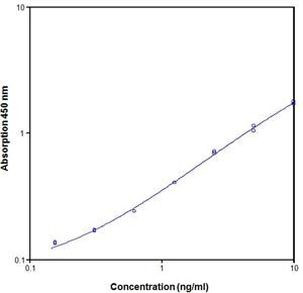
0.16-10.0 ng/mL
检测样本类型/体积
{Cell lysate=50 µL, Serum=50 µL, Supernatant=50 µL}
手工操作时间
1 hr 20 min
总时间
3 hr 15 min
均相(无需洗涤)
No
批间差异
8.5%
批内差异
6.7%
检测仪器
Absorbance Microplate Reader
产品规格
96 Tests
产品成分
Pre-coated 96 well plate
Standard
Sample Diluent
Assay Buffer concentrate
Detection Antibody
anti-rabbit HRP conjugate
Lysis Buffer
Wash Buffer
Chromogen
Stop Solution
Adhesive Plate Covers
Standard
Sample Diluent
Assay Buffer concentrate
Detection Antibody
anti-rabbit HRP conjugate
Lysis Buffer
Wash Buffer
Chromogen
Stop Solution
Adhesive Plate Covers
运输条件
Wet ice
储存
2-8°C
蛋白名称
Caspase 8
Target site-specificity
检测试剂盒格式
Sandwich ELISA Kit
检测抗体结合物
HRP
标签或染料
HRP
关于本试剂盒
The Human Caspase 8/FLICE ELISA quantitates Hu Caspase 8 in human serum, cell lysate or cell culture medium. The assay will exclusively recognize both natural and recombinant Hu Caspase 8.
原理方法
The Human Caspase 8 solid-phase sandwich ELISA (enzyme-linked immunosorbent assay) is designed to measure the amount of the target bound between a matched antibody pair. A target-specific antibody has been pre-coated in the wells of the supplied microplate. Samples, standards, or controls are then added into these wells and bind to the immobilized (capture) antibody. The sandwich is formed by the addition of the second (detector) antibody, a substrate solution is added that reacts with the enzyme-antibody-target complex to produce measurable signal. The intensity of this signal is directly proportional to the concentration of target present in the original specimen.
严格验证
Each manufactured lot of this ELISA kit is quality tested for criteria such as sensitivity, specificity, precision, and lot-to-lot consistency. See manual for more information on validation.
靶标信息
Caspase 8 (CASP8) is a member of the cysteine-aspartic acid protease (caspase) family. Sequential activation of caspases play a central role in the execution-phase of cell apoptosis. Caspases exist as inactive proenzymes composed of a pro-domain, a large protease subunit, and a small protease subunit. Activation of caspases requires proteolytic processing at conserved internal aspartic residues to generate a heterodimeric enzyme consisting of the large and small subunits. Caspase 8 is involved in the programmed cell death induced by Fas and various apoptotic stimuli. The N-terminal FADD-like death effector domain of Caspase 8 suggests that it may interact with Fas-interacting protein FADD. Caspase 8 was detected in the insoluble fraction of the affected brain region from Huntington disease patients but not in those from normal controls, which implicated the role in neurodegenerative diseases. Caspase 8 binds to the death effector domain (DED) of FADD through an analogous DED domain present in tandem in the pro-form of the Caspase 8 protein. Activated Caspase 8 then activates other downstream caspases including Caspase 9, thereby committing the cell to undergo apoptosis. In addition, Caspase 8 also reacts with Jurkat cells and Tonsil. Overexpression of Caspase 8 induces apoptosis, which can be blocked by inhibitors specific for the ICE family. Many alternatively spliced transcript variants encoding different isoforms have been described for Caspase 8, however, not all variants have had their full-length sequences determined.
For Research Use Only. Not for use in diagnostic procedures. Not for resale without express authorization.

