Search
Invitrogen
Human Fc epsilon RI ELISA Kit
{{$productOrderCtrl.translations['antibody.pdp.commerceCard.promotion.promotions']}}
{{$productOrderCtrl.translations['antibody.pdp.commerceCard.promotion.promocode']}}: {{promo.promoCode}} {{promo.promoTitle}} {{promo.promoDescription}}. {{$productOrderCtrl.translations['antibody.pdp.commerceCard.promotion.learnmore']}}
{{$ctrl.translations['antibody.pdp.skuNotes.additionalInformation']}}:

产品规格
检测灵敏度
<0.068 ng/mL
测定范围
0.078-5 ng/mL
检测样本类型/体积
{Serum=20 µL, Plasma=20 µL, Supernatant=20 µL}
手工操作时间
1 hr 20 min
总时间
4 hr 30 min
均相(无需洗涤)
No
批间差异
6.8%
批内差异
6.1%
检测仪器
Absorbance Microplate Reader
产品规格
96 Tests
产品成分
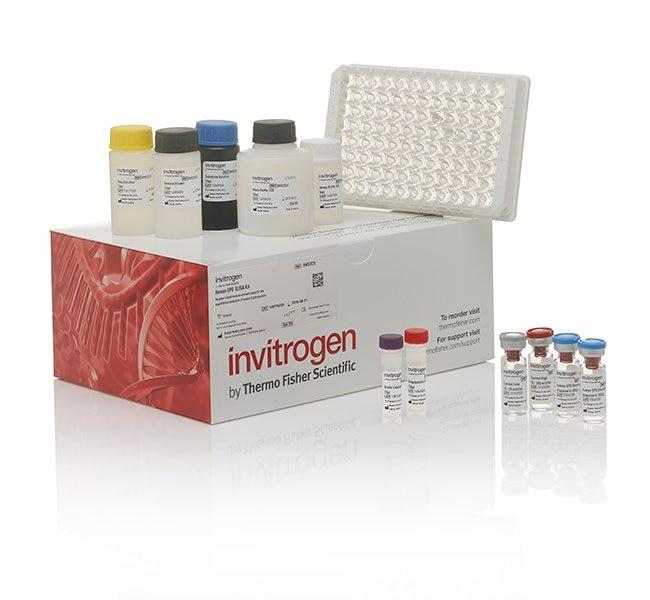
Pre-coated 96 well plate
Standard
Detection antibody (chimeric IgE)
IgE - HRP conjugate
Assay Buffer concentrate
Wash Buffer concentrate
Substrate solution
Stop Solution
Adhesive Plate Covers
Standard
Detection antibody (chimeric IgE)
IgE - HRP conjugate
Assay Buffer concentrate
Wash Buffer concentrate
Substrate solution
Stop Solution
Adhesive Plate Covers
运输条件
Wet ice
储存
2-8°C
蛋白名称
FceR1 alpha
均相(无需洗涤)
Human
检测试剂盒格式
Sandwich ELISA Kit
检测抗体结合物
HRP
标签或染料
HRP
关于本试剂盒
The Human Fc epsilon RI ELISA quantitates Fc epsilon RI in human serum, plasma, and cell culture medium.
原理方法
The Human Fc epsilon RI solid-phase sandwich ELISA (enzyme-linked immunosorbent assay) is designed to measure the amount of the target bound between a matched antibody pair. A target-specific antibody has been pre-coated in the wells of the supplied microplate. Samples, standards, or controls are then added into these wells and bind to the immobilized (capture) antibody. The sandwich is formed by the addition of the second (detector) antibody, a substrate solution is added that reacts with the enzyme-antibody-target complex to produce measurable signal. The intensity of this signal is directly proportional to the concentration of target present in the original specimen.
靶标信息
Fc epsilon RI alpha, also known as FceR1 alpha, is a subunit of the high-affinity receptor for IgE, primarily expressed on mast cells and basophils. Its expression is upregulated by the presence of IgE. Fc epsilon RI alpha forms a tetrameric complex with one beta and two gamma subunits, which are essential for signal transduction. The beta and gamma subunits contain immunoreceptor tyrosine-based activation motifs (ITAMs). The Fc epsilon RI complex plays a crucial role in triggering IgE-mediated allergic reactions. When allergen-bound IgE molecules bring together two or more high-affinity IgE receptors, it leads to the release of mediators such as histamine, which are responsible for allergy symptoms. This process couples allergens and mast cells to initiate inflammatory responses characteristic of allergic disorders like hay fever and asthma. The release of histamine and proteases also leads to the synthesis of prostaglandins and leukotrienes, which are potent effectors of the hypersensitivity response.
For Research Use Only. Not for use in diagnostic procedures. Not for resale without express authorization.
生物信息学
基因别名 : FCE1A, FcERI, FCERIA
基因ID : (Human) 2205
基因符号 : FCER1A
蛋白别名 : Fc epsilon RI alpha-chain, Fc fragment of IgE receptor Ia, Fc fragment of IgE, high affinity I, receptor for, alpha polypeptide, Fc IgE receptor, Fc-epsilon RI-alpha, FcepsilonRI alpha chain, FcepsilonRIalpha, high affinity immunoglobulin epsilon receptor alpha-subunit, igE Fc receptor subunit alpha, immunoglobulin E receptor, high-affinity, of mast cells, mast cell IgE receptor alpha-chain, RP11-550P17.3, fc epsilon r1, Fc Receptor Epsilon I alpha, FceR1a, FceRI, unnamed protein product
UniProt ID (Human) P12319

