Search
Invitrogen
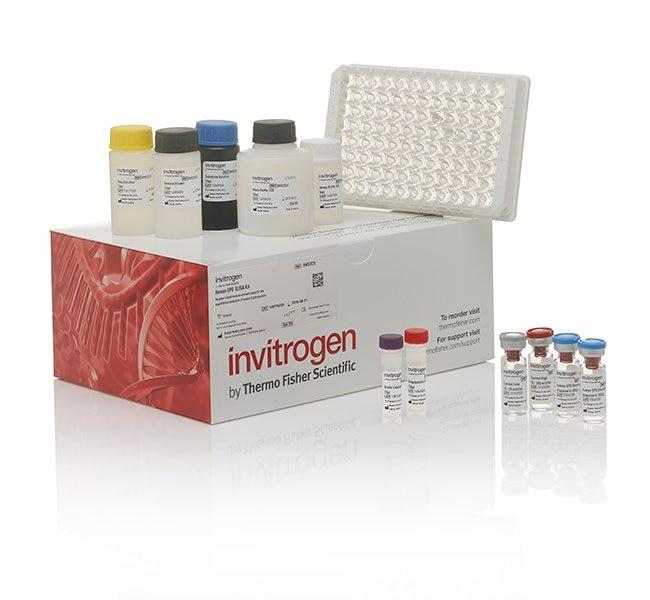
Human Heparan Sulfate ELISA Kit
{{$productOrderCtrl.translations['antibody.pdp.commerceCard.promotion.promotions']}}
{{$productOrderCtrl.translations['antibody.pdp.commerceCard.promotion.promocode']}}: {{promo.promoCode}} {{promo.promoTitle}} {{promo.promoDescription}}. {{$productOrderCtrl.translations['antibody.pdp.commerceCard.promotion.learnmore']}}
{{$ctrl.translations['antibody.pdp.skuNotes.additionalInformation']}}:
产品规格
检测灵敏度
0.19 ng/mL
测定范围
0.31-20 ng/mL
检测样本类型/体积
{Plasma=100 µL, Serum=100 µL}
手工操作时间
1 hr 20 min
总时间
3 hr 30 min
均相(无需洗涤)
No
批间差异
<10%
批内差异
<10%
检测仪器
Absorbance Microplate Reader
产品规格
96 Tests
产品成分
Micro ELISA Plate (Dismountable)
Reference Standard
Concentrated Biotinylated Detection Ab(100x)
Concentrated HRP Conjugate (100x)
Reference Standard & Sample Diluent
Biotinylated Detection Ab Diluent
HRP Conjugate Diluent
Concentrated Wash Buffer(25x)
Substrate Reagent
Stop Solution
Plate Sealer
Product Description
Certificate of Analysis
Reference Standard
Concentrated Biotinylated Detection Ab(100x)
Concentrated HRP Conjugate (100x)
Reference Standard & Sample Diluent
Biotinylated Detection Ab Diluent
HRP Conjugate Diluent
Concentrated Wash Buffer(25x)
Substrate Reagent
Stop Solution
Plate Sealer
Product Description
Certificate of Analysis
运输条件
Wet ice
储存
Refer to product documentation for component specific storage temperature.
蛋白名称
N-sulfated Heparan Sulfate
均相(无需洗涤)
Human
检测试剂盒格式
Sandwich ELISA Kit
检测抗体结合物
Biotin
标签或染料
HRP
关于本试剂盒
Human Heparan Sulfate ELISA Kit quantifies N-sulfated Heparan Sulfate in serum and plasma.
The Human Heparan Sulfate solid-phase sandwich ELISA (enzyme-linked immunosorbent assay) is designed to measure the amount of the target bound between a matched antibody pair. A target-specific antibody has been pre-coated in the wells of the supplied microplate. Samples are then added into these wells and bind to the immobilized (capture) antibody. The sandwich is formed by the binding of the second (detector) antibody to the target on a different epitope from the capture antibody. An antibody conjugated with enzyme binds the formed sandwich. After incubation and washing steps to rid the microplate of unbound substances.
Rigorous validation:
Each manufactured lot of this ELISA kit is quality tested for criteria such as sensitivity, specificity, precision, and lot-to-lot consistency. See manual for more information on validation.
For Research Use Only. Not for use in diagnostic procedures. Not for resale without express authorization.
靶标信息
Heparan sulfate (HS) is a glycosaminoglycan that is ubiquitously expressed on cell surfaces and in the extracellular matrix and basement membrane. Each HS molecule is a linear polysaccharide composed of repeating disaccharides of hexuronic acid and d-glucosamine that can exhibit immense structural diversity due to substitution to varying extents with sulfate groups and epimerization of glucuronic acid to iduronic acid, with areas of high sulfation and glucuronic acid epimerization being co-located in hot spots throughout the molecule. HS is structurally related to heparin, an extremely highly sulfated form of HS that is restricted to mast cells. The biosynthesis and modification of HS chains is thought to take place within the endoplasmic reticulum, Golgi apparatus, and trans Golgi network, which in the end produce unique HS chains that are covalently attached to a range of core proteins to form HS-proteoglycans [PMID: 24391644].
For Research Use Only. Not for use in diagnostic procedures. Not for resale without express authorization.
篇参考文献 (0)
您是否在文献中引用过该产品?请点击下方按钮邮件告知我们。
生物信息学
蛋白别名 : Heparan sulfate

