Search
Invitrogen
Human IgE ELISA Kit
{{$productOrderCtrl.translations['antibody.pdp.commerceCard.promotion.promotions']}}
{{$productOrderCtrl.translations['antibody.pdp.commerceCard.promotion.promocode']}}: {{promo.promoCode}} {{promo.promoTitle}} {{promo.promoDescription}}. {{$productOrderCtrl.translations['antibody.pdp.commerceCard.promotion.learnmore']}}
{{$ctrl.translations['antibody.pdp.skuNotes.additionalInformation']}}:


产品规格
检测灵敏度
0.5 ng/mL
测定范围
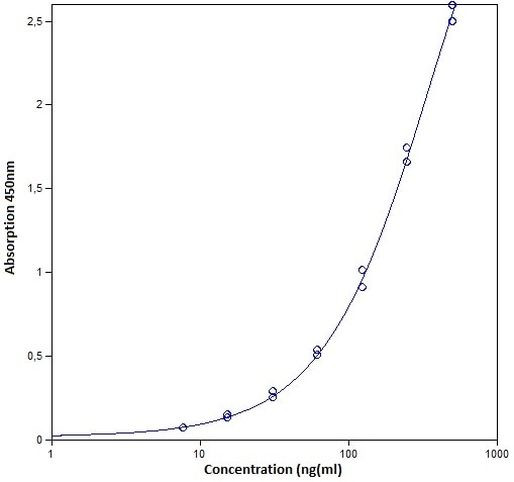
7.8-500 ng/mL
检测样本类型/体积
{Plasma=10 µL, Serum=10 µL}
手工操作时间
1 hr 20 min
总时间
1 hr 30 min
均相(无需洗涤)
No
批间差异
5.2%
批内差异
6.6%
检测仪器
Absorbance Microplate Reader
产品规格
96 Tests
产品成分
Pre-coated 96 well plate
Standard
Assay Buffer concentrate
HRP-conjugated Detection Antibody
Wash Buffer Concentrate
TMB Substrate Solution
Stop Solution
Controls
Adhesive Plate Covers
Standard
Assay Buffer concentrate
HRP-conjugated Detection Antibody
Wash Buffer Concentrate
TMB Substrate Solution
Stop Solution
Controls
Adhesive Plate Covers
运输条件
Wet ice
储存
2-8°C
蛋白名称
Human IgE
均相(无需洗涤)
Human
检测试剂盒格式
Sandwich ELISA Kit
检测抗体结合物
HRP
标签或染料
HRP
关于本试剂盒
The Human Immunoglobulin E (Hu IgE) ELISA quantitates Hu IgE in human serum or plasma. The assay will exclusively recognize both natural and recombinant Hu IgE.
原理方法
The Human IgE solid-phase sandwich ELISA (enzyme-linked immunosorbent assay) is designed to measure the amount of the target bound between a matched antibody pair. A target-specific antibody has been pre-coated in the wells of the supplied microplate. Samples, standards, or controls are then added into these wells and bind to the immobilized (capture) antibody. The sandwich is formed by the addition of the second (detector) antibody, a substrate solution is added that reacts with the enzyme-antibody-target complex to produce measurable signal. The intensity of this signal is directly proportional to the concentration of target present in the original specimen.
严格验证
Each manufactured lot of this ELISA kit is quality tested for criteria such as sensitivity, specificity, precision, and lot-to-lot consistency. See manual for more information on validation.
靶标信息
IgE is one of the five classes of immunoglobulins found in mammals, characterized by its monomeric structure consisting of two heavy (epsilon) chains with four Ig-like constant domains and two light chains. Although IgE comprises only a small portion of the total immunoglobulin in serum, it plays a crucial role in type I hypersensitivity reactions, such as hay fever, asthma, hives, and anaphylactic shock. IgE is produced by terminally differentiated plasma B cells and basophils. It binds to Fc epsilon receptors on mast cells and basophils, leading to the release of histamine and other molecules that promote allergic responses. Crosslinking of IgE bound to these receptors induces degranulation of mast cells and basophils, resulting in allergic manifestations. In addition to its role in allergic responses, IgE is functionally important for immunity against parasites, highlighting its dual role in both protective and pathological immune processes.
For Research Use Only. Not for use in diagnostic procedures. Not for resale without express authorization.
生物信息学
蛋白别名 : Immunoglobulin E, ImmunoglobulinE

