Search
Invitrogen
Human LDLR Rapid ELISA Kit
{{$productOrderCtrl.translations['antibody.pdp.commerceCard.promotion.promotions']}}
{{$productOrderCtrl.translations['antibody.pdp.commerceCard.promotion.promocode']}}: {{promo.promoCode}} {{promo.promoTitle}} {{promo.promoDescription}}. {{$productOrderCtrl.translations['antibody.pdp.commerceCard.promotion.learnmore']}}
{{$ctrl.translations['antibody.pdp.skuNotes.additionalInformation']}}:
产品规格
检测灵敏度
0.19 ng/mL
测定范围
0.31-20 ng/mL
检测样本类型/体积
{Plasma=50 µL, Serum=50 µL}
手工操作时间
15 min
总时间
1 hr 30 min
均相(无需洗涤)
No
批间差异
<10%
批内差异
<10%
检测仪器
Absorbance Microplate Reader
产品规格
96 Tests
产品成分
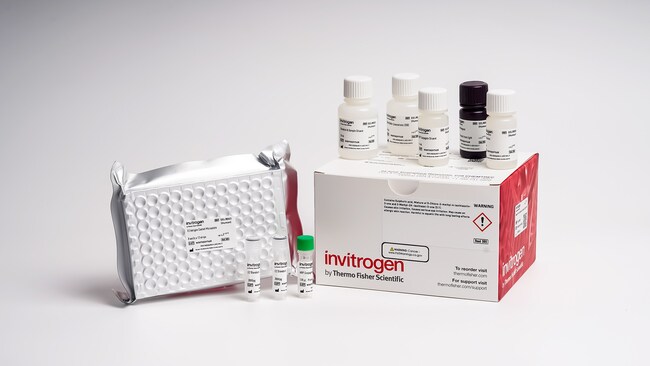
Pre-coated 96 well plate, Standard, HRP Conjugate, Standard & Sample Diluent, HRP Conjugate Diluent, Wash Buffer, TMB Substrate, Stop Solution, Plate Sealer
运输条件
Wet ice
储存
Refer to product documentation for component specific storage temperature.
蛋白名称
LDLR
均相(无需洗涤)
Human
检测试剂盒格式
Rapid ELISA Kit
检测抗体结合物
HRP
标签或染料
Unconjugated
关于本试剂盒
The Human LDLR (Low Density Lipoprotein Receptor) ELISA quantitates LDLR in serum and plasma.
原理方法
The Human Low Density Lipoprotein Receptor (LDLR) solid-phase sandwich ELISA (enzyme-linked immunosorbent assay) is designed to measure the concentration of Low Density Lipoprotein Receptor (LDLR) in biological samples. A target-specific antibody has been pre-coated in the wells of the supplied microplate. Samples, standards, or controls are added into these wells and bind to the immobilized (capture) antibody.
The sandwich complex is formed by the addition of a second (HRP-linked) detection antibody specific to Low Density Lipoprotein Receptor (LDLR). Excess reagents are washed from the plate.
A substrate solution is added that reacts with the enzyme-antibody-target complex to produce a measurable signal. The enzyme-substrate reaction is terminated by the addition of stop solution. The intensity of the signal, measured spectrophotometrically at 450 ± 2 nm, is directly proportional to the concentration of Low Density Lipoprotein Receptor (LDLR) present in the original specimen.
Rigorous validation:
Each manufactured lot of this ELISA kit is quality tested for criteria such as sensitivity, specificity, precision, and lot-to-lot consistency. See manual for more information on validation.
For Research Use Only. Not for use in diagnostic procedures. Not for resale without express authorization.
靶标信息
The low density lipoprotein receptor (LDL-R) gene family consists of cell surface proteins involved in receptor-mediated endocytosis of specific ligands. Low density lipoprotein (LDL) is normally bound at the cell membrane and taken into the cell ending up in lysosomes where the protein is degraded and the cholesterol is made available for repression of microsomal enzyme 3-hydroxy-3-methylglutaryl coenzyme A (HMG CoA) reductase, the rate-limiting step in cholesterol synthesis. At the same time, a reciprocal stimulation of cholesterol ester synthesis takes place. Mutations in the LDL-R gene cause the autosomal dominant disorder, familial hypercholesterolemia. Along with SCARB1, CLDN1, and the tetraspanin superfamily member CD81, LDL-R has been reported to be an entry factor for the Hepatitis C virus. At least three isoforms of LDL-R are known to exist.
For Research Use Only. Not for use in diagnostic procedures. Not for resale without express authorization.
篇参考文献 (0)
您是否在文献中引用过该产品?请点击下方按钮邮件告知我们。
生物信息学
基因别名 : LDLCQ2
基因ID : (Human) 3949
基因符号 : LDLR
蛋白别名 : LDL receptor, ldl-r, low-density lipoprotein receptor class A domain-containing protein 3, unnamed protein product
UniProt ID (Human) P01130

