Search
Invitrogen
Human NSE ELISA Kit
{{$productOrderCtrl.translations['antibody.pdp.commerceCard.promotion.promotions']}}
{{$productOrderCtrl.translations['antibody.pdp.commerceCard.promotion.promocode']}}: {{promo.promoCode}} {{promo.promoTitle}} {{promo.promoDescription}}. {{$productOrderCtrl.translations['antibody.pdp.commerceCard.promotion.learnmore']}}
{{$ctrl.translations['antibody.pdp.skuNotes.additionalInformation']}}:
产品规格
检测灵敏度
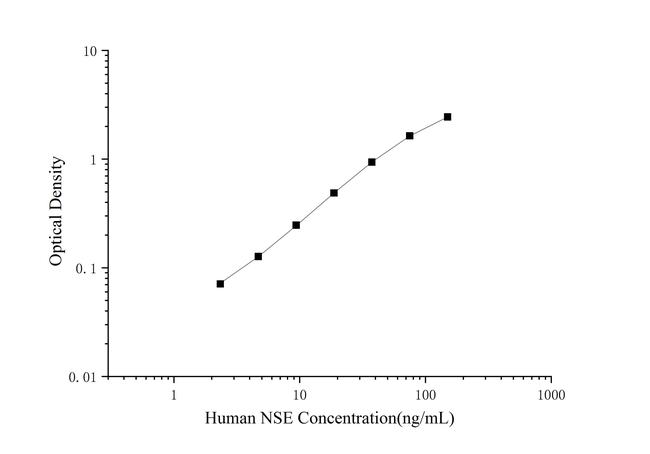
1.4 ng/mL
测定范围
2.34-150 ng/mL
检测样本类型/体积
{Plasma=100 µL, Serum=100 µL}
手工操作时间
1 hr 20 min
总时间
3 hr 30 min
均相(无需洗涤)
No
批间差异
<10%
批内差异
<10%
检测仪器
Absorbance Microplate Reader
产品规格
96 Tests
产品成分
Pre-coated 96 well plate, Standard, Biotinylated Detection Antibody, HRP Conjugate, Standard & Sample Diluent, Biotinylated Detection Antibody Diluent, HRP Conjugate Diluent, Wash Buffer, TMB Substrate, Stop Solution, Plate Sealer
运输条件
Wet ice
储存
Refer to product documentation for component specific storage temperature.
蛋白名称
NSE
蛋白家族
Enolase
均相(无需洗涤)
Human
检测试剂盒格式
Sandwich ELISA Kit
检测抗体结合物
Biotin
标签或染料
HRP
关于本试剂盒
The Human Neuron Specific Enolase (NSE) ELISA quantitates NSE in serum, plasma, and other biological fluids
The Human Neuron Specific Enolase solid-phase sandwich ELISA (enzyme-linked immunosorbent assay) is designed to measure the amount of the target bound between a matched antibody pair. A target-specific antibody has been pre-coated in the wells of the supplied microplate. Samples are then added into these wells and bind to the immobilized (capture) antibody. The sandwich is formed by the binding of the second (detector) antibody to the target on a different epitope from the capture antibody. An antibody conjugated with enzyme binds the formed sandwich. After incubation and washing steps to rid the microplate of unbound substances, a substrate solution is added that reacts with the enzyme-antibody-target complex to produce measurable signal. The intensity of this signal is directly proportional to the concentration of target present in the original specimen.
Rigorous validation:
Each manufactured lot of this ELISA kit is quality tested for criteria such as sensitivity, specificity, precision, and lot-to-lot consistency. See manual for more information on validation.
靶标信息
Neuron specific enolase (NSE, ENO1, ENO2, ENO3) is an enzyme that catalyzes the conversion of 2-phosphoglycerate to phosphoenolpyruvate in the glycolytic pathway, and the reverse reaction in gluconeogenesis. NSE has a high stability in biological fluids and can easily diffuse to the extracellular medium and cerebrospinal fluid (CSF) when neuronal membranes are injured.NSE is one of three mammalian enolases, which are also known as ENO1, ENO2, and ENO3 or alternately as enolase alpha, beta and gamma. The alpha-subunit is expressed in most tissues, the beta-subunit only in muscle, and the gamma-subunit is expressed primarily in neurons, in normal and in neoplastic neuroendocrine cells. Co-expression of NSE and chromogranin A is common in neuroendocrine neoplasms. Since neurons require a great deal of energy, they are very rich in glycolytic enzymes such a GAPDH and NSE. Antibodies to NSE protein are useful to identify neuronal cell bodies, developing neuronal lineage and neuroendocrine cells. Release of NSE from damaged neurons into CSF and blood has also been used as a biomarker of neuronal injury. NSE is used clinically as a sensitive and useful marker of neuronal damage in several neurological disorders including stroke, hypoxic brain damage, status epilepticus, Creutzfeldt-Jakob disease, and herpetic encephalitis. Further, NSE is found in elevated concentrations in plasma and certain neoplasias that include pediatric neuroblastoma and small cell lung cancer.
For Research Use Only. Not for use in diagnostic procedures. Not for resale without express authorization.
生物信息学
基因别名 : HEL-S-279, NSE
基因ID : (Human) 2026
基因符号 : ENO2
蛋白别名 : 2-phospho-D-glycerate hydro-lyase, 2-phospho-D-glycerate hydrolyase, Eno, ENOG, gamma enolase, neuron specific enolase, Neuronal Enolase, ENO2, enolase 2 (gamma, neuronal), epididymis secretory protein Li 279, neural enolase, neuron specific gamma enolase, neuron-specific enolase, neuronal enriched enolase, neurone-specific enolase, unnamed protein product
UniProt ID (Human) P09104

