Search
Invitrogen
Human c-Met (Total) ELISA Kit
{{$productOrderCtrl.translations['antibody.pdp.commerceCard.promotion.promotions']}}
{{$productOrderCtrl.translations['antibody.pdp.commerceCard.promotion.promocode']}}: {{promo.promoCode}} {{promo.promoTitle}} {{promo.promoDescription}}. {{$productOrderCtrl.translations['antibody.pdp.commerceCard.promotion.learnmore']}}
{{$ctrl.translations['antibody.pdp.skuNotes.additionalInformation']}}:
产品规格
检测灵敏度
<0.4 ng/mL
测定范围
0.78-50 ng/mL
检测样本类型/体积
{Cell lysate=10 µL}
手工操作时间
1 hr 20 min
总时间
4 hr
均相(无需洗涤)
No
批间差异
10.8%
批内差异
8.6%
检测仪器
Absorbance Microplate Reader
产品规格
96 Tests
产品成分
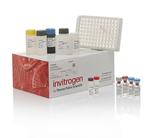
Pre-coated 96 well plate
Standard
Standard Dilution Buffer
Detection Antibody
anti-rabbit-HRP
HRP Diluent
Wash Buffer
Chromogen
Stop Solution
Adhesive Plate Covers
Standard
Standard Dilution Buffer
Detection Antibody
anti-rabbit-HRP
HRP Diluent
Wash Buffer
Chromogen
Stop Solution
Adhesive Plate Covers
储存
2-8°C
蛋白名称
c-Met
Target site-specificity
Target sub-specificity
Total
蛋白亚型
Receptor Tyrosine Kinases
蛋白家族
Kinases & Inhibitors
检测试剂盒格式
Sandwich ELISA Kit
检测抗体结合物
HRP
标签或染料
HRP
关于本试剂盒
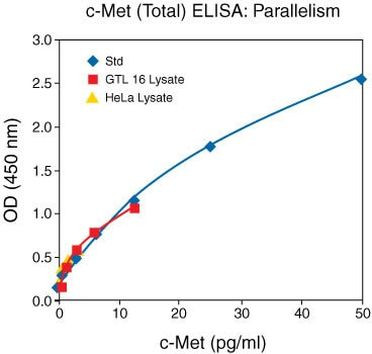
The Human c-Met (Total) ELISA Kit is a solid-phase sandwich Enzyme-Linked Immunosorbent Assay (ELISA) designed to detect and quantify the level of c-Met (Total) in fresh or frozen human cell lysates. The assay recognizes both natural and recombinant full length human c-Met (Total), independent of its phosphorylation state.
原理方法
A monoclonal capture antibody specific for c-Met (Total) has been coated onto the wells of the 96-well plate. During the first incubation, standards of known content and unknown samples are pipetted into the wells and the antigen binds to the immobilized (capture) antibody. After washing, a rabbit antibody specific for the target protein is added to the wells and serves as a detection antibody by binding to the immobilized protein captured during the first incubation. After washing, a horseradish peroxidase labeled anti-rabbit IgG is added. This binds to the detection antibody to complete the four member sandwich. After a third incubation and washing to remove all the unbound enzyme, a substrate solution (TMB) is added, which is acted upon by the bound enzyme to produce color. The intensity of this colored product is directly proportional to the concentration of target protein present in the original specimen and the optical density can be read on a standard microplate reader.
严格验证
Each manufactured lot of this ELISA kit is quality tested for criteria such as sensitivity, specificity, precision, and lot-to-lot consistency. See manual for more information on validation.
靶标信息
MET (cMET) is a receptor-like tyrosine kinase whose dysregulation has been linked to many types of human malignancies. After activation of the ligand, MET interacts with the PI3-kinase subunit PIK3R1, PLCG1, SRC, GRB2, and STAT3. There interactions lead to the activation of signaling cascades including RAS-ERK, PI3, kinase-AKT, and PLCgamma-PKC. MET plays a role in embryonic development including gastrulation, development of muscles and neurons, angiogenesis, and kidney formation. It also plays a role in adults including wound healing, organ regeneration, and tissue remodeling. MET has been linked to cancers including gastric, renal, and breast; therefore, making it a target for cancer therapeutics and diagnostic testing.
For Research Use Only. Not for use in diagnostic procedures. Not for resale without express authorization.
篇参考文献 (0)
您是否在文献中引用过该产品?请点击下方按钮邮件告知我们。

