Search


引用和文献 (85)
Gibco™
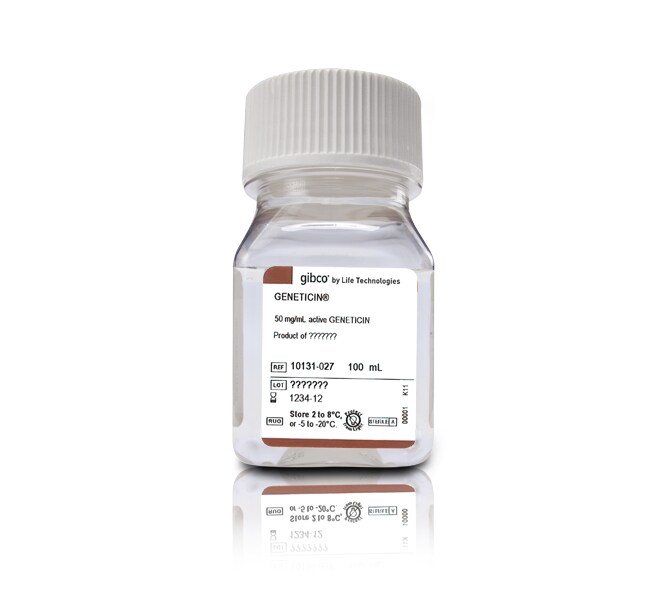
Geneticin™ 选择性抗生素(G418 硫酸盐)(50 mg/mL)
Gibco Geneticin Selective Antibiotic (G418 Sulfate) is produced by the bacterium Micromonospora rhodorangea and acts by binding the ribosome, thus了解更多信息
Have Questions?
更改视图

| 货号 | 数量 |
|---|---|
| 10131027 | 100 mL |
| 10131035 | 20 mL |
货号 10131027
价格(CNY)
3,977.00
Special offer
Online exclusive
Ends: 27-Nov-2026
6,589.00共减 2,612.00 (40%)
Each
数量:
100 mL
价格(CNY)
3,977.00
Special offer
Online exclusive
Ends: 27-Nov-2026
6,589.00共减 2,612.00 (40%)
Each
Gibco Geneticin Selective Antibiotic (G418 Sulfate) is produced by the bacterium Micromonospora rhodorangea and acts by binding the ribosome, thus inhibiting protein synthesis in both prokaryotic and eukaryotic cells. Resistance to Geneticin Selective Antibiotic (G418 Sulfate) is conferred by the E. coli APH (3’) – I and APH (3’) – II resistance genes. Geneticin Selective Antibiotic (G418 Sulfate) is used as a selective antibiotic in the concentration range of 100–200 μg/mL for bacteria, or 200–500 μg/mL for most mammalian cells. This product is supplied as a 50 mg/mL solution in water.
Dual-Site cGMP Manufacturing and Quality Standard
For supply chain continuity, we manufacture Gibco Geneticin Selective Antibiotic (G418 Sulfate) at two separate facilities located in Grand Island, NY, and Scotland, UK. Both sites are compliant with cGMP manufacturing requirements and are certified to the ISO 13485 standard.
Dual-Site cGMP Manufacturing and Quality Standard
For supply chain continuity, we manufacture Gibco Geneticin Selective Antibiotic (G418 Sulfate) at two separate facilities located in Grand Island, NY, and Scotland, UK. Both sites are compliant with cGMP manufacturing requirements and are certified to the ISO 13485 standard.
仅供科研使用。不可用于诊断程序。
规格
细胞类型真核细胞、原核细胞
最大浓度50 mg/mL
培养类型哺乳动物细胞培养,昆虫细胞培养
适用于(应用)真核细胞选择⁄稳定细胞系生成
产品线Geneticin
数量100 mL
有效期24 个月
运输条件室温
形式液体
产品类型Geneticin
无菌无菌过滤
灭菌方法Sterile-filtered
Unit SizeEach
内容与储存
储存条件:2 至 8°C
运输条件:环境条件
有效期:自生产之日起 24 个月
运输条件:环境条件
有效期:自生产之日起 24 个月
常见问题解答 (FAQ)
哺乳动物细胞的稳转筛选过程中可一起使用哪些种类的抗生素(Geneticin,Zeocin,潮霉素B,杀稻瘟素和嘌呤霉素)?
我该如何对我的培养物去污染?
你们提供哪些抗生素来帮助用户控制或减少细胞培养中的污染情况?
Which of your antibiotics (Geneticin, Zeocin, Hygromycin B, Blasticidin, and Puromycin) can be used together for stable selection in mammalian cells?
Can Neomycin be used in mammalian selection? Can Neomycin be used instead of Kanamycin in bacterial selection?
引用和文献 (85)
引用和文献
Abstract
Cloning and functional expression of a thyrotropin receptor cDNA from rat fat cells.
Journal:J Biol Chem
PubMed ID:7738021
Thyrotropin receptor (TSH-R) has been thought to be thyroid-specific, but, by Northern blot analysis, we found that rat adipose tissue expressed TSH-R mRNAs in amounts approaching those in the thyroid. To investigate the function of TSH-R from adipose tissue, we screened a rat fat cell lambda gt11 cDNA library for
Residues throughout the cytoplasmic domain affect the internalization efficiency of P-selectin.
Journal:J Biol Chem
PubMed ID:7592923
'The cytoplasmic domains of many membrane proteins have short sequences, usually including a tyrosine or a di-leucine, that function as sorting signals. P-selectin is an adhesion receptor for leukocytes that is expressed on activated platelets and endothelial cells. Its 35-residue cytoplasmic domain contains signals for sorting into regulated secretory granules,
Structural basis of G protein specificity of human endothelin receptors. A study with endothelinA/B chimeras.
Journal:J Biol Chem
PubMed ID:7730310
'The endothelin (ET) family of peptides acts via two subtypes of guanine nucleotide-binding regulatory protein (G protein)-coupled receptors termed ETA and ETB. ET-1 stimulated cAMP formation in Chinese hamster ovary (CHO) cells stably expressing human wild-type ETA (CHO/hETA cells) while it inhibited cAMP formation in CHO cells expressing human wild-type
Fli-1, an Ets-related transcription factor, regulates erythropoietin- induced erythroid proliferation and differentiation: evidence for direct transcriptional repression of the Rb gene during differentiation.
Journal:Mol Cell Biol
PubMed ID:10330185
'Erythropoietin (Epo) is a major regulator of erythropoiesis that alters the survival, proliferation, and differentiation of erythroid progenitor cells. The mechanism by which these events are regulated has not yet been determined. Using HB60, a newly established erythroblastic cell line, we show here that Epo-induced terminal erythroid differentiation is associated
Distinct STAT structure promotes interaction of STAT2 with the p48 subunit of the interferon-alpha-stimulated transcription factor ISGF3.
Journal:J Biol Chem
PubMed ID:9242679
'Cells express a variety of STAT (signal transducer and activator of transcription) transcription factors that are structurally homologous and yet function specifically in response to particular cytokines. The functions of the individual STATs are dependent on distinct protein- protein interactions. STAT1 and STAT2 are activated by tyrosine phosphorylation in response