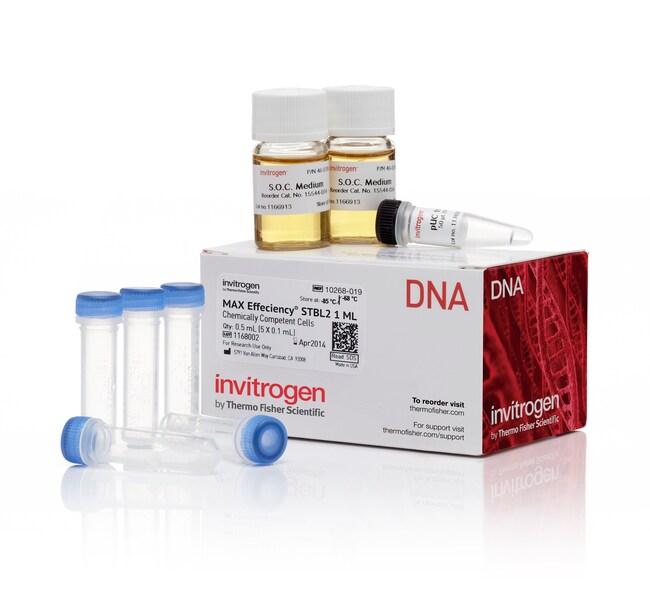
MAX Efficiency™ Stbl2™ 感受态细胞
Invitrogen™

MAX Efficiency™ Stbl2™ 感受态细胞

MAX Efficiency™ Stbl2™ 感受态细胞是专门设计用于克隆不稳定插入片段的高效化学感受态细胞。除 recA1 外,一组独特的基因标记物还可用于稳定克隆正向重复序列和逆转录病毒序列及串联阵列基因。MAX Efficiency™ Stbl2™了解更多信息
Have Questions?
货号数量
102680195 x 200μL
货号 10268019
价格(CNY)
2,782.00
Each
添加至购物车
数量:
5 x 200μL
价格(CNY)
2,782.00
Each
添加至购物车
MAX Efficiency™ Stbl2™ 感受态细胞是专门设计用于克隆不稳定插入片段的高效化学感受态细胞。除 recA1 外,一组独特的基因标记物还可用于稳定克隆正向重复序列和逆转录病毒序列及串联阵列基因。MAX Efficiency™ Stbl2™ 感受态细胞可提供:

•>1 x 10⁹ 个转化体/µg 质粒 DNA(用于克隆罕见序列)
•消除 mcrBC-hsdRMS-mrr mcrA 突变—可克隆甲基化基因组序列
• 一组可稳定正向重复序列和逆转录病毒序列(如 SIV 和 HIV)的独特基因型
• 由于 endA1 突变,质粒得率和质量大幅增加
仅供科研使用。不可用于诊断程序。
规格
耐抗生素细菌No
蓝色/白色筛查
是否可克隆甲基化 DNA
克隆不稳定 DNA适用于克隆不稳定 DNA
是否含 F' 附加体缺乏 F’附加体
高通量能力不兼容高通量应用(手动)
提高质粒质量
质粒可用于 > 20 kb 质粒
制备无甲基化 DNA不适合制备未甲基化DNA
产品线DH5a, MAX Efficiency™
产品类型感受态细胞
数量5 x 200μL
减少克隆重组现象
运输条件干冰
T1 噬菌体 - 抗性 (tonA)
转化效率级别高效率 (> 10^9 cfu/μg)
产品规格One Shot
种属大肠杆菌
Unit SizeEach
内容与储存
包含:
• MAX Efficiency™ Stbl2™ 感受态细胞:5 样品瓶,每样品瓶 200 µL(总计 1 mL)
•pUC19 DNA (0.01 µg/mL):1 小瓶,100 µL
• SOC 培养基:1 瓶,6 mL

感受态细胞储存在 -80°C 下。pUC19 DNA 储存在 -20°C 下。SOC 培养基储存在 4°C 或室温下。

常见问题解答 (FAQ)

我正在尝试克隆一个毒性可能非常大的插入片段。我使用过DH5α和TOP10细胞进行转化但是没有在平板上得到克隆。你们能为我提供一些建议吗?

如果插入片段对于宿主细胞有潜在毒性,您可以尝试以下建议:

•转化TOP10或DH5α细胞后,在25-30摄氏度而不是在37摄氏度下孵育。这会降低生长速度并能提高克隆具有潜在毒性的插入片段的几率。
•尝试使用TOP10F’细胞进行转化,但是不在培养板中加入IPTG。这些细胞带lacIq阻抑物抑制从lac启动子起始表达,因此能克隆毒性基因。请注意,没有加入IPTG时不能进行蓝白斑筛选。
•尝试使用Stbl2细胞进行转化。

你们提供Subcloning Efficiency、Library Efficiency和MAX Efficiency感受态细胞。它们的区别是什么?

有少数例外,但他们主要的区别在于所保证的转化效率:

Subcloning Efficiency细胞每转化1 µg pUC19或pUC18超螺旋质粒保证产生至少1.0 x 10E6个转化子。
Library Efficiency细胞每转化1 µg pUC19或pUC18 DNA保证产生至少1.0 x 10E8个转化子。
MAX Efficiency细胞每转化1 µg pUC19或pUC18 DNA保证产生至少1.0 x 10E9个转化子。

I am trying to clone an insert that is supposedly pretty toxic. I used DH5? and TOP10 cells for the transformation and got no colonies on the plate. Do you have any suggestions for me?

If the insert is potentially toxic to the host cells, here are some suggestions that you can try:

- After transforming TOP10 or DH5? cells, incubate at 25-30°C instead of 37°C. This will slow down the growth and will increase the chances of cloning a potentially toxic insert.
- Try using TOP10F' cells for the transformation, but do not add IPTG to the plates. These cells carry the lacIq repressor that represses expression from the lac promoter and so allows cloning of toxic genes. Keep in mind that in the absence of IPTG, blue-white screening cannot be performed.
- Try using Stbl2 cells for the transformation.

How do you recommend that I prepare my DNA for successful electroporation of E. coli?

For best results, DNA used in electroporation must have a very low ionic strength and a high resistance. A high-salt DNA sample may be purified by either ethanol precipitation or dialysis.

The following suggested protocols are for ligation reactions of 20ul. The volumes may be adjusted to suit the amount being prepared.

Purifying DNA by Precipitation: Add 5 to 10 ug of tRNA to a 20ul ligation reaction. Adjust the solution to 2.5 M in ammonium acetate using a 7.5 M ammonium acetate stock solution. Mix well. Add two volumes of 100 % ethanol. Centrifuge at 12,000 x g for 15 min at 4C. Remove the supernatant with a micropipet. Wash the pellet with 60ul of 70% ethanol. Centrifuge at 12,000 x g for 15 min at room temperature. Remove the supernatant with a micropipet. Air dry the pellet. Resuspend the DNA in 0.5X TE buffer [5 mM Tris-HCl, 0.5 mM EDTA (pH 7.5)] to a concentration of 10 ng/ul of DNA. Use 1 ul per transformation of 20 ul of cell suspension.

Purifying DNA by Microdialysis: Float a Millipore filter, type VS 0.025 um, on a pool of 0.5X TE buffer (or 10% glycerol) in a small plastic container. Place 20ul of the DNA solution as a drop on top of the filter. Incubate at room temperature for several hours. Withdraw the DNA drop from the filter and place it in a polypropylene microcentrifuge tube. Use 1ul of this DNA for each electrotransformation reaction.

You offer competent cells in Subcloning Efficiency, Library Efficiency and MAX Efficiency. How do these differ?

There are a few exceptions, but in general the difference is in guaranteed transformation efficiency as follows:

Subcloning Efficiency cells are guaranteed to produce at least 1.0 x 10E6 transformants per µg of transformed pUC19 or pUC18 supercoiled plasmid
Library Efficiency cells are guaranteed to produce at least 1.0 x 10E8 transformants per µg pUC19 or pUC18 DNA
MAX Efficiency cells are guaranteed to produce at least 1.0 x 10E9 transformants per µg pUC19 or pUC18 DNA