Search


引用和文献 (12)
Gibco™
Bac-to-Bac™ 载体试剂盒
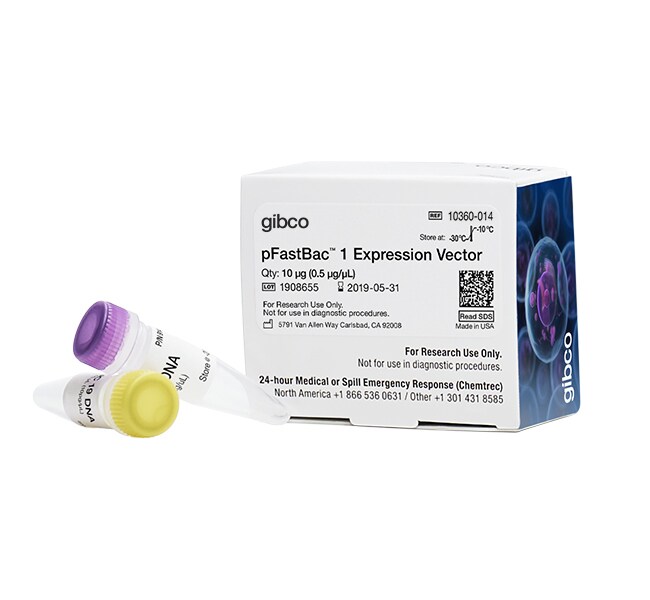
Bac-to-Bac™ 载体试剂盒包含一个 pFastBac™ 1 载体以及一个表达对照载体,作为 Bac-to-Bac™ 杆状病毒表达系统的一部分使用(货号:10359-016),可有效生成用于昆虫细胞表达检测的重组杆状病毒。Bac-to-Bac™了解更多信息
| 货号 | 数量 |
|---|---|
| 10360014 | 1 kit |
货号 10360014
价格(CNY)
16,824.00
Each
数量:
1 kit
价格(CNY)
16,824.00
Each
Bac-to-Bac™ 载体试剂盒包含一个 pFastBac™ 1 载体以及一个表达对照载体,作为 Bac-to-Bac™ 杆状病毒表达系统的一部分使用(货号:10359-016),可有效生成用于昆虫细胞表达检测的重组杆状病毒。Bac-to-Bac™ 系统依赖于通过大肠杆菌位点特异性转位而不是昆虫细胞中的同源重组进行的重组杆状病毒生成(图1)。该系统具有以下特性:
•节省时间的表达杆状病毒质粒。凭借 Bac-to-Bac™,pFastBac™ 载体表达盒与 DH10Bac™ 大肠杆菌感受态细胞(不包含在该载体试剂盒内)中的亲本杆状病毒质粒重组,以形成表达杆状病毒质粒。然后,杆状病毒质粒转染到昆虫细胞中以生成重组杆状病毒颗粒。
•简单的菌落筛选。DH10Bac™ 大肠杆菌中的亲本杆状病毒质粒包含一个 lacZα 基因片段。lacZα 基因在将表达盒转位为杆状病毒质粒的过程中被破坏,以实现重组体的蓝白斑筛选。这使得识别重组菌落变得容易。
Bac-to-Bac™ 杆状病毒表达系统设计用于快速、小规模生成重组杆状病毒。该试剂盒提供的 pFastBac™ 1 载体可提供强多角体蛋白启动子以用于蛋白表达,以及大型多克隆位点以简化克隆。
•节省时间的表达杆状病毒质粒。凭借 Bac-to-Bac™,pFastBac™ 载体表达盒与 DH10Bac™ 大肠杆菌感受态细胞(不包含在该载体试剂盒内)中的亲本杆状病毒质粒重组,以形成表达杆状病毒质粒。然后,杆状病毒质粒转染到昆虫细胞中以生成重组杆状病毒颗粒。
•简单的菌落筛选。DH10Bac™ 大肠杆菌中的亲本杆状病毒质粒包含一个 lacZα 基因片段。lacZα 基因在将表达盒转位为杆状病毒质粒的过程中被破坏,以实现重组体的蓝白斑筛选。这使得识别重组菌落变得容易。
Bac-to-Bac™ 杆状病毒表达系统设计用于快速、小规模生成重组杆状病毒。该试剂盒提供的 pFastBac™ 1 载体可提供强多角体蛋白启动子以用于蛋白表达,以及大型多克隆位点以简化克隆。
仅供科研使用。不可用于诊断程序。
规格
产品类型载体试剂盒
数量1 kit
载体pFastBac
克隆方法限制性内切酶/MCS
产品线Bac-to-Bac
促进剂多角体蛋白
蛋白标记未标记
Unit SizeEach
内容与储存
包含 10 μg pFastBac™1 载体和 pFastBac™ 1-Gus 对照载体。
在 -20°C 下储存。
在 -20°C 下储存。
常见问题解答 (FAQ)
白色菌落不能在液体培养基中生长。我该怎么办?
为什么会出现蓝色菌落?为什么会出现中心为蓝色而边缘为白色的菌落?
我得到的主要是白色/野生型空斑,而不是蓝色/重组型空斑。哪里出错了?
感染细胞后,我在一个细胞中看到较大的多角体,而在相邻细胞中看到较小的多角体(数量更多)。这正常吗?
我担心得不到空斑。出现空斑需要几天?空斑通常为多大?
引用和文献 (12)
引用和文献
Abstract
Cytoskeletal changes regulated by the PAK4 serine/threonine kinase are mediated by LIM kinase 1 and cofilin.
Journal:J Biol Chem
PubMed ID:11413130
'PAK4 is the most recently identified member of the PAK family of serine/threonine kinases. PAK4 differs from other members of the PAK family in sequence and in many of its functions. Previously, we have shown that an important function of this kinase is to mediate the induction of filopodia in
Allocation of helper T-cell epitope immunodominance according to three-dimensional structure in the human immunodeficiency virus type I envelope glycoprotein gp120.
Journal:J Biol Chem
PubMed ID:11551929
'The specificity and intensity of CD4(+) helper T-cell responses determine the effectiveness of immune effector functions. Promiscuously immunodominant helper T-cell epitopes in the human immunodeficiency virus (HIV) envelope glycoprotein gp120 could be important in the development of broadly protective immunity, but the underlying mechanisms of immunodominance and promiscuity remain poorly
Interaction of Fibroblast Growth Factor Receptor 3 and the Adapter Protein SH2-B. A ROLE IN STAT5 ACTIVATION.
Journal:J Biol Chem
PubMed ID:11827956
'Fibroblast growth factor receptor 3 (FGFR3) influences a diverse array of biological processes, including cell growth, differentiation, and migration. Activating mutations in FGFR3 are associated with multiple myeloma, cervical carcinoma, and bladder cancer. To identify proteins that interact with FGFR3 and which may mediate FGFR3-dependent signaling, a yeast two-hybrid screen
Functional differences between the human ATP-dependent nucleosome remodeling proteins BRG1 and SNF2H.
Journal:J Biol Chem
PubMed ID:11435432
'ATP-dependent nucleosome remodeling complexes can be grouped into several classes that may differ in their biochemical remodeling activities and biological roles. Although there are a number of biochemical studies of each class of remodeler, there are very little data directly comparing the biochemical activities of remodelers from different classes. We
PIAS1 and PIASxalpha function as SUMO-E3 ligases toward androgen receptor and repress androgen receptor-dependent transcription.
Journal:J Biol Chem
PubMed ID:12177000
The androgen receptor (AR) has been shown to be modified by SUMO-1, a ubiquitin-like protein. Recently we showed that PIAS family proteins function as SUMO-E3 ligases. Here we provide evidence that PIAS1 and PIASxalpha act as specific SUMO-E3 ligases for the AR. PIAS1 and PIASxalpha but not PIAS3 or PIASxbeta