Search


引用和文献 (18)
Invitrogen™
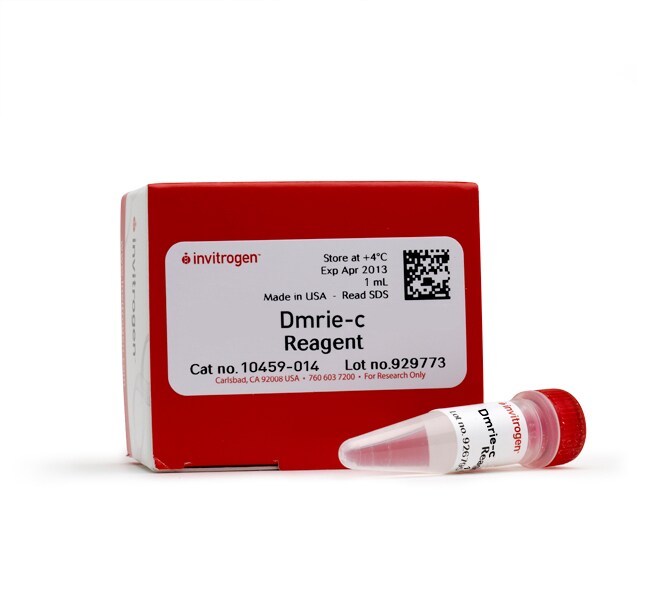
DMRIE-C 转染试剂
DMRIE-C 转染试剂适用于将 DNA 和 RNA 转染至真核细胞中,并且特别有效地转染悬浮细胞(例如 Jurkat)和其他淋巴衍生细胞系。有关成功转染的细胞类型列表,请参阅了解更多信息
| 货号 | 数量 |
|---|---|
| 10459014 | 1 mL |
货号 10459014
价格(CNY)
8,057.00
Each
数量:
1 mL
价格(CNY)
8,057.00
Each
DMRIE-C 转染试剂适用于将 DNA 和 RNA 转染至真核细胞中,并且特别有效地转染悬浮细胞(例如 Jurkat)和其他淋巴衍生细胞系。有关成功转染的细胞类型列表,请参阅 www.invitrogen.com 中的细胞系数据库。DMRIE-C 也可用于 DNA 的体内递送。DMRIE-C 是 1:1 (M/M) 阳离子脂质 DMRIE(1,2-二十四烷氧基-丙基-3-二甲基-羟基乙基溴化铵)和胆固醇溶于膜过滤水的脂质体制剂。
仅供科研使用。不可用于诊断程序。
规格
适用于(应用)转染
高通量能力不兼容高通量应用(手动)
产品类型转染试剂
数量1 mL
血清兼容性否
运输条件湿冰
细胞类型已建立的细胞系
产品规格6孔板、12孔板、24孔板、48孔板、96孔板、培养瓶
样品类型质粒 DNA
转染技术脂质转染
Unit SizeEach
内容与储存
含一管 (1 mL) DMRIE-C 转染试剂。储存在 4°C 下。切勿冷冻。
常见问题解答 (FAQ)
我不慎将我的脂质体试剂留在了室温条件下,还能继续使用吗?
你们是否为悬浮细胞(如Jurkat细胞)的转染操作提供专门试剂?
反向转染与正向转染之间区别是什么?我该如何选择?
转染过程中的培养基可使用抗生素么?
在脂质体转染过程中必须使用无血清的培养基么?
引用和文献 (18)
引用和文献
Abstract
Induction of bacterial lipoprotein tolerance is associated with suppression of toll-like receptor 2 expression.
Journal:J Biol Chem
PubMed ID:12133836
'Tolerance to bacterial cell wall components including lipopolysaccharide (LPS) may represent an essential regulatory mechanism during bacterial infection. Two members of the Toll-like receptor (TLR) family, TLR2 and TLR4, recognize the specific pattern of bacterial cell wall components. TLR4 has been found to be responsible for LPS tolerance. However, the
Safety and short-term toxicity of a novel cationic lipid formulation for human gene therapy.
Journal:Hum Gene Ther
PubMed ID:8186291
'Among the potential nonviral vectors for human gene therapy are DNA-liposome complexes. In a recent clinical study, this delivery system has been utilized. In this report, a novel cationic lipid, dimyristyloxypropyl-3-dimethyl-hydroxyethyl ammonium (DMRIE), has been substituted into the DNA-liposome complex with dioleoyl phosphatidylethanolamine (DOPE), which both improves transfection efficiencies and
Nitrosative Stress-induced Apoptosis through Inhibition of NF-kappa B.
Journal:J Biol Chem
PubMed ID:12091382
'Nitrosative stress produced by cytokines predisposes to apoptotic cell death. However, the molecular mechanism by which this occurs is not well understood. We have shown previously that nitric oxide (NO) regulates the activity of the anti-apoptotic transcription factor NF-kappaB. Here we demonstrate that the inhibition of NF-kappaB by NO sensitizes
Evaluation of cationic liposome suitable for gene transfer into pregnant animals.
Journal:Biochem Biophys Res Commun
PubMed ID:10329392
'Cationic liposome-mediated in vivo gene transfer represents a promising approach for somatic gene therapy. To assess the most suitable liposome for gene delivery into a wide range of organs and fetuses in mice, we have explored several types of cationic liposomes conjugated with plasmid DNA carrying the beta-galactosidase gene through
BiZyme: a novel fusion protein-mediating selection of vaccinia virus recombinants by fluorescence and antibiotic resistance.
Journal:Biotechniques
PubMed ID:12019792
'Recombinant vaccinia virus is a useful and powerful tool for the expression and study of foreign genes. Methods that are currently available for the selection of vaccinia virus recombinants include the restoration of viral plaque-forming phenotype, the replication of viral DNA in the presence of BUdR or mycophenolic acid, and