Search


引用和文献 (10)
Invitrogen™
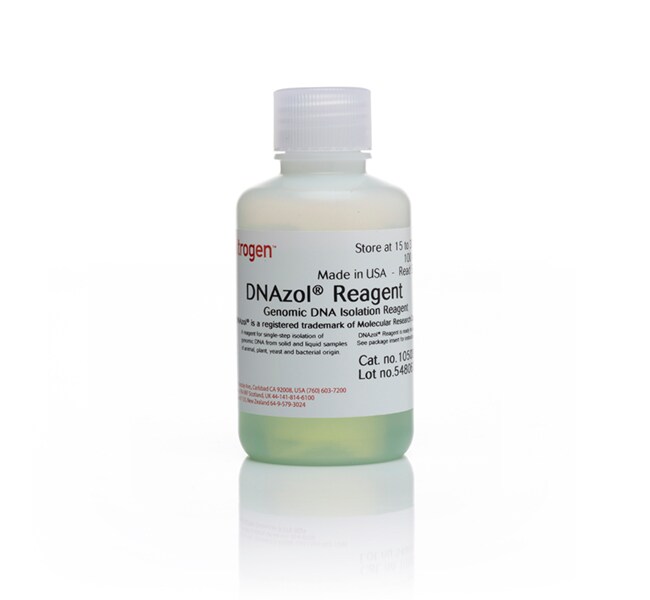
DNAzol™ 试剂用于从固体和液体样品中分离基因组 DNA
DNAzol™ 试剂是一种完整的即用型有机试剂,用于从动物、植物、酵母菌和细菌来源的固体和液体样品中分离基因组 DNA。DNAzol™ 试剂程序通常可在 10–30 分钟内完成,DNA 回收率为了解更多信息
| 货号 | 数量 |
|---|---|
| 10503027 | 100 mL |
货号 10503027
价格(CNY)
3,024.00
Each
数量:
100 mL
价格(CNY)
3,024.00
Each
DNAzol™ 试剂是一种完整的即用型有机试剂,用于从动物、植物、酵母菌和细菌来源的固体和液体样品中分离基因组 DNA。DNAzol™ 试剂程序通常可在 10–30 分钟内完成,DNA 回收率为 70–100%。DNAzol™ 试剂具有以下特点:
•通用—可与广泛类型的样品材料配合使用
•高效—可快速分离基因组 DNA 且回收率较高
从多种样品类型中高效分离基因组 DNA
DNAzol™ 试剂程序使用一种新型胍-去污剂裂解液,可从细胞裂解物中选择性沉淀 DNA。1 mL DNAzol™ 试剂可用于从 1–3 x 10⁷ 个细胞、0.1 mL 全血或 25–50 mg 组织中分离基因组 DNA。
快速分离基因组 DNA 且回收率较高
DNAzol™ 试剂在其 DNA 分离方案中兼具可靠性、高效性和简单性。在分离期间,生物样品在 DNAzol™ 试剂中裂解(或均质化),然后用乙醇从裂解物中沉淀基因组 DNA。乙醇洗涤后,DNA 可能溶解于水或 8 mM NaOH 中。整个程序可在 10–30 min 内完成,DNA 回收率为 70–100%。
分离的 DNA 可用于多种下游应用
使用 DNAzol™ 程序提取的基因组 DNA 适用于多种应用,包括 Southern 印迹、克隆、PCR、限制性核酸内切酶酶切和斑点印迹杂交。
•通用—可与广泛类型的样品材料配合使用
•高效—可快速分离基因组 DNA 且回收率较高
从多种样品类型中高效分离基因组 DNA
DNAzol™ 试剂程序使用一种新型胍-去污剂裂解液,可从细胞裂解物中选择性沉淀 DNA。1 mL DNAzol™ 试剂可用于从 1–3 x 10⁷ 个细胞、0.1 mL 全血或 25–50 mg 组织中分离基因组 DNA。
快速分离基因组 DNA 且回收率较高
DNAzol™ 试剂在其 DNA 分离方案中兼具可靠性、高效性和简单性。在分离期间,生物样品在 DNAzol™ 试剂中裂解(或均质化),然后用乙醇从裂解物中沉淀基因组 DNA。乙醇洗涤后,DNA 可能溶解于水或 8 mM NaOH 中。整个程序可在 10–30 min 内完成,DNA 回收率为 70–100%。
分离的 DNA 可用于多种下游应用
使用 DNAzol™ 程序提取的基因组 DNA 适用于多种应用,包括 Southern 印迹、克隆、PCR、限制性核酸内切酶酶切和斑点印迹杂交。
仅供科研使用。不可用于诊断程序。
规格
洗脱体积Varies
最终产品类型基因组 DNA 纯化
适用于(应用)PCR、Southern 印迹、测序、克隆
高通量能力不兼容高通量应用(手动)
数量100 mL
样品类型细胞, 细胞, Plant, 组织, Yeast
运输条件室温
原始材料量Bacteria: ≤107 cells or 0.1 mL
Cells: ≤107
Plant: ≤50 mg
Tissue: ≤50 mg
Yeast: ≤107 cells or 0.1 mL
Cells: ≤107
Plant: ≤50 mg
Tissue: ≤50 mg
Yeast: ≤107 cells or 0.1 mL
测试时间30 分钟
分离技术有机提取
Unit SizeEach
内容与储存
内容物:1 瓶 (100 mL)
在 15°C 至 30°C 下储存
在 15°C 至 30°C 下储存
常见问题解答 (FAQ)
使用DNAzol试剂分离DNA时,在加入乙醇后出现两相,该如何处理?
我已经使用DNAzol试剂分离得到了DNA,但使用限制性内切酶无法剪切。原因是什么?
我使用DNAzol试剂提取得到的DNA很难进行溶解,对此你们有什么建议吗?
我的DNAzol试剂由原来的浅绿色变为模糊的暗绿色了,还能使用吗?
DNAzol试剂只能用来分离基因组DNA吗?还是也可用于分离质粒DNA?能用于分离线粒体DNA吗?
引用和文献 (10)
引用和文献
Abstract
p21Cip-1/SDI-1/WAF-1 gene is involved in chondrogenic differentiation of ATDC5 cells in vitro.
Journal:J Biol Chem
PubMed ID:11406616
'Development of skeletal cartilage is characterized with coupling growth arrest and cell differentiation. Here, to understand the cyclin-dependent kinase inhibitors involved in the progression of chondrogenic differentiation, we examined changes in the expression levels of cyclin-dependent kinase inhibitor members using mouse ATDC5 prechondrocytes as a widely used in vitro model
A new type of high affinity folic acid transporter in the protozoan parasite Leishmania and deletion of its gene in methotrexate-resistant cells.
Journal:J Biol Chem
PubMed ID:12023977
'The protozoan parasite Leishmania is a folate auxotroph and thus depends on the uptake of folate from the environment to meet its folate requirement. We show here that Leishmania contains several putative pteridine transporter genes. Some of these genes are deleted in methotrexate-resistant Leishmania cells where there is no measurable
Isolation of high-molecular-weight genomic DNA from intact biohazardous mammalian tissues.
Journal:Biotechniques
PubMed ID:9894593
n/a
DNA extraction from fixed cytogenetic cell suspensions.
Journal:Genet Mol Res
PubMed ID:17985302
We developed a procedure for DNA extraction from small volumes of fixed cell suspensions previously prepared for conventional cytogenetic analysis. Good quality DNA was isolated with a fast and simple protocol using DNAzol reagent. This provided suitable DNA for various types of molecular analyses, including polymerase chain reaction, restriction fragment
Rapid and efficient extraction of genomic DNA from different phytopathogenic fungi using DNAzol reagent.
Journal:Biotechnol Lett
PubMed ID:15685411
A modified procedure using the commercial DNAzol reagent was successfully applied to extract genomic DNA from 25 fungal species. The DNA yield varied from 306 to 1,927 microg g(-1) dry mycelia and the A(260)/A(280) ratio from 1.59 to 1.93. Compared with the method of J.L. Cenis (Nucleic Acids Res. 1992,