Search


引用和文献 (5)
Gibco™
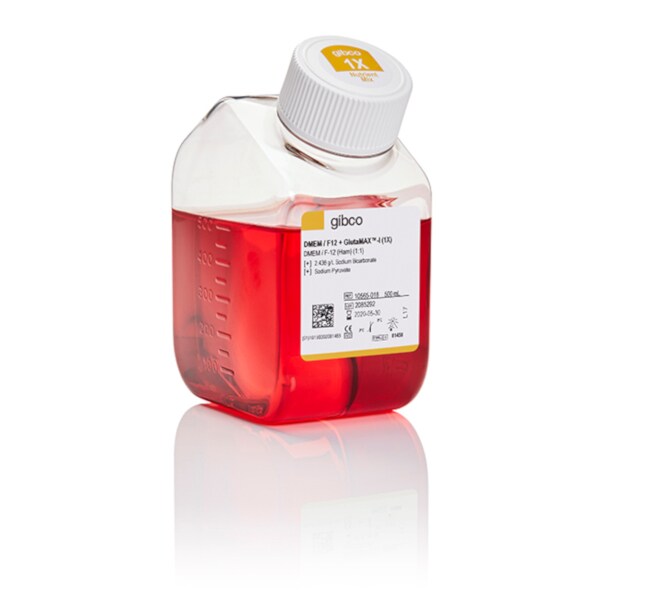
DMEM/F-12,GlutaMAX™ 添加剂
DMEM/F-12(Dulbecco's Modified Eagle Medium/Nutrient Mixture F-12)是一种广泛使用的基础培养基,可用于支持很多不同种类的哺乳动物细胞生长。已在 DMEM/F-12了解更多信息
Have Questions?
更改视图

| 货号 | 数量 |
|---|---|
| 10565018 | 500 mL |
| 31331093 又称 31331-093 | 10 x 500 mL |
| 10565042 | 10 x 500 mL |
货号 10565018
价格(CNY)
593.00
飞享价
Ends: 31-Dec-2026
752.00共减 159.00 (21%)
Each
数量:
500 mL
价格(CNY)
593.00
飞享价
Ends: 31-Dec-2026
752.00共减 159.00 (21%)
Each
DMEM/F-12(Dulbecco's Modified Eagle Medium/Nutrient Mixture F-12)是一种广泛使用的基础培养基,可用于支持很多不同种类的哺乳动物细胞生长。已在 DMEM/F-12 中成功培养的细胞包括 MDCK、神经胶质细胞、成纤维细胞、人内皮细胞及大鼠成纤维细胞。我们针对广泛的细胞培养应用,提供了多种组分的 DMEM/F-12 改良培养基。使用培养基选择工具查找适合的配方。
这种 DMEM/F-12 经过如下改良:
可提供完整配方。
使用 DMEM/F-12
DMEM/F-12 是 DMEM 和 Ham's F-12 的 1:1 混合物。该配方包含 DMEM 的高浓度葡萄糖、氨基酸及维生素与 F-12 的多种组分。含有 GlutaMAX™ 补充剂的 DMEM/F-12 具有易于使用的包装形式,可显著减少有毒氨的积累,改善细胞活力和生长。DMEM/F-12 不含蛋白质、脂质或生长因子。因此,DMEM/F-12 可能需要补充营养成分,通常需要添加 10% 胎牛血清 (FBS)。DMEM/F-12 使用碳酸氢钠缓冲系统,因此需要 5–10% CO2 的环境来维持生理 pH 值。
cGMP 生产和质量体系
DMEM/F-12 在位于纽约格兰德岛上符合 cGMP 要求的工厂内生产。该工厂是在 FDA 注册的医疗器械生产商,通过 ISO 13485 标准认证。为确保供应链的稳定,我们同时提供由我们的苏格兰工厂生产的相同 DMEM/F-12 产品 (31331-028)。该工厂也是在 FDA 注册的医疗器械生产商,且通过 ISO 13485 标准认证。
这种 DMEM/F-12 经过如下改良:
| 包含 | 不含 |
| •GlutaMAX™ | •HEPES: |
| • 酚红 |
可提供完整配方。
使用 DMEM/F-12
DMEM/F-12 是 DMEM 和 Ham's F-12 的 1:1 混合物。该配方包含 DMEM 的高浓度葡萄糖、氨基酸及维生素与 F-12 的多种组分。含有 GlutaMAX™ 补充剂的 DMEM/F-12 具有易于使用的包装形式,可显著减少有毒氨的积累,改善细胞活力和生长。DMEM/F-12 不含蛋白质、脂质或生长因子。因此,DMEM/F-12 可能需要补充营养成分,通常需要添加 10% 胎牛血清 (FBS)。DMEM/F-12 使用碳酸氢钠缓冲系统,因此需要 5–10% CO2 的环境来维持生理 pH 值。
cGMP 生产和质量体系
DMEM/F-12 在位于纽约格兰德岛上符合 cGMP 要求的工厂内生产。该工厂是在 FDA 注册的医疗器械生产商,通过 ISO 13485 标准认证。为确保供应链的稳定,我们同时提供由我们的苏格兰工厂生产的相同 DMEM/F-12 产品 (31331-028)。该工厂也是在 FDA 注册的医疗器械生产商,且通过 ISO 13485 标准认证。
仅用于研究和生产用途。不可用于临床诊断或直接用于人类或动物。
规格
细胞系MDCK、神经胶质细胞、成纤维细胞、人内皮细胞和大鼠成纤维细胞
最大浓度1 X
生产质量cGMP-compliant under the ISO 13485 standard
产品线Gibco、GlutaMAX
产品类型DMEM(Dulbecco 改良 Eagle 培养基)/F-12
数量500 mL
有效期自生产之日起 12 个月
运输条件室温
分类非动物源性
形式液体
血清水平标准血清
无菌无菌过滤
灭菌方法无菌过滤
加有添加剂高糖, GlutaMAX, 酚红, 丙酮酸钠
不加添加剂不含 HEPES
Unit SizeEach
内容与储存
储存条件:2-8°C。避光储存
运输条件:环境
有效期:自生产之日起 12 个月
运输条件:环境
有效期:自生产之日起 12 个月
常见问题解答 (FAQ)
加入血清后的培养基可以使用多久?
我的培养基是室温条件下运送来的,但注明应保存于冷藏条件下。这会有影响么?
清除,缺少或降解谷氨酰胺或生长因子等促生长的基本成份会对培养物的生长速率造成影响么?
配方中含有Gibco GlutaMAX添加剂会改变L-谷氨酰胺的含量么?
我该如何去除细胞培养基中的支原体污染?
引用和文献 (5)
引用和文献
Abstract
Glycine-extended progastrin processing intermediates induce H+,K(+)-ATPase alpha-subunit gene expression through a novel receptor.
Journal:J Biol Chem
PubMed ID:7744746
'Although plasma levels of G-Gly are equivalent to those of gastrin, G-Gly has essentially no acute effect on gastric acid secretion. However, we have observed that inhibition of gastrin amidation leads to increased plasma concentrations of G-Gly and enhanced gastric acid secretion. We hypothesized, therefore, that G-Gly might have a
Adenosine nucleotides acting at the human P2Y1 receptor stimulate mitogen-activated protein kinases and induce apoptosis.
Journal:J Biol Chem
PubMed ID:11278310
For the widely distributed P2Y receptors for nucleotides, the transductional and functional responses downstream of their coupling to G proteins are poorly characterized. Here we describe apoptotic induction and the associated differential stimulation of mitogen-activated protein (MAP) kinase family members by the human P2Y(1) receptor. The potent P2Y(1) receptor agonist,
Activity of adenosine diphosphates and triphosphates on a P2Y(T) -type receptor in brain capillary endothelial cells.
Journal:Br J Pharmacol
PubMed ID:11156575
1. A P2Y (nucleotide) receptor activity in a clonal population (B10) of rat brain capillary endothelial cells is coupled to inhibition of adenylyl cyclase and has functional similarities to the P2Y(T) (previously designated 'P2T') receptor for ADP of blood platelets. However, the only P2Y receptor which was detectable in a
Transcriptional induction of mitogen-activated protein kinase phosphatase 1 by retinoids. Selective roles of nuclear receptors and contribution to the antiapoptotic effect.
Journal:J Biol Chem
PubMed ID:12186877
All-trans-retinoic acid (t-RA) inhibits hydrogen peroxide (H(2)O(2))-induced apoptosis by inhibiting the c-Jun N-terminal kinase (JNK)-activator protein 1 (AP-1) pathway. In this report, we examined the involvement of mitogen-activated protein kinase phosphatase 1 (MKP-1) in suppression of JNK and the antiapoptotic effect of t-RA and the roles of nuclear receptors in
Genetic Evidence That Protease-activated Receptors Mediate Factor Xa Signaling in Endothelial Cells.
Journal:J Biol Chem
PubMed ID:11850418
The coagulation protease Factor Xa (Xa)(1) triggers a variety of cellular responses that may be important for inflammatory reactions to tissue injury. Protease-activated receptors (PAR1, PAR2, and PAR4) can mediate Xa signaling in heterologous expression systems. However, other candidate Xa receptors have been described, and the extent to which one