Search


引用和文献 (10)
Gibco™
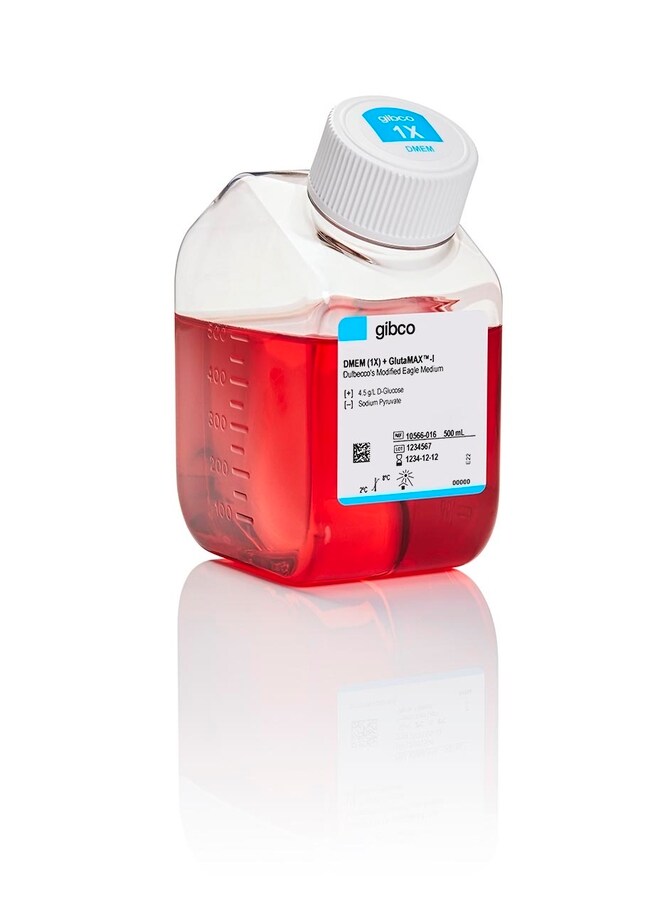
DMEM, high glucose, GlutaMAX™ Supplement
DMEM (Dulbecco's Modified Eagle Medium) is a widely used basal medium for supporting the growth of many different mammalian cells.
Have Questions?
更改视图

| 货号 | 数量 |
|---|---|
| 10566016 | 500 mL |
| 10566024 | 10 x 500 mL |
| 10566032 | 5 L |
货号 10566016
价格(CNY)
421.00
飞享价
Ends: 31-Dec-2026
526.00共减 105.00 (20%)
Each
数量:
500 mL
价格(CNY)
421.00
飞享价
Ends: 31-Dec-2026
526.00共减 105.00 (20%)
Each
DMEM (Dulbecco's Modified Eagle Medium) is a widely used basal medium for supporting the growth of many different mammalian cells. Cells successfully cultured in DMEM include primary fibroblasts, neurons, glial cells, HUVECs, and smooth muscle cells, as well as cell lines such as HeLa, 293, Cos-7, and PC-12. We offer a variety of DMEM modifications for a range of cell culture applications. Find the right formulation using the media selector tool.
This DMEM is modified as follows:
With: High Glucose, GlutaMAX™, Phenol Red
Without: Sodium Pyruvate
The complete formulation is available.
Using DMEM
DMEM is unique from other media as it contains 4 times the concentration of amino acids and vitamins than the original Eagle's Minimal Essential Medium. DMEM was originally formulated with low glucose (1 g/L) and sodium pyruvate, but is often used with higher glucose levels, with or without sodium pyruvate. DMEM with GlutaMAX™ supplement minimizes toxic ammonia build-up and improves cell viability and growth in an easy-to-use format. DMEM contains no proteins, lipids, or growth factors. Therefore, DMEM requires supplementation, commonly with 10% Fetal Bovine Serum (FBS). DMEM uses a sodium bicarbonate buffer system (3.7 g/L), and therefore requires a 5–10% CO2 environment to maintain physiological pH.
For Research Use or Further Manufacturing. Not for diagnostic use or direct administration into humans or animals.
规格
细胞系HeLa、293、Cos-7 和 PC-12
细胞类型原代成纤维细胞、神经元、神经胶质细胞、HUVEC、平滑肌细胞
最大浓度1 X
培养环境CO2
适用于(应用)Mammalian Cell Culture
产品规格Bottle
生产质量cGMP-compliant under the ISO 13485 standard
产品线Gibco、GlutaMAX
产品类型DMEM(Dulbecco 改良 Eagle 培养基)
数量500 mL
有效期自生产之日起 12 个月
运输条件室温
分类非动物源性
培养类型Mammalian Cell Culture
形式液体
血清水平标准血清
无菌无菌过滤
灭菌方法无菌过滤
加有添加剂高糖, GlutaMAX, 酚红
不加添加剂不含 HEPES, 不含丙酮酸钠
Unit SizeEach
内容与储存
储存条件:2-8°C。避光储存
运输条件:环境
有效期:自生产之日起 12 个月
运输条件:环境
有效期:自生产之日起 12 个月
常见问题解答 (FAQ)
加入血清后的培养基可以使用多久?
我的培养基是室温条件下运送来的,但注明应保存于冷藏条件下。这会有影响么?
清除,缺少或降解谷氨酰胺或生长因子等促生长的基本成份会对培养物的生长速率造成影响么?
配方中含有Gibco GlutaMAX添加剂会改变L-谷氨酰胺的含量么?
我该如何去除细胞培养基中的支原体污染?
引用和文献 (10)
引用和文献
Abstract
Ectodysplasin is released by proteolytic shedding and binds to the EDAR protein.
Journal:Hum Mol Genet
PubMed ID:11309369
'Anhidrotic ectodermal dysplasia (EDA) is an X-linked disorder characterized by abnormal development of ectoderm and its appendices. The EDA gene encodes different isoforms of ectodysplasin, a transmembrane protein. The two longest isoforms, ectodysplasin-A1 and -A2, which differ by an insertion of two amino acids, are trimeric type II membrane proteins
A novel site on the Galpha -protein that recognizes heptahelical receptors.
Journal:J Biol Chem
PubMed ID:11027680
'Specific domains of the G-protein alpha subunit have been shown to control coupling to heptahelical receptors. The extreme N and C termini and a region between alpha4 and alpha5 helices of the G-protein alpha subunit are known to determine selective interaction with the receptors. The metabotropic glutamate receptor 2 activated
Cell adhesion and migration properties of beta 2-integrin negative polymorphonuclear granulocytes on defined extracellular matrix molecules. Relevance for leukocyte extravasation.
Journal:J Biol Chem
PubMed ID:11278780
'Regulated adhesion of leukocytes to the extracellular matrix is essential for transmigration of blood vessels and subsequent migration into the stroma of inflamed tissues. Although beta(2)-integrins play an indisputable role in adhesion of polymorphonuclear granulocytes (PMN) to endothelium, we show here that beta(1)- and beta(3)-integrins but not beta(2)-integrin are essential
Delivery of proteins into living cells by reversible membrane permeabilization with streptolysin-O.
Journal:Proc Natl Acad Sci U S A
PubMed ID:11248053
'The pore-forming toxin streptolysin O (SLO) can be used to reversibly permeabilize adherent and nonadherent cells, allowing delivery of molecules with up to 100 kDa mass to the cytosol. Using FITC-labeled albumin, 10(5)-10(6) molecules were estimated to be entrapped per cell. Repair of toxin lesions depended on Ca(2+)-calmodulin and on
Phosphorylation regulates intracellular trafficking of beta-secretase.
Journal:J Biol Chem
PubMed ID:11278841
beta-Secretase (BACE) is a transmembrane aspartyl protease, which generates the N terminus of Alzheimer's disease amyloid beta-peptide. Here, we report that BACE can be phosphorylated within its cytoplasmic domain at serine residue 498 by casein kinase 1. Phosphorylation exclusively occurs after full maturation of BACE by propeptide cleavage and complex