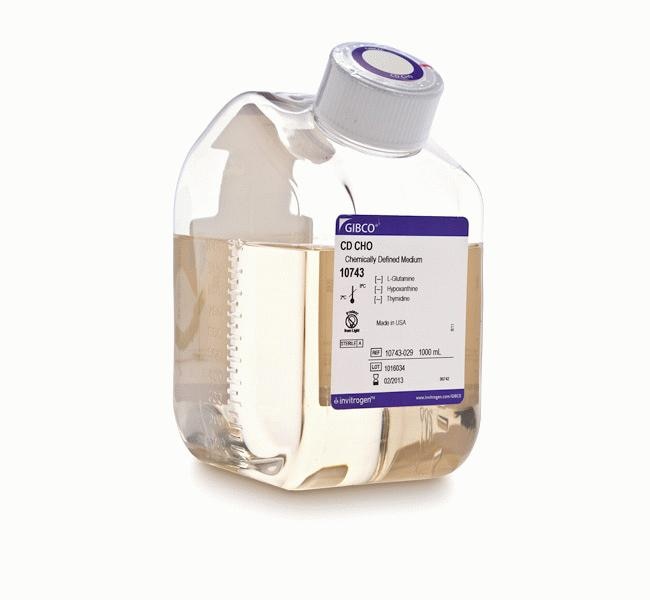
CD CHO 培养基
Invitrogen17万+抗体限时买二赠一,靶点广,灵活用!
CD CHO 培养基
Gibco™

CD CHO 培养基

CD CHO 培养基是一种无蛋白、无血清且化学成分确定的培养基,该培养基经过优化,非常适用于中国仓鼠卵巢细胞 (CHO) 的生长和悬浮培养中的重组蛋白表达。CD CHO 培养基具有超过 10了解更多信息
Have Questions?
更改视图buttonViewtableView
货号数量
107430291 L
107430110.5 L
货号 10743029
价格(CNY)
2,034.00
Each
添加至购物车
数量:
1 L
Customize this product
价格(CNY)
2,034.00
Each
添加至购物车
CD CHO 培养基是一种无蛋白、无血清且化学成分确定的培养基,该培养基经过优化,非常适用于中国仓鼠卵巢细胞 (CHO) 的生长和悬浮培养中的重组蛋白表达。CD CHO 培养基具有超过 10 年的可靠质量记录,不含动物、植物或合成来源的蛋白或肽组分,也不含成分不明确的裂解物或水解物。

何时使用 CD CHO 培养基
• 建议 GS CHO 细胞在 CD CHO 培养基中进行培养
• 您的细胞以前曾在 CD CHO 培养基中成功培养,而且您的流程即将进行监管备案(可提供 DMF)

何时考虑使用其他 Gibco™ 培养基

在下列情况时考虑使用 CD FortiCHO™ 培养基
•您使用的细胞系是经过转染的 CHO K1、GS CHO 或 CHO-S™ 细胞系
• 需要达到尽可能高的分批培养细胞密度和蛋白滴度
• 您在尽量提高滴度时有时间让细胞适应新的培养基
• 收获时的细胞健康是下游加工的优先考虑事项

在以下情况时考虑使用 CD OptiCHO™ 培养基
• 您使用的是经过转染的 CHO 细胞系,而非 CHO K1、GS CHO 或 CHO-S™ 细胞系
•在您尽量提高生产率时,补下料策略的优化将成为基础培养基选择测试的一部分
• 您的 CHO 细胞系为“苛养型”,即很难生长或适应

在以情况时考虑使用 CD DG44 培养基
•您使用的是亲代 DG44 或 DXB11 CHO 细胞 (dhfr-)

干粉培养基配方
Gibco™ 液体培养基可提供 AGT™(高级颗粒技术)干粉培养基规格,该规格设计用于在从开发到商业生产的各个生产阶段提供更高的一致性和生产率。AGT™ 培养基无动物源性,采用与对应的液体培养基完全相同的无血清、无蛋白质且化学成分明确的配方制成,并且具有相同的性能。

设计适合您需求的特定培养基
无论是工作台级别的实验还是大规模生物制造过程,我们都能根据您的需求提供专门的规格、包装和质量水平。借助 Gibco™ cGMP 培养基定制服务,您可以利用我们 R&D 和生物生产应用专家的制造能力和多年的技术经验为您效力。
规格
细胞系CHO
最大浓度1 X
内毒素水平
产品规格瓶装
所含抗生素不含抗生素
产品线Gibco™
产品类型CD CHO 培养基
数量1 L
运输条件室温
种属仓鼠
分类非动物源性, 化学成分明确, 无蛋白, 无血清
培养类型悬浮液细胞培养
形式液体
血清水平无血清
加有添加剂Sodium Pyruvate, 碳酸氢钠
不加添加剂无谷氨酰胺, 无酚红, 无胸腺嘧啶, 无次黄嘌呤
Unit SizeEach
内容与储存
在冰箱 (2–8°C) 中储存并避光。

常见问题解答 (FAQ)

Which serum-free medium should I select for my CHO cells?

Thermo Fisher Scientific offers multiple serum free media (SFM) and chemically defined (CD) media options for CHO cultures. For adherent cultures, CD CHO (10743-011) and CD OptiCHO medium (12681-011) are robust media; both are protein free and animal origin free (AOF). For adherent cultures, CD CHO-A (097-0182DJ) is a widely used protein free and animal origin free medium. There are other formulations available to suit other research needs; contact Technical Support for further information.

Find additional tips, troubleshooting help, and resources within our Cell Culture Support Center.

How do I adapt my cells to serum-free medium?

Cells can be adapted by Sequential or Direct Adaptation. Suggested protocols for each are below, and you can also find more information by searching "Adaptation of Cell Cultures to a Serum-Free Medium" from our website home page.

SEQUENTIAL ADAPTATION
1) Subculture the cells growing in serum-supplemented medium into a 25%:75% mixture of SFM and serum supplemented medium.
2) When the cell density is 5 x 10E5 cells/ml, subculture the cells into a 50%:50% mixture of SFM and serum supplemented medium at a cell density 2.5 x 10E5 to 3 x 10E5 cells/ml.
3) Continue to subculture after the cell density 5 x 10E5 cells/ml in gradually increasing proportions of SFM until the serum is ~0.1% with about 85% cell viability.
4) Subculture the cells into SFM with an innoculum of 2.5 x 10E5 to 3 x 10E5 cells/ml.
5) When the cell density is 1 x 10E6 to 3 x 10E6 cells/ml (4 to 6 days post planting) subculture the cells again.
6) Stock cultures of SFM adapted cells should be subcultured in SFM every 3 to 5 days when the cell density is 1 x 10E6 to 3 x 10E6 cells/ml with 90% viability.

DIRECT ADAPTATION
Some cells can be directly adapted from serum-containing medium to SFM. For direct adaptation, the cell innoculum should be 1.5 x 10E5 to 3 x 10E5 cells/ml.
Cells should be subcultured when the cell density is 1 x 10E6 to 3 x 10E6 cells/ml. Cells are fully adapted to SFM when the cell density is 2 x 10E6 to 4 x 10E6 cells/ml after 4 to 7 days in culture.
Stock cultures of cells adapted to SFM should be subcultured in SFM every 3 to 5 days when the cell density is 1 x 10E6 to 3 x 10E6 cells/ml with 90% viability.

Are there any recommendations for preventing or dispersing cell clumps in a suspension culture?

When cells meant to be grown in suspension are grown in static culture, they may form clumps. These clumps will severely limit transfection efficiency and protein expression. It is suggested that FreeStyle 293 cells in FreeStyle media and CHO-S cells in CD-CHO or CHO-SFM are grown in agitated suspension to reduce the appearance of clumps. However, if clumps do form, you can try the following protocol to select for cells that don't form clumps:

- Transfer cells into an appropriate size centrifuge tube that will hold the entire cell suspension.
- Allow cells to sit undisturbed for about 5 minutes. The time can vary depending on the specific cell line. Larger cell clumps will settle to the bottom of the tube.
- Collect cells from the upper portion of the tube to passage into a new flask.

Find additional tips, troubleshooting help, and resources within our Cell Culture Support Center.

Why is it necessary to gradually adapt the cells to serum-free medium?

Some cells, such as insect cells, are sensitive to changes in their medium. By sequentially adapting cells, the medium is changed with minimal effects on cell growth.

Find additional tips, troubleshooting help, and resources within our Cell Culture Support Center.

Does 1X CD CHO Medium contain a surfactant? Do I need to add extra surfactant for a suspension CHO culture in a shake flask?

While the full formulation for 1X CD CHO Medium is proprietary information that cannot be disclosed, we can confirm that the medium contains a surfactant and that no additional surfactant would need to be added to the medium to support your suspension CHO cells in shake flask culture.

Find additional tips, troubleshooting help, and resources within our Cell Culture Support Center.