Search


引用和文献 (5)
Invitrogen™
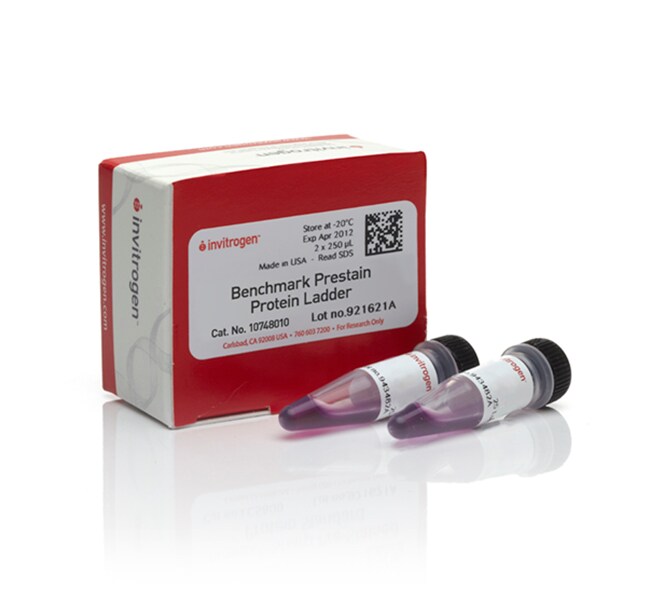
BenchMark™ 预染蛋白分子量标准
BenchMark 预染蛋白分子量标准含有 10 种表观分子量范围为 6 至 180 kDa 的蛋白,可用于监测蛋白免疫印迹中蛋白电泳或从凝胶转印到膜上的情况。蛋白标准品以即用型规格提供,用于直接上样至凝胶;使用前无需加热了解更多信息
| 货号 | 数量 |
|---|---|
| 10748010 | 2 x 250μL |
货号 10748010
价格(CNY)
938.00
Each
数量:
2 x 250μL
价格(CNY)
938.00
Each
BenchMark 预染蛋白分子量标准含有 10 种表观分子量范围为 6 至 180 kDa 的蛋白,可用于监测蛋白免疫印迹中蛋白电泳或从凝胶转印到膜上的情况。蛋白标准品以即用型规格提供,用于直接上样至凝胶;使用前无需加热、还原或添加样品缓冲液。
比较和查看所有其他蛋白标准品和分子量标准品›
应用
•在 SDS-聚丙烯酰胺凝胶电泳期间监测蛋白迁移
•Western 印迹后监测蛋白转印到膜上的过程
•SDS-PAGE 凝胶和 Western 印迹上的蛋白大小分析
比较和查看所有其他蛋白标准品和分子量标准品›
应用
•在 SDS-聚丙烯酰胺凝胶电泳期间监测蛋白迁移
•Western 印迹后监测蛋白转印到膜上的过程
•SDS-PAGE 凝胶和 Western 印迹上的蛋白大小分析
仅供科研使用。不可用于诊断程序。
规格
检测方法比色法
凝胶兼容性Novex™ Tris-甘氨酸凝胶
分子量180、115、82、64、49、37、26、19、15、6 kDa
数量2 x 250μL
即用型是
运输条件干冰
标记物数量10
产品线BenchMark
产品类型蛋白分子量标准品
大小范围6-180 kDa
染色剂类型2 色:蓝色、粉色
系统类型Western 印迹,SDS-PAGE
Unit SizeEach
内容与储存
提供两样品瓶(各 250μL,加在上样缓冲液中),缓冲液由 50 mM Tris-HCl (pH 6.8)、5 mM EDTA、10 mM DTT、1% (w/v) SDS、10% (w/v) 甘油组成。
在 -20°C 下储存。请避免反复冻融。
在 -20°C 下储存。请避免反复冻融。
常见问题解答 (FAQ)
我使用了你们的一种预染蛋白质标准品进行转印,发现在转印过程中条带在膜上褪色了。为什么会这样?
我使用了你们的一种蛋白质标准品进行转印,发现一些小分子蛋白质条带穿过了膜。我该如何解决这个问题?
我使用了你们的一种蛋白质标准品进行转印,发现一些高分子蛋白质条带转印到膜上的效果很差。可以提供一些提示吗?
我在Tris-甘氨酸凝胶上使用了一种预染标准品,发现蛋白质的分子量与在NuPAGE Bis-Tris凝胶上的分子量不同。这是什么原因?
我使用了你们的一种蛋白质标准品,并在泳道中看到了一些额外的条带。可以提供一些建议吗?
引用和文献 (5)
引用和文献
Abstract
2F3 monoclonal antibody recognizes the O26 O-antigen moiety of the lipopolysaccharide of enterohemorrhagic Escherichia coli strain 4276.
Journal:Clin Diagn Lab Immunol
PubMed ID:15138178
'Enterohemorrhagic Escherichia coli (EHEC) and enteropathogenic E. coli (EPEC) organisms are groups of pathogenic strains whose infections are characterized by a typical lesion of enterocyte attachment and effacement. They are involved in enteric diseases both in humans and in animals, and EHEC strains can be responsible for hemolytic uremic syndrome
In the Absence of the First Membrane-spanning Segment of Subunit 4(b), the Yeast ATP Synthase Is Functional but Does Not Dimerize or Oligomerize.
Journal:J Biol Chem
PubMed ID:11799128
'The N-terminal portion of the mitochondrial b-subunit is anchored in the inner mitochondrial membrane by two hydrophobic segments. We investigated the role of the first membrane-spanning segment, which is absent in prokaryotic and chloroplastic enzymes. In the absence of the first membrane-spanning segment of the yeast subunit (subunit 4), a
The formation of highly soluble oligomers of alpha-synuclein is regulated by fatty acids and enhanced in Parkinson's disease.
Journal:Neuron
PubMed ID:12597857
Accumulation of misfolded proteins as insoluble aggregates occurs in several neurodegenerative diseases. In Parkinson's disease (PD) and dementia with Lewy bodies (DLB), alpha-synuclein (alpha S) accumulates in insoluble inclusions. To identify soluble alpha S oligomers that precede insoluble aggregates, we probed the cytosols of mesencephalic neuronal (MES) cells, normal and
The typically mitochondrial DNA-encoded ATP6 subunit of the F1F0-ATPase is encoded by a nuclear gene in Chlamydomonas reinhardtii.
Journal:J Biol Chem
PubMed ID:11744727
The atp6 gene, encoding the ATP6 subunit of F(1)F(0)-ATP synthase, has thus far been found only as an mtDNA-encoded gene. However, atp6 is absent from mtDNAs of some species, including that of Chlamydomonas reinhardtii. Analysis of C. reinhardtii expressed sequence tags revealed three overlapping sequences that encoded a protein with
Bee Venom Phospholipase Inhibits Malaria Parasite Development in Transgenic Mosquitoes.
Journal:J Biol Chem
PubMed ID:12167627
Malaria kills millions of people every year, and new control measures are urgently needed. The recent demonstration that (effector) genes can be introduced into the mosquito germ line to diminish their ability to transmit the malaria parasite offers new hope toward the fight of the disease (Ito, J., Ghosh, A.,