Search


引用和文献 (17)
Invitrogen™
Platinum™ Taq DNA聚合酶
Invitrogen Platinum Taq DNA 聚合酶是用于 PCR 的一种便利且可靠的“热启动”耐热 DNA 聚合酶,其特异性高于 Taq了解更多信息
Have Questions?
更改视图

| 货号 | 反应次数 |
|---|---|
| 10966018 | 120 次反应 |
| 10966026 | 300 次反应 |
| 10966034 | 600 次反应 |
| 10966083 | 5000 次反应 |
货号 10966018
价格(CNY)
802.00
飞享价
Ends: 31-Dec-2026
1,145.00共减 343.00 (30%)
Each
反应次数:
120 次反应
价格(CNY)
802.00
飞享价
Ends: 31-Dec-2026
1,145.00共减 343.00 (30%)
Each
Invitrogen Platinum Taq DNA 聚合酶是用于 PCR 的一种便利且可靠的“热启动”耐热 DNA 聚合酶,其特异性高于 Taq DNA 聚合酶。酶的“热启动”特性取决于不耐热的单克隆抗体,该抗体使得 Taq DNA 聚合酶在初始的 PCR 变性步骤之前无活性,从而防止了非特异性退火引物的扩展并提高了产物产率。
使用 Platinum Taq DNA 聚合酶
Platinum Taq DNA 聚合酶的热启动特性支持在室温下便利地反应组装。正如 Taq DNA 聚合酶一样,Platinum Taq DNA 聚合酶具有不依赖模板的末端转移酶活性(其将3'脱氧腺苷添加到产物末端),并具有5'→3'核酸外切酶活性。利用 Taq DNA 聚合酶生成的 PCR 产物可用于相同的下游应用,无需修改方案。将 Platinum Taq DNA 聚合酶用于从复杂基因组、病毒和质粒模板扩增 DNA,以及 RT-PCR。
备注:为了获得更优的 PCR 性能,我们推荐使用下一代酶 Platinum II Taq 热启动 DNA 聚合酶。Platinum II Taq 热启动 DNA 聚合酶是专为通用引物退火和快速、简易的 PCR 而设计的,其以独特的方式结合了创新的缓冲液、高性能设计的 Taq DNA 聚合酶和更优的热启动技术。
使用 Platinum Taq DNA 聚合酶
Platinum Taq DNA 聚合酶的热启动特性支持在室温下便利地反应组装。正如 Taq DNA 聚合酶一样,Platinum Taq DNA 聚合酶具有不依赖模板的末端转移酶活性(其将3'脱氧腺苷添加到产物末端),并具有5'→3'核酸外切酶活性。利用 Taq DNA 聚合酶生成的 PCR 产物可用于相同的下游应用,无需修改方案。将 Platinum Taq DNA 聚合酶用于从复杂基因组、病毒和质粒模板扩增 DNA,以及 RT-PCR。
备注:为了获得更优的 PCR 性能,我们推荐使用下一代酶 Platinum II Taq 热启动 DNA 聚合酶。Platinum II Taq 热启动 DNA 聚合酶是专为通用引物退火和快速、简易的 PCR 而设计的,其以独特的方式结合了创新的缓冲液、高性能设计的 Taq DNA 聚合酶和更优的热启动技术。
仅供科研使用。不可用于诊断程序。
规格
外切核酸酶活性5' - 3'
保真度(相对于 Taq)1 X
产品规格管装
热启动内置热启动
反应次数120 次反应
突出端3'-A
聚合酶Platinum Taq DNA 聚合酶
产品类型DNA 聚合酶
数量120 次反应
反应形式分离组分
运输条件湿冰或干冰
尺寸(最终产品)5 kb或更小
原始材料DNA
适用于(应用)Hot-start PCR
高 GC PCR 扩增效果低
反应速度快速,标准
Unit SizeEach
内容与储存
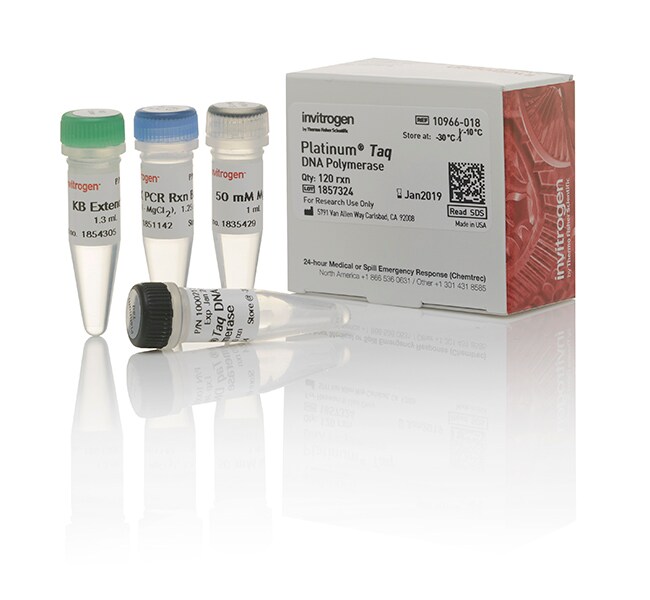
每盒都包含:
•24 µL Platinum™ Taq DNA 聚合酶
• 1.25 mL 10X PCR 缓冲液(无氯化镁)
• 1 mL 50 mM 氯化镁
• 1.3 mL KB 延长液
储存在 -30°C 至 -10°C 下非自动除霜冷冻冰箱中。
•24 µL Platinum™ Taq DNA 聚合酶
• 1.25 mL 10X PCR 缓冲液(无氯化镁)
• 1 mL 50 mM 氯化镁
• 1.3 mL KB 延长液
储存在 -30°C 至 -10°C 下非自动除霜冷冻冰箱中。
常见问题解答 (FAQ)
当我用凝胶电泳检测时,我的寡核苷酸似乎没有显示出正确长度。这是为什么?
我所使用的引物刚开始时可以用来做PCR的,但是随着时间的推移它失效了。这是什么情况?
在我定制的寡核苷酸管中没有看到沉淀。我是否应该要求换货?
在我的寡核苷酸管子底部有球状的沉淀。这是什么?我的寡核苷酸还能再用吗?
我的冻干寡核苷酸是绿色的。还能再用吗?
引用和文献 (17)
引用和文献
Abstract
De novo ceramide regulates the alternative splicing of caspase 9 and Bcl-x in A549 lung adenocarcinoma cells. Dependence on protein phosphatase-1.
Journal:J Biol Chem
PubMed ID:11801602
'In a recent study, we showed that ceramide induces the dephosphorylation of SR proteins, a family of protein factors that regulate alternative splicing. In this study, the regulation of the alternative processing of pre-mRNA of both caspase 9 and Bcl-x(L) was examined in response to ceramide. Treatment of A549 lung
Quantitative Assessment of Gene Targeting in Vitro and in Vivo by the Pancreatic Transcription Factor, Pdx1. IMPORTANCE OF CHROMATIN STRUCTURE IN DIRECTING PROMOTER BINDING.
Journal:J Biol Chem
PubMed ID:11825903
'The transcription factor Pdx1 is expressed in the pancreatic beta-cell, where it is believed to regulate several beta-cell-specific genes. Whereas binding by Pdx1 to elements of beta-cell genes has been demonstrated in vitro, almost none of these genes has been demonstrated to be a direct binding target for Pdx1 within
Angiotensin II inhibits human trophoblast invasion through AT1 receptor activation.
Journal:J Biol Chem
PubMed ID:11983698
Trophoblast implantation depends, in part, on the controlled production of plasmin from plasminogen, a process regulated by plasminogen activators and plasminogen activator inhibitors. We have determined that angiotensin II (Ang II) stimulates plasminogen activator inhibitor-1 (PAI-1) synthesis and secretion in human trophoblasts in a time- and concentration-dependent manner. Our results
Sensory nerves determine the pattern of arterial differentiation and blood vessel branching in the skin.
Journal:Cell
PubMed ID:12086669
Nerves and blood vessels are branched structures, but whether their branching patterns are established independently or coordinately is not clear. Here we show that arteries, but not veins, are specifically aligned with peripheral nerves in embryonic mouse limb skin. Mutations that eliminate peripheral sensory nerves or Schwann cells prevent proper
Translational regulation of BACE-1 expression in neuronal and non-neuronal cells.
Journal:Nucleic Acids Res
PubMed ID:15034149
As the main beta-secretase of the central nervous system, BACE-1 is a key protein in the pathogenesis of Alzheimer's disease. Excessive expression of the protein might cause an overproduction of the neurotoxic beta-amyloid peptide. Therefore, a tight regulation of BACE-1 expression is expected in vivo. In addition to a possible