Search


Citations & References (3)
Gibco™
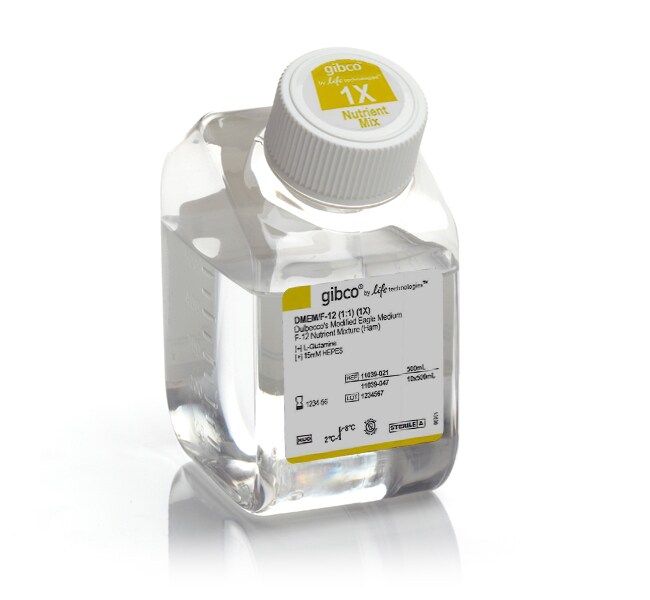
DMEM/F-12, HEPES, no phenol red
DMEM/F-12 (Dulbecco's Modified Eagle Medium/Nutrient Mixture F-12) is a widely used basal medium for supporting the growth of many differentRead more
Have Questions?
Change view

| Catalog Number | Quantity |
|---|---|
| 11039021 | 500 mL |
| 11039047 | 10 x 500 mL |
Catalog number 11039021
Price (CNY)
666.00
Online exclusive
Ends: 31-Dec-2026
833.00Save 167.00 (20%)
Each
Quantity:
500 mL
Price (CNY)
666.00
Online exclusive
Ends: 31-Dec-2026
833.00Save 167.00 (20%)
Each
DMEM/F-12 (Dulbecco's Modified Eagle Medium/Nutrient Mixture F-12) is a widely used basal medium for supporting the growth of many different mammalian cells. Cells successfully cultured in DMEM/F-12 include MDCK, glial cells, fibroblasts, human endothelial cells, and rat fibroblasts. We offer a variety of DMEM/F-12 modifications for a range of cell culture applications. Find the right formulation using the media selector tool.
This DMEM/F-12 is modified as follows:
With: L-glutamine, HEPES
Without: Phenol Red
The complete formulation is available.
Using DMEM/F-12
DMEM/F-12 is a 1:1 mixture of DMEM and Ham's F-12. This formulation combines DMEM's high concentrations of glucose, amino acids, and vitamins with F-12's wide variety of components. DMEM/F-12 contains no proteins, lipids, or growth factors. Therefore, DMEM/F-12 may require supplementation, commonly with 10% Fetal Bovine Serum (FBS). DMEM/F-12 uses a sodium bicarbonate buffer system and therefore requires a 5–10% CO2 environment to maintain physiological pH.
For Research Use Only. Not for use in diagnostic procedures.
Specifications
Cell LineMDCK, glial cells, fibroblasts, human endothelial cells, and rat fibroblasts
Concentration1X
Manufacturing QualitycGMP-compliant under the ISO 13485 standard
Product LineGibco
Product TypeDMEM (Dulbecco's Modified Eagle Medium)/F-12
Quantity500 mL
Shelf Life12 Months From Date of Manufacture
Shipping ConditionRoom Temperature
ClassificationAnimal Origin-free
FormLiquid
Serum LevelStandard Serum Supplementation
SterilitySterile-filtered
Sterilization MethodSterile-filtered
With AdditivesHigh Glucose, Glutamine, HEPES
Without AdditivesNo Phenol Red
Unit SizeEach
Contents & Storage
Storage conditions: 2°C to 8°C (protect from light)
Shipping conditions: Ambient
Shelf life: 12 months from date of manufacture
Shipping conditions: Ambient
Shelf life: 12 months from date of manufacture
Frequently asked questions (FAQs)
Do you offer DMEM/F12 medium without folic acid?
How long can I keep my media after supplementing with serum?
My medium was shipped at room temperature but it is supposed to be stored refrigerated. Is it okay?
How can I remove mycoplasma contamination from my cell culture medium?
I see a decrease in growth of my culture. What should I do?
Citations & References (3)
Citations & References
Abstract
A comparison between different human hepatocyte models reveals profound differences in net glucose production, lipid composition and metabolism in vitro.
Journal:Experimental cell research
PubMed ID:38499143
Identification of a contractile-responsive element in the cardiac alpha-myosin heavy chain gene.
Journal:J Biol Chem
PubMed ID:8537395
The mechanisms by which the cardiac-specific alpha-myosin heavy chain (alpha-MHC) gene responds to contractile activity was studied in cultured cardiomyocytes and in vivo. Deletion analysis of the alpha-MHC promoter transiently transfected into neonatal rat cardiomyocytes localized the contractile-responsive element within -80 to -40 base pairs of the transcriptional start site.
Activation of the canonical bone morphogenetic protein (BMP) pathway during lung morphogenesis and adult lung tissue repair.
Journal:PLoS One
PubMed ID:22916109
Signaling by Bone Morphogenetic Proteins (BMP) has been implicated in early lung development, adult lung homeostasis and tissue-injury repair. However, the precise mechanism of action and the spatio-temporal pattern of BMP-signaling during these processes remains inadequately described. To address this, we have utilized a transgenic line harboring a BMP-responsive eGFP-reporter