Search


Citations & References (12)
Gibco™
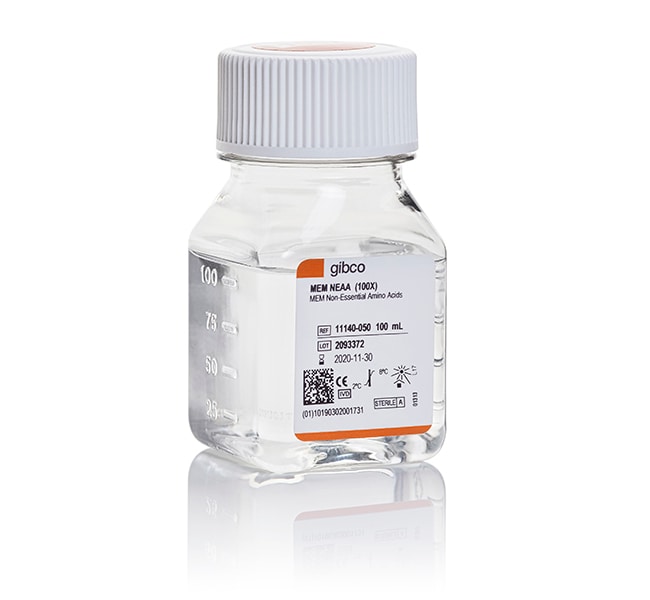
MEM Non-Essential Amino Acids Solution (100X)
Gibco™ MEM Non-Essential Amino Acids are used as a supplement for cell culture medium, to increase cell growth and viability.
Have Questions?
Change view

| Catalog Number | Quantity |
|---|---|
| 11140050 | 100 mL |
| 11140076 | 20 x 100 mL |
Catalog number 11140050
Price (CNY)
336.00
Online exclusive
Ends: 26-Sep-2026
448.00Save 112.00 (25%)
Each
Quantity:
100 mL
Price (CNY)
336.00
Online exclusive
Ends: 26-Sep-2026
448.00Save 112.00 (25%)
Each
Gibco™ MEM Non-Essential Amino Acids are used as a supplement for cell culture medium, to increase cell growth and viability. Gibco™ MEM Non-Essential Amino Acids contains the same non-essential amino acids found in the standard Minimum Essential Medium (MEM) at a strength of 100X. The complete formulation is available.
For Research Use or Further Manufacturing. Not for diagnostic use or direct administration into humans or animals.
Specifications
Cell TypeMammalian Cells
Concentration100X
Manufacturing QualitycGMP-compliant under the ISO 13485 standard
Quantity100 mL
Shelf Life18 Months
Shipping ConditionRoom Temperature
FormLiquid
Product TypeAmino Acid Supplement
SterilitySterile-filtered
pH0.9
Unit SizeEach
Contents & Storage
Store at 2–8°C. Protect from light.
Frequently asked questions (FAQs)
Where can I find the formulation of MEM Non-Essential Amino Acids Solution (100X) (Cat. No. 11140050)?
What is the solvent used for MEM Non-Essential Amino Acids Solution (100X)?
What is Gibco MEM Non-Essential Amino Acids?
Citations & References (12)
Citations & References
Abstract
Identification of a novel redox-sensitive gene, Id3, which mediates angiotensin II-induced cell growth.
Journal:Circulation
PubMed ID:12021231
BACKGROUND: Reactive oxygen species, such as superoxide (O(2)(-)), are involved in the abnormal growth of various cell types. Angiotensin II (Ang II) is one of the most potent inducers of oxidative stress in the vasculature. The molecular events involved in Ang II-induced proliferation of vascular smooth muscle cells (VSMCs) are
Patient-derived glioblastoma organoids as real-time avatars for assessing responses to clinical CAR-T cell therapy
Journal:Cell Stem Cell
PubMed ID:39657679
Patient-derived tumor organoids have been leveraged for disease modeling and preclinical studies but rarely applied in real time to aid with interpretation of patient treatment responses in clinics. We recently demonstrated early efficacy signals in a first-in-human, phase 1 study of dual-targeting chimeric antigen receptor (CAR)-T cells (EGFR-IL13Rα2 CAR-T cells)
Effects of an indole derivative on cell proliferation, transfection, and alternative splicing in production of lentiviral vectors by transient co-transfection.
Journal:PloS one
PubMed ID:38833479
Lentiviral vectors derived from human immunodeficiency virus type I are widely used to deliver functional gene copies to mammalian cells for research and gene therapies. Post-transcriptional splicing of lentiviral vector transgene in transduced host and transfected producer cells presents barriers to widespread application of lentiviral vector-based therapies. The present study
Mutation of the cytoplasmic domain of the integrin beta 3 subunit. Differential effects on cell spreading, recruitment to adhesion plaques, endocytosis, and phagocytosis.
Journal:J Biol Chem
PubMed ID:7721884
'The cytoplasmic domain of the beta subunit of the alpha IIb beta 3 integrin is required for cell spreading on fibrinogen. Here we report that deletion of six amino acids from the COOH terminus of the beta 3 (I757TYRGT) totally abolished cell spreading and formation of adhesion plaques, whereas retaining
Gene correction of the apolipoprotein (Apo) E2 phenotype to wild-type ApoE3 by in situ chimeraplasty.
Journal:J Biol Chem
PubMed ID:11278248
'Apolipoprotein (apo) E is a polymorphic plasma protein, synthesized mainly by liver. Here, we evaluate whether synthetic DNA-RNA oligonucleotides (chimeraplasts) can convert a dysfunctional isoform, apoE2 (C --> T, R158C), which causes Type III hyperlipidemia and premature atherosclerosis, into apoE3. First, we treated recombinant Chinese hamster ovary cells stably secreting