Search


引用和文献 (4)
Gibco™
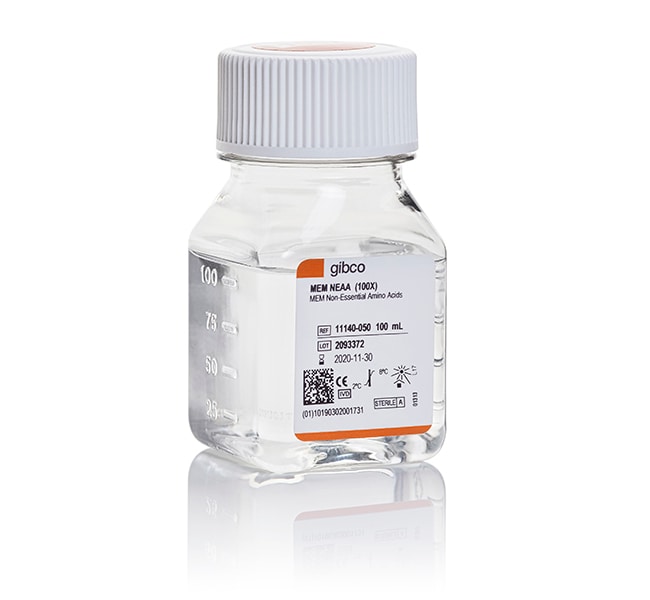
MEM 非必需氨基酸溶液 (100X)
Gibco™ MEM 非必须氨基酸用作细胞培养基的添加剂,可以提高细胞生长和活性。Gibco® MEM 非必需氨基酸含有与标准最小必需培养基 (MEM) 中相同的 100X 浓度非必需氨基酸了解更多信息
Have Questions?
更改视图

| 货号 | 数量 |
|---|---|
| 11140076 | 20 x 100 mL |
| 11140050 | 100 mL |
货号 11140076
价格(CNY)
7,766.00
Each
数量:
20 x 100 mL
价格(CNY)
7,766.00
Each
Gibco™ MEM 非必须氨基酸用作细胞培养基的添加剂,可以提高细胞生长和活性。Gibco® MEM 非必需氨基酸含有与标准最小必需培养基 (MEM) 中相同的 100X 浓度非必需氨基酸。完整的配方请见此处。
两工厂 cGMP 生产和质量体系
Gibco™ MEM 非必需氨基酸溶液在位于纽约格兰德岛的符合 cGMP 要求的工厂内生产。该工厂是在 FDA 注册的医疗器械生产商,通过 ISO 13485 标准认证。为确保供应链连续性,我们同时提供由我们的苏格兰工厂生产的相同的 Gibco® MEM 非必需氨基酸溶液产品 (11140-035)。后者亦是在FDA登记的医疗仪器生产商,且符合ISO 13485标准。
两工厂 cGMP 生产和质量体系
Gibco™ MEM 非必需氨基酸溶液在位于纽约格兰德岛的符合 cGMP 要求的工厂内生产。该工厂是在 FDA 注册的医疗器械生产商,通过 ISO 13485 标准认证。为确保供应链连续性,我们同时提供由我们的苏格兰工厂生产的相同的 Gibco® MEM 非必需氨基酸溶液产品 (11140-035)。后者亦是在FDA登记的医疗仪器生产商,且符合ISO 13485标准。
仅用于研究和生产用途。不可用于临床诊断或直接用于人类或动物。
规格
细胞类型哺乳动物细胞
最大浓度100 X
生产质量cGMP-compliant under the ISO 13485 standard
数量20 x 100 mL
有效期18 个月
形式液体
产品类型非必需氨基酸
无菌无菌过滤
pH0.9
Unit SizeEach
内容与储存
储存在 2–8°C 下。避光。
常见问题解答 (FAQ)
何为Gibco MEM非必需氨基酸?
Where can I find the formulation of MEM Non-Essential Amino Acids Solution (100X) (Cat. No. 11140050)?
What is the solvent used for MEM Non-Essential Amino Acids Solution (100X)?
What is Gibco MEM Non-Essential Amino Acids?
引用和文献 (4)
引用和文献
Abstract
Identification of a novel redox-sensitive gene, Id3, which mediates angiotensin II-induced cell growth.
Journal:Circulation
PubMed ID:12021231
BACKGROUND: Reactive oxygen species, such as superoxide (O(2)(-)), are involved in the abnormal growth of various cell types. Angiotensin II (Ang II) is one of the most potent inducers of oxidative stress in the vasculature. The molecular events involved in Ang II-induced proliferation of vascular smooth muscle cells (VSMCs) are
Mutation of the cytoplasmic domain of the integrin beta 3 subunit. Differential effects on cell spreading, recruitment to adhesion plaques, endocytosis, and phagocytosis.
Journal:J Biol Chem
PubMed ID:7721884
'The cytoplasmic domain of the beta subunit of the alpha IIb beta 3 integrin is required for cell spreading on fibrinogen. Here we report that deletion of six amino acids from the COOH terminus of the beta 3 (I757TYRGT) totally abolished cell spreading and formation of adhesion plaques, whereas retaining
Reprogramming human fibroblasts to pluripotency using modified mRNA.
Journal:Nat Protoc
PubMed ID:23429718
Induced pluripotent stem (iPS) cells hold the potential to revolutionize regenerative medicine through their capacity to generate cells of diverse lineages for future patient-specific cell-based therapies. To facilitate the transition of iPS cells to clinical practice, a variety of technologies have been developed for transgene-free pluripotency reprogramming. We recently reported
Measuring energy metabolism in cultured cells, including human pluripotent stem cells and differentiated cells.
Journal:Nat Protoc
PubMed ID:22576106
Measurements of glycolysis and mitochondrial function are required to quantify energy metabolism in a wide variety of cellular contexts. In human pluripotent stem cells (hPSCs) and their differentiated progeny, this analysis can be challenging because of the unique cell properties, growth conditions and expense required to maintain these cell types.