Search


引用和文献 (5)
Gibco™
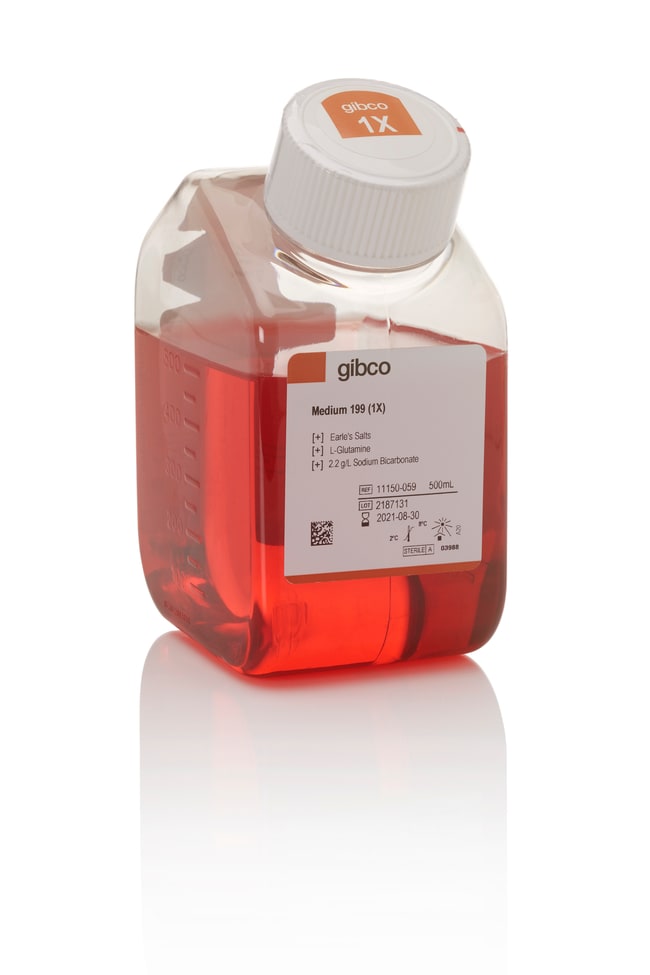
199 培养基,Earle's 平衡盐
199 培养基起初开发用于鸡胚成纤维细胞的营养研究。它具有广泛的物种适用性,特别适用于非转化细胞的培养。199 培养基广泛用于病毒学、疫苗生产以及小鼠胰腺上皮和大鼠晶状体组织原代外植体的体外培养。针对广泛的细胞培养应用,我们提供了多种 Gibco™ 199 改良培养基了解更多信息
Have Questions?
更改视图

| 货号 | 数量 | 加有添加剂 |
|---|---|---|
| 11150059 | 500 mL | 低糖, 谷氨酰胺, 酚红 |
| 11150067 | 10 x 500 mL | 低糖, 谷氨酰胺, 酚红 |
货号 11150059
价格(CNY)
435.00
飞享价
Ends: 31-Dec-2026
544.00共减 109.00 (20%)
Each
数量:
500 mL
加有添加剂:
低糖, 谷氨酰胺, 酚红
价格(CNY)
435.00
飞享价
Ends: 31-Dec-2026
544.00共减 109.00 (20%)
Each
199 培养基起初开发用于鸡胚成纤维细胞的营养研究。它具有广泛的物种适用性,特别适用于非转化细胞的培养。199 培养基广泛用于病毒学、疫苗生产以及小鼠胰腺上皮和大鼠晶状体组织原代外植体的体外培养。针对广泛的细胞培养应用,我们提供了多种 Gibco™ 199 改良培养基。使用培养基选择工具查找适合的配方。
提供完整配方。
与其他基础培养基相比,199 培养基包含独特的组分,包括腺嘌呤、腺苷、次黄嘌呤、胸腺嘧啶和其他维生素。199 培养基包含 Earle's 盐,用于 CO2 培养箱,或包含 Hanks' 盐,用于无 CO2 培养箱。
cGMP 生产和质量体系
Gibco™ 199 培养基在位于纽约格兰德岛的符合 cGMP 要求的工厂内生产。该工厂是在FDA登记的医疗器械生产商,且通过ISO 13485标准认证。为确保供应链的连续性,我们同时提供在苏格兰工厂生产的同等 Gibco™ 199 培养基产品 (31150-022)。该工厂是在 FDA 注册的医疗器械生产商,且通过 ISO 13485 标准认证。
199 培养基不含蛋白质、脂质或生长因子。199 培养基使用碳酸氢钠缓冲系统 (2.2 g/L),因此需要 5–10% CO2 环境来维持生理 pH 值。
该 M199 进行了以下改良:
| 包含 | 不含 |
| •酚红 | •HEPES: |
| •L-谷氨酰胺 |
提供完整配方。
与其他基础培养基相比,199 培养基包含独特的组分,包括腺嘌呤、腺苷、次黄嘌呤、胸腺嘧啶和其他维生素。199 培养基包含 Earle's 盐,用于 CO2 培养箱,或包含 Hanks' 盐,用于无 CO2 培养箱。
cGMP 生产和质量体系
Gibco™ 199 培养基在位于纽约格兰德岛的符合 cGMP 要求的工厂内生产。该工厂是在FDA登记的医疗器械生产商,且通过ISO 13485标准认证。为确保供应链的连续性,我们同时提供在苏格兰工厂生产的同等 Gibco™ 199 培养基产品 (31150-022)。该工厂是在 FDA 注册的医疗器械生产商,且通过 ISO 13485 标准认证。
199 培养基不含蛋白质、脂质或生长因子。199 培养基使用碳酸氢钠缓冲系统 (2.2 g/L),因此需要 5–10% CO2 环境来维持生理 pH 值。
仅用于研究和生产用途。不可用于临床诊断或直接用于人类或动物。
规格
细胞系大鼠上皮
细胞类型鸡胚成纤维细胞、小鼠胰腺上皮、大鼠晶状体组织
最大浓度1 X
生产质量cGMP-compliant under the ISO 13485 standard
产品线Gibco
产品类型199 培养基
数量500 mL
有效期自生产之日起 12 个月
运输条件室温
分类动物来源
形式液体
无菌无菌过滤
灭菌方法无菌过滤
加有添加剂低糖, 谷氨酰胺, 酚红
不加添加剂不含 HEPES, 不含丙酮酸钠
Unit SizeEach
内容与储存
储存条件:2-8°C。避光
运输条件:环境
有效期:自生产之日起12个月
运输条件:环境
有效期:自生产之日起12个月
常见问题解答 (FAQ)
加入血清后的培养基可以使用多久?
我的培养基是室温条件下运送来的,但注明应保存于冷藏条件下。这会有影响么?
我该如何去除细胞培养基中的支原体污染?
我发现培养物的生长速率变缓。我该如何处理?
我的细胞不能贴附于培养容器。我该如何处理?
引用和文献 (5)
引用和文献
Abstract
Nuclear factor-kappa B directs carcinoembryonic antigen-related cellular adhesion molecule 1 receptor expression in Neisseria gonorrhoeae-infected epithelial cells.
Journal:J Biol Chem
PubMed ID:11751883
'The human-specific pathogen Neisseria gonorrhoeae expresses opacity-associated (Opa) protein adhesins that bind to various members of the carcinoembryonic antigen-related cellular adhesion molecule (CEACAM) family. In this study, we have analyzed the mechanism underlying N. gonorrhoeae-induced CEACAM up-regulation in epithelial cells. Epithelial cells represent the first barrier for the microbial pathogen.
Evidence against glycogen cycling of gluconeogenic substrates in various liver preparations.
Journal:J Biol Chem
PubMed ID:12042303
'The effect of inhibition of glycogen phosphorylase by 1,4-dideoxy-1,4-imino-d-arabinitol on rates of gluconeogenesis, gluconeogenic deposition into glycogen, and glycogen recycling was investigated in primary cultured hepatocytes, in perfused rat liver, and in fed or fasted rats in vivo clamped at high physiological levels of plasma lactate. 1,4-Dideoxy-1,4-imino-d-arabinitol did not alter
Guanine nucleotide exchange factor-like factor (Rlf) induces gene expression and potentiates alpha 1-adrenergic receptor-induced transcriptional responses in neonatal rat ventricular myocytes.
Journal:J Biol Chem
PubMed ID:11847222
Expression of constitutively active Ras (V12Ras) in cultured neonatal rat ventricular myocytes or targeted cardiac expression of V12Ras in transgenic mice induces myocardial cell growth and expression of genes that are markers of cardiac hypertrophy including atrial natriuretic factor (ANF) and myosin light chain-2. However, the signaling pathways that modulate
Mechanism for peroxisome proliferator-activated receptor-alpha activator-induced up-regulation of UCP2 mRNA in rodent hepatocytes.
Journal:J Biol Chem
PubMed ID:11782473
Peroxisome proliferator-activated receptor-alpha (PPARalpha)activators, fish oil feeding, or fibrate administration up-regulated mitochondrial uncoupling protein (UCP2) mRNA expression in mouse liver by 5-9-fold, whereas tumor necrosis factor-alpha (TNFalpha) also up-regulated UCP2 in liver. In this study, the mechanisms for PPARalpha activators-induced up-regulation of UCP2 mRNA, related to TNFalpha and reactive oxygen
Lithocholic acid decreases expression of bile salt export pump through farnesoid X receptor antagonist activity.
Journal:J Biol Chem
PubMed ID:12052824
Bile salt export pump (BSEP) is a major bile acid transporter in the liver. Mutations in BSEP result in progressive intrahepatic cholestasis, a severe liver disease that impairs bile flow and causes irreversible liver damage. BSEP is a target for inhibition and down-regulation by drugs and abnormal bile salt metabolites,