Search

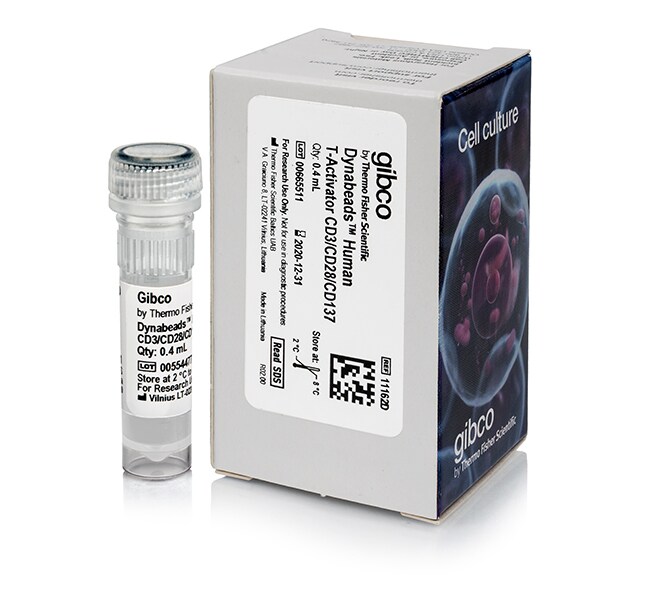
Gibco™
Dynabeads™ Human T-Activator CD3/CD28/CD137
Dynabeads Human T-Activator CD3/CD28/CD137 beads are 4.5-μm superparamagnetic beads covalently coupled with an optimized combination of anti-human CD3, CD28, and了解更多信息
Have Questions?
更改视图

| 货号 | 容积(公制) |
|---|---|
| 11162D | 0.4 mL |
| 11163D | 2 mL |
货号 11162D
价格(CNY)
1,610.00
飞享价
Ends: 31-Dec-2026
2,581.00共减 971.00 (38%)
Each
容积(公制):
0.4 mL
价格(CNY)
1,610.00
飞享价
Ends: 31-Dec-2026
2,581.00共减 971.00 (38%)
Each
Dynabeads Human T-Activator CD3/CD28/CD137 beads are 4.5-μm superparamagnetic beads covalently coupled with an optimized combination of anti-human CD3, CD28, and CD137 antibodies and intended for ex vivo expansion/proliferation of human antigen (Ag)-specific T cells. CD3 and CD28 provide primary and co-stimulatory signals that are required for the activation and expansion of T cells. Anti-CD137 acts as an antagonist that promotes both survival and proliferation of T lymphocytes. This is especially important for memory T cells where they may lack CD28 expression.
Benefits of Dynabeads Human T-Activator CD3/CD28/CD137 beads include:
• Easy—no need to prepare antigen-presenting cells or antigen
• Efficient—improved expansion and increased survival of Ag-specific T-cells
• Functional—expanded T cells maintain Ag-specific responses
Simple and fast procedure
Dynabeads Human T-Activator CD3/CD28/CD137 beads offer a simple method for expansion of CD3+, CD4+, or CD8+ antigen-specific T cells from T cell clones, cell lines, or freshly isolated Ag-specific T cells from PBMC or whole blood. Ag-specific T cells are activated by adding the beads and human recombinant IL-2 (rIL-2) and rIL7 (for CD8+ Ag-specific T cells only) to the cell culture. Optimal expansion is performed when appropriate T-cell medium is used, such as CTS OpTmizer T Cell Expansion SFM or Advanced RPMI 1640 Medium with added supplements according to the manual.
When experiencing reduced expansion or cell shrinking the T cells can be restimulated with the Dynabeads Human T-Activator CD3/CD28/CD137 beads. The beads can be removed with a DynaMag magnet and used in applications like cell:cell interaction studies, flow cytometry (after 3–4 days of culture to obtain bead release), proteomics, or nucleic acid-based assays.
Dynabeads Human T-Activator CD3/CD28/CD137 applications
The use of Dynabeads Human T-Activator CD3/CD28/CD137 beads have also been used to expand chronic lymphocytic leukemia in vitro by activating T cells, which in turn promote the expansion of leukemic B cells (Baptista et al, 2021). In addition, the Dynabeads Human T-Activator CD3/CD28/CD137 beads have been used to understand T cell suppression in blood neoplasms (Deng, et al, 2018).
Pre-isolate human antigen-specific T cells
To obtain the most optimal Ag-specific expansion from a heterogenous T-cell population, the Ag-specific T cells can be sorted or isolated and released directly from human whole blood or from peripheral blood mononuclear cells (PBMCs) with the Dynabeads FlowComp Flexi Kit in combination with an agonistic anti-CD137 antibody.
Alternative activation products
• For activation of naïve polyclonal human T cells, use Dynabeads Human T Activator CD3/CD28
• For activation of naïve polyclonal mouse T cells, use Dynabeads Mouse T Activator CD3/CD28
• For activation of human regulatory T cells (Tregs), use Dynabeads CD3/CD28 Treg Expander
• For ex vivo activation and expansion of human T cells for cell-based therapy, use the aseptically manufactured CTS Dynabeads CD3/CD28
Commercial supply
Our manufacturing sites are ISO 13485–certified. Bead characteristics and manufacturing conditions help ensure consistency and batch reproducibility, making them an ideal choice for commercial supply. If you are utilizing Dynabeads Human T-Activator CD3/CD28/CD137 beads in a commercial product or service or need a larger bulk volume of this product, please contact us at oemdynal@lifetech.com or read more on our Dynabeads OEM page.
References
Deng M, et al., LILRB4 signalling in leukaemia cells mediates T cell suppression and tumour infiltration. Nature. 2018 Oct;562(7728):605-609.
Baptista MJ, Baskar S, Gaglione EM, Keyvanfar K, Ahn IE, Wiestner A, Sun C. Select Antitumor Cytotoxic CD8+ T Clonotypes Expand in Patients with Chronic Lymphocytic Leukemia Treated with Ibrutinib. Clin Cancer Res. 2021 Aug 15;27(16):4624-4633.
仅供科研使用。不可用于诊断程序。
规格
细胞类型T 细胞(已活化)
认证/合规ISO9001 和 ISO13485
最大浓度5.4 x 10⁵ Beads/mL
描述Monoclonal antibodies covalently bound to DynaBeads magnetic Beads
适用于(设备)DynaMag™ Magnet
宿主种属小鼠
分离技术Magnetic Beads
产品线Dynabeads
数量0.4 mL
反应性人
调控状态For Research Use Only
样品类型Pre-isolated human antigen-specific T-cells from cell lines or clones
有效期自生产之日起 36 个月
运输条件室温
表面功能基团环氧树脂
目标种属人
均一性Monosized 4.5 μm (CV <5%)
容积(公制)0.4 mL
直径(公制)4.5 μm
适用于(应用)Activation and Expansion of T-cells
材质磁性聚苯乙烯
产品类型抗体包被微球
Unit SizeEach
内容与储存
一种悬浮液,浓度为 5 x 10⁵ Dynabeads/mL,保存在磷酸盐缓冲盐水 (PBS) 中,pH 7.4,含有 0.1% 人血清白蛋白 (HSA)。储存于:2-8°C。