Search


引用和文献 (12)
Invitrogen™
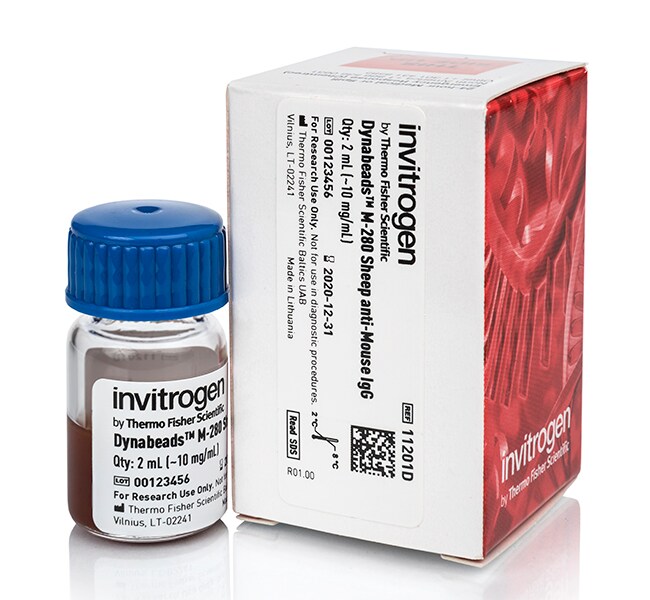
Dynabeads™ M-280 羊抗小鼠 IgG
Dynabeads M-280 绵羊抗小鼠 IgG 为微珠表面共价偶联有亲和纯化的多克隆绵羊抗小鼠 IgG 的 2.8 µm 超顺磁性微珠了解更多信息
Have Questions?
更改视图

| 货号 | 数量 |
|---|---|
| 11201D | 2 mL |
| 11202D | 10 mL |
货号 11201D
价格(CNY)
4,065.00
飞享价
Ends: 31-Dec-2026
5,421.00共减 1,356.00 (25%)
Each
数量:
2 mL
价格(CNY)
4,065.00
飞享价
Ends: 31-Dec-2026
5,421.00共减 1,356.00 (25%)
Each
Dynabeads M-280 绵羊抗小鼠 IgG 为微珠表面共价偶联有亲和纯化的多克隆绵羊抗小鼠 IgG 的 2.8 µm 超顺磁性微珠。这些微球为固体支持物,设计用于简单且有效地结合小鼠 IgG 及其它靶蛋白。大小均一的单分散性无孔 Dynabeads 微珠是适合多种应用的灵活产品,如结合免疫球蛋白 (Ig)、蛋白纯化、夹心法免疫检测、免疫沉淀 (Ip)、免疫共沉淀 (Co-IP) 以及细胞与微生物分离。多克隆绵羊抗体可结合小鼠 IgG1、IgG2a 和 IgG2b,且对小鼠 IgG3 和 IgM 具有较低反应性。人交叉反应性更低。
•在不到40分钟的时间内分离蛋白
• 可结合大多数小鼠 IgG 亚类
• 极低的非特异性结合及高信噪比
• 无需色谱柱、离心步骤或耗时的预清洗步骤
• 高重现性和高通量与 KingFisher 仪器兼容
可快速且简便的进行手动 Dynabeads 分离
可将能够识别靶分子的一抗加入到样品中(间接技术)或预包被到 Dynabeads M-280 绵羊抗小鼠 IgG 上(直接技术)。无论采用哪种技术,Dynabeads M-280 绵羊抗小鼠 IgG 与样品混合时,微珠都会结合靶标。将样品置于 DynaMag 磁架上即可将微珠结合的靶分子从其余样品中分离出来。然后通过吸液移除上清液。可采用传统的洗脱方法将靶分子与微珠洗脱分离并用于诸如 Western 印迹或质谱分析等应用,或用于进一步的下游应用但仍与微珠附着。
Dynabeads 自动化分离有助于提高通量,减少手动操作时间
如果您并行处理多个样品,那么洗涤步骤的数量与手动操作时间会与样品数量成比例地增加。一次处理多个样品时,移液管及其他手动操作获得的结果往往不如自动化。为了更好地处理中等至高通量的样品,减少手动操作时间并确保可重现性较高,我们开发了适用于 KingFisher Flex 和 KingFisher Duo Prime 仪器的 IP 方案。自动化方案复制人工方案,从而获得同样高的靶蛋白产率以及相同的低非特异性结合和高可重现性。无论您要处理 10 个还是 96 个样品,IP 方案可在 40 分钟内完成。’只需将试剂加载到孔板上,按下“开始”按钮,到您准备好下游分析时,IP 即可完成。根据抗体和靶蛋白的丰度和/或特异性,可能需要进行一些优化(例如,孵育时间)。
•使用 KingFisher Duo 仪器进行低到中等通量的处理(1-12份样品/次)
• 使用 KingFisher Flex 仪器进行高通量的处理(12-96份样品/次)
请参阅自动化方案
请观看 KingFisher Flex 仪器相关视频
了解有关 Dynabeads 的更多信息
• 请参阅免疫沉淀选择指南、数据和参考文献
• 请参阅用于 Dynabeads 分离的磁力架
• 查找适用于其它应用的 Dynabeads 产品
OEM 采购
如需以 OEM 形式采购 Dynabeads 绵羊抗小鼠 IgG 产品,请联系我们对外授权的销售部门和 OEM 销售部门。
•在不到40分钟的时间内分离蛋白
• 可结合大多数小鼠 IgG 亚类
• 极低的非特异性结合及高信噪比
• 无需色谱柱、离心步骤或耗时的预清洗步骤
• 高重现性和高通量与 KingFisher 仪器兼容
可快速且简便的进行手动 Dynabeads 分离
可将能够识别靶分子的一抗加入到样品中(间接技术)或预包被到 Dynabeads M-280 绵羊抗小鼠 IgG 上(直接技术)。无论采用哪种技术,Dynabeads M-280 绵羊抗小鼠 IgG 与样品混合时,微珠都会结合靶标。将样品置于 DynaMag 磁架上即可将微珠结合的靶分子从其余样品中分离出来。然后通过吸液移除上清液。可采用传统的洗脱方法将靶分子与微珠洗脱分离并用于诸如 Western 印迹或质谱分析等应用,或用于进一步的下游应用但仍与微珠附着。
Dynabeads 自动化分离有助于提高通量,减少手动操作时间
如果您并行处理多个样品,那么洗涤步骤的数量与手动操作时间会与样品数量成比例地增加。一次处理多个样品时,移液管及其他手动操作获得的结果往往不如自动化。为了更好地处理中等至高通量的样品,减少手动操作时间并确保可重现性较高,我们开发了适用于 KingFisher Flex 和 KingFisher Duo Prime 仪器的 IP 方案。自动化方案复制人工方案,从而获得同样高的靶蛋白产率以及相同的低非特异性结合和高可重现性。无论您要处理 10 个还是 96 个样品,IP 方案可在 40 分钟内完成。’只需将试剂加载到孔板上,按下“开始”按钮,到您准备好下游分析时,IP 即可完成。根据抗体和靶蛋白的丰度和/或特异性,可能需要进行一些优化(例如,孵育时间)。
•使用 KingFisher Duo 仪器进行低到中等通量的处理(1-12份样品/次)
• 使用 KingFisher Flex 仪器进行高通量的处理(12-96份样品/次)
请参阅自动化方案
请观看 KingFisher Flex 仪器相关视频
了解有关 Dynabeads 的更多信息
• 请参阅免疫沉淀选择指南、数据和参考文献
• 请参阅用于 Dynabeads 分离的磁力架
• 查找适用于其它应用的 Dynabeads 产品
OEM 采购
如需以 OEM 形式采购 Dynabeads 绵羊抗小鼠 IgG 产品,请联系我们对外授权的销售部门和 OEM 销售部门。
仅供科研使用。不可用于诊断程序。
规格
认证/合规ISO9001 和 ISO13485
颜色Brown
最大浓度10 mg/mL
描述Polyclonal sheep anti-mouse IgG covalently bound to Dynabeads
直径(公制)2.8 μm
适用于(应用)蛋白纯化
适用于(设备)DynaMag 磁力架或 KingFisher 仪器
产品规格悬浮磁珠
高通量能力兼容高通量应用
配基类型抗体
材料Polystyrene
数量2 mL
反应性可结合小鼠 IgG1、IgG2a 和 IgG2b。对小鼠 IgG3 和 IgM 具有较低反应性。
调控状态RUO
有效期自生产之日起 36 个月
运输条件室温
种属绵羊
靶标Proteins
均一性Monosized 2.8 μm (CV <5%)
类型抗体包被微球
Unit SizeEach
内容与储存
包含:2mL Dynabeads M-280 羊抗小鼠 IgG(10mg 微珠/mL)
储存:2°C 至 8°C
储存:2°C 至 8°C
常见问题解答 (FAQ)
使用Dynabeads M-280链霉亲和素磁珠时,背景很高。我该如何避免这种情况的发生?
我的Dynabeads磁珠不能很好地吸附到磁力架上,对此你们有什么建议吗?
我想要分离较长的双链DNA片段,你们有什么产品可以推荐?
我能否使用Dynabeads磁珠分离单链DNA模板?
什么是磁化率?
引用和文献 (12)
引用和文献
Abstract
Development and mechanism of ?-secretase modulators for Alzheimer's disease.
Journal:Biochemistry
PubMed ID:23614767
'?-Secretase is an aspartyl intramembranal protease composed of presenilin, Nicastrin, Aph1, and Pen2 with 19 transmembrane domains. ?-Secretase cleaves the amyloid precursor proteins (APP) to release Aß peptides that likely play a causative role in the pathogenesis of Alzheimer's disease (AD). In addition, ?-secretase cleaves Notch and other type I
Characterization of the postsynaptic protein neurogranin in paired cerebrospinal fluid and plasma samples from Alzheimer's disease patients and healthy controls.
Journal:
PubMed ID:26136856
'Synaptic dysfunction and degeneration are central events in Alzheimer''s disease (AD) pathophysiology that are thought to occur early in disease progression. Synaptic pathology may be studied by examining protein biomarkers specific for different synaptic elements. We recently showed that the dendritic protein neurogranin (Ng), including the endogenous Ng peptide 48
Brain amyloid-beta fragment signatures in pathological ageing and Alzheimer's disease by hybrid immunoprecipitation mass spectrometry.
Journal:
PubMed ID:25591542
'Senile plaques in Alzheimer''s disease (AD) are composed of amyloid-ß (Aß), especially N-truncated forms including Aß4-42. These are thought to be neurotoxic. However, individuals may live for decades with biomarker evidence of cerebral ß-amyloidosis (positive amyloid PET imaging and/or low cerebrospinal fluid levels of the 42 amino acid form of
Pyroglutamate amyloid ß (Aß) aggravates behavioral deficits in transgenic amyloid mouse model for Alzheimer disease.
Journal:J Biol Chem
PubMed ID:22267726
'Pyroglutamate-modified Aß peptides at amino acid position three (Aß(pE3-42)) are gaining considerable attention as potential key players in the pathogenesis of Alzheimer disease (AD). Aß(pE3-42) is abundant in AD brain and has a high aggregation propensity, stability and cellular toxicity. The aim of the present work was to study the
APP metabolism regulates tau proteostasis in human cerebral cortex neurons.
Journal:
PubMed ID:25921538
'Accumulation of Aß peptide fragments of the APP protein and neurofibrillary tangles of the microtubule-associated protein tau are the cellular hallmarks of Alzheimer''s disease (AD). To investigate the relationship between APP metabolism and tau protein levels and phosphorylation, we studied human-stem-cell-derived forebrain neurons with genetic forms of AD, all of