Search


引用和文献 (7)
Invitrogen™
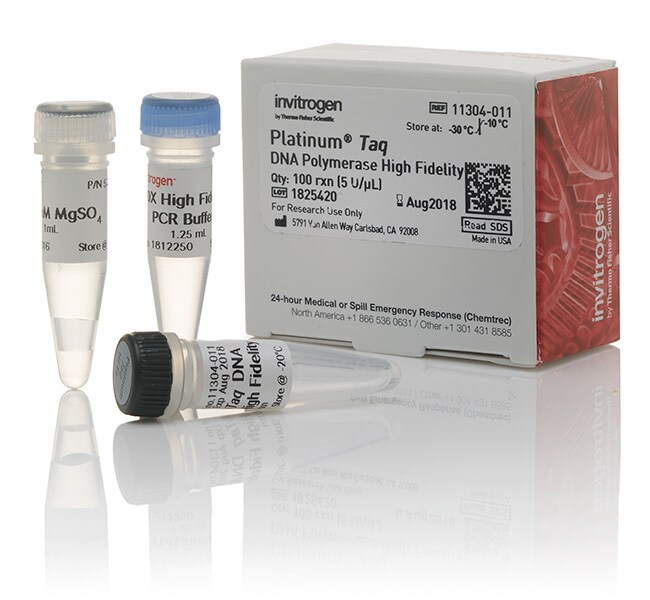
Platinum™ Taq 高保真 DNA 聚合酶
当需要高产量和稳健扩增时,Platinum™ Taq 高保真 DNA 聚合酶是扩增 DNA 片段的理想选择。通过 Platinum™ Taq了解更多信息
Have Questions?
更改视图

| 货号 | 反应次数 |
|---|---|
| 11304011 | 100 次反应 |
| 11304029 | 500 次反应 |
| 11304102 | 5000 次反应 |
货号 11304011
价格(CNY)
1,454.00
飞享价
Ends: 31-Dec-2026
2,077.00共减 623.00 (30%)
Each
反应次数:
100 次反应
价格(CNY)
1,454.00
飞享价
Ends: 31-Dec-2026
2,077.00共减 623.00 (30%)
Each
当需要高产量和稳健扩增时,Platinum™ Taq 高保真 DNA 聚合酶是扩增 DNA 片段的理想选择。通过 Platinum™ Taq DNA 聚合酶与校正读码(3´→5´ 核酸外切酶活性)酶火球菌属 GB-D 聚合酶的混合物提供高保真度。采用 Platinum™ 自动“热启动”技术提高了 PCR 特异性。Platinum™ Taq 高保真 DNA 聚合酶的特点:
•高保真度 — 比 Taq DNA 聚合酶的保真度高六倍以上
• 扩增子大小 — 对高达 15 kb 的片段进行扩增(如图所示)
• 便利性 — 室温反应组装
• 应用 — 从复杂基因组、病毒和质粒模板扩增 DNA;以及 RT-PCR
单位定义
一个单位的 Platinum™ Taq 高保真 DNA 聚合酶是在 74°C 下30分钟内将 10 nmol 脱氧核苷酸掺入 DNA 中所需的酶量。
•高保真度 — 比 Taq DNA 聚合酶的保真度高六倍以上
• 扩增子大小 — 对高达 15 kb 的片段进行扩增(如图所示)
• 便利性 — 室温反应组装
• 应用 — 从复杂基因组、病毒和质粒模板扩增 DNA;以及 RT-PCR
单位定义
一个单位的 Platinum™ Taq 高保真 DNA 聚合酶是在 74°C 下30分钟内将 10 nmol 脱氧核苷酸掺入 DNA 中所需的酶量。
仅供科研使用。不可用于诊断程序。
规格
保真度(相对于 Taq)6 X
热启动内置热启动
反应次数100 次反应
突出端混合性
聚合酶Platinum Taq 高保真 DNA 聚合酶
产品类型高保真 DNA 聚合酶
数量100 次反应
反应形式分离组分
运输条件干冰
尺寸(最终产品)20 kb 或更小
检测方法引物-探针
适用于(应用)Hot-start PCR, High-fidelity PCR
高 GC PCR 扩增效果低
反应速度标准
Unit SizeEach
内容与储存
• 1 x 20 μL Platinum Taq 高保真 DNA 聚合酶 (5 U/μL)
• 1 x 1.25 mL 10X 高保真缓冲液 [600 mM Tris-SO4(pH 值 8.9),180 mM (NH4)2SO4]
• 1 x 1 mL 50 mM MgSO4
在 -10°C 至 -30°C 下储存。
• 1 x 1.25 mL 10X 高保真缓冲液 [600 mM Tris-SO4(pH 值 8.9),180 mM (NH4)2SO4]
• 1 x 1 mL 50 mM MgSO4
在 -10°C 至 -30°C 下储存。
常见问题解答 (FAQ)
当我用凝胶电泳检测时,我的寡核苷酸似乎没有显示出正确长度。这是为什么?
我所使用的引物刚开始时可以用来做PCR的,但是随着时间的推移它失效了。这是什么情况?
在我定制的寡核苷酸管中没有看到沉淀。我是否应该要求换货?
在我的寡核苷酸管子底部有球状的沉淀。这是什么?我的寡核苷酸还能再用吗?
我的冻干寡核苷酸是绿色的。还能再用吗?
引用和文献 (7)
引用和文献
Abstract
Rice phosphate transporters include an evolutionarily divergent gene specifically activated in arbuscular mycorrhizal symbiosis.
Journal:Proc Natl Acad Sci U S A
PubMed ID:12271140
'Using a genome-wide approach, we asked how many transporter genes contribute to symbiotic phosphate uptake and analyzed their evolutionary conservation. Considering the sequenced rice genome at hand, only the Oryza sativa phosphate transporter (OsPT) gene OsPT11 was specifically induced during the arbuscular mycorrhizal symbiosis. This induction was confined to the
Relation between kidney function, proteinuria, and adverse outcomes.
Journal:JAMA
PubMed ID:20124537
'The current staging system for chronic kidney disease is based primarily on estimated glomerular filtration rate (eGFR) with lower eGFR associated with higher risk of adverse outcomes. Although proteinuria is also associated with adverse outcomes, it is not used to refine risk estimates of adverse events in this current system.'
Factor B and the mitochondrial ATP synthase complex.
Journal:J Biol Chem
PubMed ID:11744738
Factor B is a subunit of the mammalian ATP synthase complex, whose existence has been controversial. This paper describes the molecular and functional properties of a recombinant human factor B, which when added to bovine submitochondrial particles depleted of their factor B restores the energy coupling activity of the ATP
Mycobacterium-inducible Nramp in striped bass (Morone saxatilis).
Journal:Infect Immun
PubMed ID:14977970
In mammals, the natural resistance-associated macrophage protein 1 gene, Nramp1, plays a major role in resistance to mycobacterial infections. Chesapeake Bay striped bass (Morone saxatilis) is currently experiencing an epizootic of mycobacteriosis that threatens the health of this ecologically and economically important species. In the present study, we characterized an
Dynamics of Pleistocene population extinctions in Beringian brown bears.
Journal:Science
PubMed ID:11910085
The climatic and environmental changes associated with the last glaciation (90,000 to 10,000 years before the present; 90 to 10 ka B.P.) are an important example of the effects of global climate change on biological diversity. These effects were particularly marked in Beringia (northeastern Siberia, northwestern North America, and the