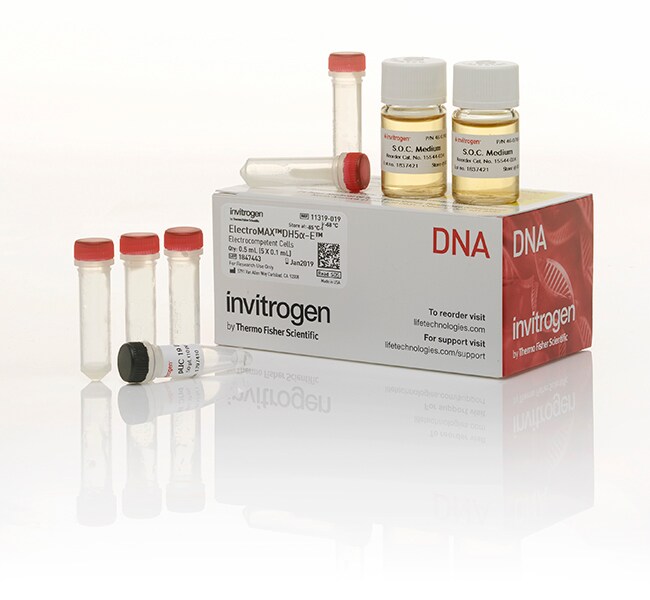
ElectroMAX™ DH5α-E 感受态细胞
Invitrogen™

ElectroMAX™ DH5α-E 感受态细胞

ElectroMAX DH5α-E 感受态细胞源自 DH5α 细胞株,适用于通过电穿孔进行转化。它们可用于需要高转化效率的程序(如生成 cDNA 文库)或了解更多信息
Have Questions?
货号数量
113190195 x 100μL
货号 11319019
价格(CNY)
3,026.00
Each
添加至购物车
数量:
5 x 100μL
价格(CNY)
3,026.00
Each
添加至购物车
ElectroMAX DH5α-E 感受态细胞源自 DH5α 细胞株,适用于通过电穿孔进行转化。它们可用于需要高转化效率的程序(如生成 cDNA 文库)或 DNA 起始量有限的转化。ElectroMAX DH5α-E 细胞可提供:

•在具有电穿孔的情况下效率为 >1 x 10¹⁰ 转化体/μg
•由于 endA1 突变,质粒得率和质量大幅增加
•使用规格为 30 kb 的质粒可实现高效转化
•由于 lacZΔM15 而实现重组克隆蓝白斑筛选
recA1 突变可确保插入片段稳定性
仅供科研使用。不可用于诊断程序。
规格
耐抗生素细菌No
蓝色/白色筛查
是否可克隆甲基化 DNA
克隆不稳定 DNA不适合克隆不稳定DNA
是否含 F' 附加体缺乏 F’附加体
高通量能力不兼容高通量应用(手动)
提高质粒质量
质粒可用于 > 20 kb 质粒
制备无甲基化 DNA不适合制备未甲基化DNA
产品线DH10B, ElectroMAX™
产品类型感受态细胞
数量5 x 100μL
减少克隆重组现象
运输条件干冰
T1 噬菌体 - 抗性 (tonA)
转化效率级别高效率 (> 10^9 cfu⁄μg)
产品规格One Shot
种属大肠杆菌
Unit SizeEach
内容与储存
包含:
•ElectroMAX DH5α-E 感受态细胞:5 样本瓶、每瓶 100 μL
•pUC19 DNA (10 pg/μL):1 个样品瓶,50μ L
• S.O.C.培养基:2 瓶,各 6 ml

感受态细胞在 -80°C 下储存。pUC19 DNA 在 -20°C 下储存。SOC 培养基在 4°C 或室温下储存。

常见问题解答 (FAQ)

How do you recommend that I prepare my DNA for successful electroporation of E. coli?

For best results, DNA used in electroporation must have a very low ionic strength and a high resistance. A high-salt DNA sample may be purified by either ethanol precipitation or dialysis.

The following suggested protocols are for ligation reactions of 20ul. The volumes may be adjusted to suit the amount being prepared.

Purifying DNA by Precipitation: Add 5 to 10 ug of tRNA to a 20ul ligation reaction. Adjust the solution to 2.5 M in ammonium acetate using a 7.5 M ammonium acetate stock solution. Mix well. Add two volumes of 100 % ethanol. Centrifuge at 12,000 x g for 15 min at 4C. Remove the supernatant with a micropipet. Wash the pellet with 60ul of 70% ethanol. Centrifuge at 12,000 x g for 15 min at room temperature. Remove the supernatant with a micropipet. Air dry the pellet. Resuspend the DNA in 0.5X TE buffer [5 mM Tris-HCl, 0.5 mM EDTA (pH 7.5)] to a concentration of 10 ng/ul of DNA. Use 1 ul per transformation of 20 ul of cell suspension.

Purifying DNA by Microdialysis: Float a Millipore filter, type VS 0.025 um, on a pool of 0.5X TE buffer (or 10% glycerol) in a small plastic container. Place 20ul of the DNA solution as a drop on top of the filter. Incubate at room temperature for several hours. Withdraw the DNA drop from the filter and place it in a polypropylene microcentrifuge tube. Use 1ul of this DNA for each electrotransformation reaction.

When should DMSO, formamide, glycerol and other cosolvents be used in PCR?

Cosolvents may be used when there is a failure of amplification, either because the template contains stable hairpin-loops or the region of amplification is GC-rich. Keep in mind that all of these cosolvents have the effect of lowering enzyme activity, which will decrease amplification yield. For more information see P Landre et al (1995). The use of co-solvents to enhance amplification by the polymerase chain reaction. In: PCR Strategies, edited by MA Innis, DH Gelfand, JJ Sninsky. Academic Press, San Diego, CA, pp. 3-16.

Additionally, when amplifying very long PCR fragments (greater than 5 kb) the use of cosolvents is often recommended to help compensate for the increased melting temperature of these fragments.

Find additional tips, troubleshooting help, and resources within our PCR and cDNA Synthesis Support Center.