Search


引用和文献 (5)
Gibco™
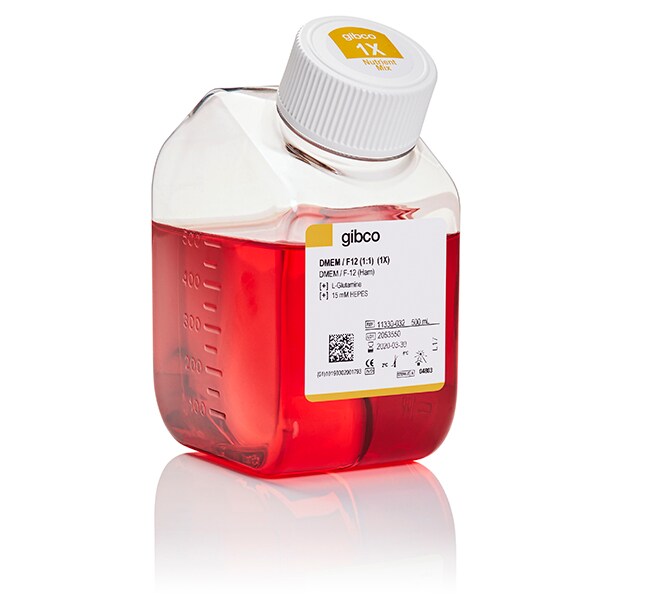
DMEM/F-12, HEPES
DMEM/F-12(Dulbecco's Modified Eagle Medium/Nutrient Mixture F-12)是一种广泛使用的基础培养基,可用于支持很多不同种类的哺乳动物细胞生长。已在 DMEM/F-12了解更多信息
Have Questions?
更改视图

| 货号 | 数量 |
|---|---|
| 11330032 | 500 mL |
| 31330038 又称 31330-038 | 500 mL |
| 31330095 又称 31330-095 | 10 x 500 mL |
| 11330057 | 10 x 500 mL |
| 11330099 | 5 L |
| 11330107 | 10 L |
货号 11330032
价格(CNY)
528.00
飞享价
Ends: 31-Dec-2026
661.00共减 133.00 (20%)
Each
数量:
500 mL
价格(CNY)
528.00
飞享价
Ends: 31-Dec-2026
661.00共减 133.00 (20%)
Each
DMEM/F-12(Dulbecco's Modified Eagle Medium/Nutrient Mixture F-12)是一种广泛使用的基础培养基,可用于支持很多不同种类的哺乳动物细胞生长。已在 DMEM/F-12 中成功培养的细胞包括 MDCK、神经胶质细胞、成纤维细胞、人内皮细胞及大鼠成纤维细胞。我们针对广泛的细胞培养应用,提供了多种组分的 DMEM/F-12 改良培养基。使用培养基选择工具查找适合的配方。
这种 DMEM/F-12 的改良方式如下:
可提供完整配方。
使用 DMEM/F-12
DMEM/F-12 是 DMEM 和 Ham's F-12 的 1:1 混合物。该配方包含 DMEM 的高浓度葡萄糖、氨基酸及维生素与 F-12 的多种组分。DMEM/F-12 不含蛋白质、脂质或生长因子。因此,DMEM/F-12 可能需要补充营养成分,通常需要添加 10% 胎牛血清 (FBS)。DMEM/F-12 使用碳酸氢钠缓冲系统,因此需要 5–10% CO2 的环境来维持生理 pH 值。
cGMP 生产和质量体系
DMEM/F-12 在位于纽约格兰德岛上符合 cGMP 要求的工厂内生产。该工厂是在 FDA 注册的医疗器械生产商,通过 ISO 13485 标准认证。为确保供应链的稳定,我们同时提供由我们的苏格兰工厂生产的相同 DMEM/F-12 产品 (31330-038)。后者亦是在FDA登记的医疗仪器生产商,且符合ISO 13485标准。
这种 DMEM/F-12 的改良方式如下:
| 包含 |
| •L-谷氨酰胺 |
| •HEPES: |
| • 酚红 |
可提供完整配方。
使用 DMEM/F-12
DMEM/F-12 是 DMEM 和 Ham's F-12 的 1:1 混合物。该配方包含 DMEM 的高浓度葡萄糖、氨基酸及维生素与 F-12 的多种组分。DMEM/F-12 不含蛋白质、脂质或生长因子。因此,DMEM/F-12 可能需要补充营养成分,通常需要添加 10% 胎牛血清 (FBS)。DMEM/F-12 使用碳酸氢钠缓冲系统,因此需要 5–10% CO2 的环境来维持生理 pH 值。
cGMP 生产和质量体系
DMEM/F-12 在位于纽约格兰德岛上符合 cGMP 要求的工厂内生产。该工厂是在 FDA 注册的医疗器械生产商,通过 ISO 13485 标准认证。为确保供应链的稳定,我们同时提供由我们的苏格兰工厂生产的相同 DMEM/F-12 产品 (31330-038)。后者亦是在FDA登记的医疗仪器生产商,且符合ISO 13485标准。
仅用于研究和生产用途。不可用于临床诊断或直接用于人类或动物。
规格
细胞系MDCK、神经胶质细胞、成纤维细胞、人内皮细胞和大鼠成纤维细胞
最大浓度1 X
适用于(应用)哺乳动物细胞培养
生产质量cGMP-compliant under the ISO 13485 standard
产品线Gibco
产品类型DMEM(Dulbecco 改良 Eagle 培养基)/F-12
数量500 mL
有效期自生产之日起 12 个月
运输条件室温
分类非动物源性
形式液体
血清水平标准血清
无菌无菌过滤
灭菌方法无菌过滤
加有添加剂高糖, 谷氨酰胺, HEPES:, 酚红, 丙酮酸钠
Unit SizeEach
内容与储存
储存条件:2°C 至 8°C(避光)
运输条件:环境
有效期:自生产之日起 12 个月
运输条件:环境
有效期:自生产之日起 12 个月
常见问题解答 (FAQ)
加入血清后的培养基可以使用多久?
我的培养基是室温条件下运送来的,但注明应保存于冷藏条件下。这会有影响么?
我该如何去除细胞培养基中的支原体污染?
我发现培养物的生长速率变缓。我该如何处理?
我的细胞不能贴附于培养容器。我该如何处理?
引用和文献 (5)
引用和文献
Abstract
Patient-derived glioblastoma organoids as real-time avatars for assessing responses to clinical CAR-T cell therapy
Journal:Cell Stem Cell
PubMed ID:39657679
Patient-derived tumor organoids have been leveraged for disease modeling and preclinical studies but rarely applied in real time to aid with interpretation of patient treatment responses in clinics. We recently demonstrated early efficacy signals in a first-in-human, phase 1 study of dual-targeting chimeric antigen receptor (CAR)-T cells (EGFR-IL13Rα2 CAR-T cells)
Fabrication of synthetic polymer coatings and their use in feeder-free culture of human embryonic stem cells.
Journal:Nat Protoc
PubMed ID:21720316
The culture of human embryonic stem (hES) cells in defined and xenogeneic-free conditions will contribute substantially to future biotechnological and medical applications. To achieve this goal, we developed the first fully defined synthetic polymer coating poly[2-(methacryloyloxy)ethyl dimethyl-(3-sulfopropyl)ammonium hydroxide] (PMEDSAH) that sustains long-term growth of hES cells in different culture media.
Insulin and insulin-like growth factor I receptors utilize different G protein signaling components.
Journal:J Biol Chem
PubMed ID:11278773
We examined the role of heterotrimeric G protein signaling components in insulin and insulin-like growth factor I (IGF-I) action. In HIRcB cells and in 3T3L1 adipocytes, treatment with the Galpha(i) inhibitor (pertussis toxin) or microinjection of the Gbetagamma inhibitor (glutathione S-transferase-betaARK) inhibited IGF-I and lysophosphatidic acid-stimulated mitogenesis but had no
Polycystin-1, the product of the polycystic kidney disease 1 gene, co-localizes with desmosomes in MDCK cells.
Journal:Hum Mol Genet
PubMed ID:11063733
Polycystin-1 is a novel protein predicted to be a large membrane-spanning glycoprotein with an extracellular N-terminus and an intracellular C-terminus, harboring several structural motifs. To study the subcellular localization, antibodies raised against various domains of polycystin-1 and against specific adhesion complex proteins were used for two-color immunofluorescence staining. In Madine
alpha-Synuclein interacts with phospholipase D isozymes and inhibits pervanadate-induced phospholipase D activation in human embryonic kidney-293 cells.
Journal:J Biol Chem
PubMed ID:11821392
alpha-Synuclein has been implicated in the pathogenesis of many neurodegenerative diseases, including Parkinson's disease and Alzheimer's disease. Although the function of alpha-synuclein remains largely unknown, recent studies have demonstrated that this protein can interact with phospholipids. To address the role of alpha-synuclein in neurodegenerative disease, we have investigated whether it