Search


引用和文献 (3)
Gibco™
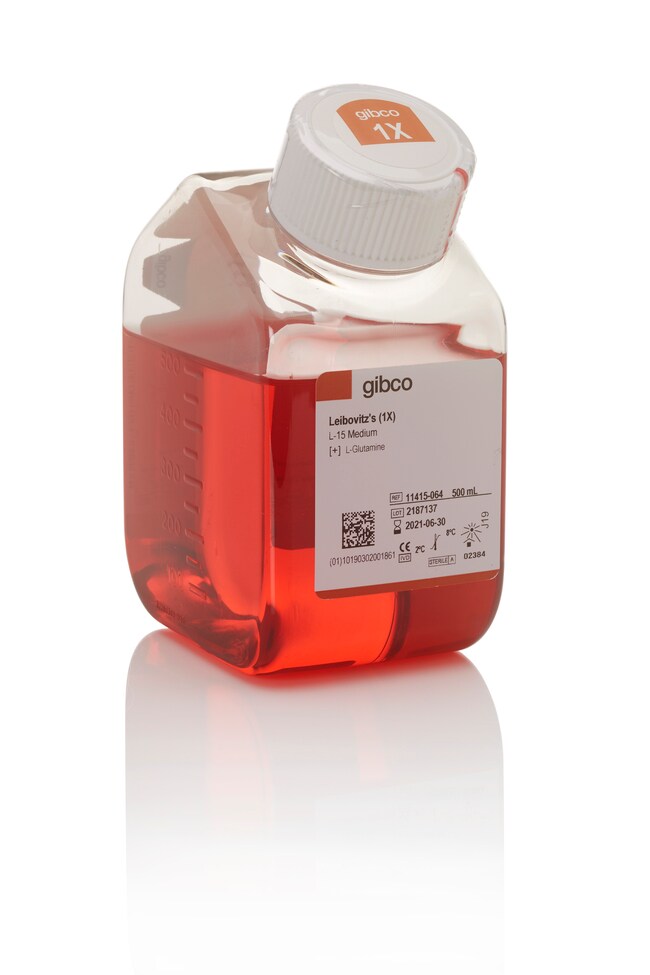
Leibovitz L-15 培养基
Leibovitz L-15 培养基支持 HEP-2 猴肾脏细胞以及胚胎和成人组织的原代组织块生长。L-15 采用磷酸盐和游离氨基酸而非碳酸氢钠进行缓冲。这种培养基适用于支持非 CO2 平衡环境中的细胞生长了解更多信息
Have Questions?
更改视图

| 货号 | 数量 |
|---|---|
| 11415064 | 500 mL |
| 11415114 | 10 x 500 mL |
货号 11415064
价格(CNY)
545.00
飞享价
Ends: 31-Dec-2026
681.00共减 136.00 (20%)
Each
数量:
500 mL
价格(CNY)
545.00
飞享价
Ends: 31-Dec-2026
681.00共减 136.00 (20%)
Each
Leibovitz L-15 培养基支持 HEP-2 猴肾脏细胞以及胚胎和成人组织的原代组织块生长。L-15 采用磷酸盐和游离氨基酸而非碳酸氢钠进行缓冲。这种培养基适用于支持非 CO2 平衡环境中的细胞生长。
可提供完整配方。
使用 Leibovitz L-15 培养基
L-15 不含蛋白、脂质或生长因子。因此,L-15 需要补充剂,通常添加 10% 胎牛血清 (FBS)。
cGMP 生产和质量体系
Gibco™ L-15 在位于纽约格兰德岛的符合 cGMP 要求的工厂内生产。该工厂是在FDA登记的医疗器械生产商,且通过ISO 13485标准认证。为确保供应链的稳定,我们同时提供由我们的苏格兰工厂生产的相同 Gibco™ L-15 产品 (11415-049)。后者亦是在FDA登记的医疗仪器生产商,且符合ISO 13485标准。
这种 L-15 经过如下改良:
| 包含 | 不含 |
| •半乳糖 | •葡萄糖 |
| •酚红 | •HEPES: |
| •L-谷氨酰胺 | •碳酸氢钠 |
| • 丙酮酸钠 |
可提供完整配方。
使用 Leibovitz L-15 培养基
L-15 不含蛋白、脂质或生长因子。因此,L-15 需要补充剂,通常添加 10% 胎牛血清 (FBS)。
cGMP 生产和质量体系
Gibco™ L-15 在位于纽约格兰德岛的符合 cGMP 要求的工厂内生产。该工厂是在FDA登记的医疗器械生产商,且通过ISO 13485标准认证。为确保供应链的稳定,我们同时提供由我们的苏格兰工厂生产的相同 Gibco™ L-15 产品 (11415-049)。后者亦是在FDA登记的医疗仪器生产商,且符合ISO 13485标准。
仅用于研究和生产用途。不可用于临床诊断或直接用于人类或动物。
规格
细胞系Hep-2 猴肾细胞
细胞类型胚胎和成人组织外植体
最大浓度1 X
生产质量cGMP-compliant under the ISO 13485 standard
产品线Gibco
产品类型Leibovitz L-15 培养基
数量500 mL
有效期自生产之日起 12 个月
运输条件室温
分类动物来源
形式液体
无菌无菌过滤
灭菌方法无菌过滤
加有添加剂谷氨酰胺, 酚红, 丙酮酸钠, 半乳糖
不加添加剂无葡萄糖, 不含 HEPES, 无碳酸氢钠
Unit SizeEach
内容与储存
储存条件:2-8°C。避光储存
运输条件:环境
有效期:自生产之日起 12 个月
运输条件:环境
有效期:自生产之日起 12 个月
常见问题解答 (FAQ)
加入血清后的培养基可以使用多久?
我的培养基是室温条件下运送来的,但注明应保存于冷藏条件下。这会有影响么?
我该如何去除细胞培养基中的支原体污染?
我发现培养物的生长速率变缓。我该如何处理?
我的细胞不能贴附于培养容器。我该如何处理?
引用和文献 (3)
引用和文献
Abstract
Tumor necrosis factor alpha increases the expression of glycosyltransferases and sulfotransferases responsible for the biosynthesis of sialylated and/or sulfated Lewis x epitopes in the human bronchial mucosa.
Journal:J Biol Chem
PubMed ID:11679593
'There is increasing evidence that inflammation may affect glycosylation and sulfation of various glycoproteins. The present study reports the effect of tumor necrosis factor alpha (TNF-alpha), a proinflammatory cytokine, on the glycosyl- and sulfotransferases of the human bronchial mucosa responsible for the biosynthesis of Lewis x epitope and of its
Antiapoptotic activity of the free caspase recruitment domain of procaspase-9: a novel endogenous rescue pathway in cell death.
Journal:J Biol Chem
PubMed ID:11825888
Mitochondrial injury initiates proteolytic processing of procaspase-9 into the large and small subunits, leading to apoptotic cell death. Here we show that the free caspase recruitment domain (CARD) released by procaspase-9 processing activates nuclear factor kappaB expression. A procaspase-9 construct with a point mutation that abrogates the release of the
Expression and localization of aquaporin water channels in rat hepatocytes. Evidence for a role in canalicular bile secretion.
Journal:J Biol Chem
PubMed ID:11932260
Although bile formation requires that large volumes of water be rapidly transported across liver epithelia, including hepatocytes, the molecular mechanisms by which water is secreted into bile are obscure. The aquaporins are a family of 10 channel-forming, integral membrane proteins of approximately 28 kDa numbered 0-9 that allow water to