Search

Invitrogen™
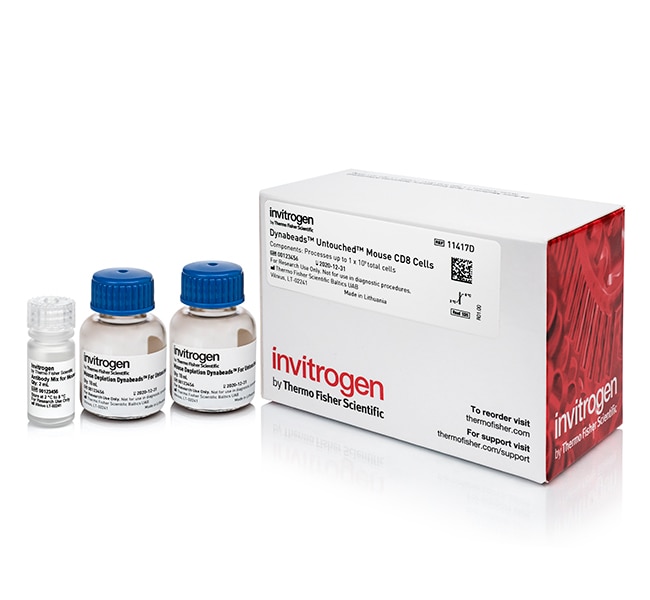
Dynabeads™ Untouched™ Mouse CD8 Cells Kit
Dynabeads™ Untouched™ Mouse CD8 Cells supplies both 4.5 μm superparamagnetic Dynabeads™ (with a polyclonal sheep anti-rat IgG antibody covalently bound了解更多信息
| 货号 | 数量 |
|---|---|
| 11417D | 2 x 10 mL |
货号 11417D
价格(CNY)
5,739.00
飞享价
Ends: 31-Dec-2026
9,771.00共减 4,032.00 (41%)
Each
数量:
2 x 10 mL
价格(CNY)
5,739.00
飞享价
Ends: 31-Dec-2026
9,771.00共减 4,032.00 (41%)
Each
Dynabeads™ Untouched™ Mouse CD8 Cells supplies both 4.5 μm superparamagnetic Dynabeads™ (with a polyclonal sheep anti-rat IgG antibody covalently bound to the bead surface) and a monoclonal Antibody Mix, together designed for the depletion of CD8-negative leucocytes from mouse spleen or lymph node single-cell suspensions. Following the depletion procedure, the negatively isolated, untouched target mouse CD8+ cells are pure, viable, and ready to be used in any downstream application.
• Rapid isolation of untouched mouse CD8+ T cells—no columns required
• Pure and viable mouse CD8+ T cells are ready for any downstream application
Excellent yield, purity, and viability of recovered cells
The Antibody Mix contains a cocktail of rat IgGs that binds mouse CD4+ T cells, B cells, NK cells, monocytes/macrophages, dendritic cells, erythrocytes, and granulocytes. The Antibody Mix is first added to the sample in a tube to bind the unwanted CD8-negative cells. The cells are then washed to remove excess antibodies. Mouse Depletion Dynabeads™ (coated with a rat IgG antibody) are added to bind the antibody-labeled, CD8-negative cells. After a short incubation, the bead-bound cells are then separated from unbound cells in 1–2 minutes using a magnet. The purified target mouse CD8+ cells in the supernatant can be transferred to a new tube for use in any downstream application.
This fast and gentle isolation method does not require the use of columns, and helps ensure high purity, recovery and viability of the untouched CD8+ cells. The protocol can be scaled up according to your sample size.
Learn more about Dynabeads™ products
• Find Dynabeads™ products for a whole range of applications.
• Find magnets for Dynabeads™ separations.
• Rapid isolation of untouched mouse CD8+ T cells—no columns required
• Pure and viable mouse CD8+ T cells are ready for any downstream application
Excellent yield, purity, and viability of recovered cells
The Antibody Mix contains a cocktail of rat IgGs that binds mouse CD4+ T cells, B cells, NK cells, monocytes/macrophages, dendritic cells, erythrocytes, and granulocytes. The Antibody Mix is first added to the sample in a tube to bind the unwanted CD8-negative cells. The cells are then washed to remove excess antibodies. Mouse Depletion Dynabeads™ (coated with a rat IgG antibody) are added to bind the antibody-labeled, CD8-negative cells. After a short incubation, the bead-bound cells are then separated from unbound cells in 1–2 minutes using a magnet. The purified target mouse CD8+ cells in the supernatant can be transferred to a new tube for use in any downstream application.
This fast and gentle isolation method does not require the use of columns, and helps ensure high purity, recovery and viability of the untouched CD8+ cells. The protocol can be scaled up according to your sample size.
Learn more about Dynabeads™ products
• Find Dynabeads™ products for a whole range of applications.
• Find magnets for Dynabeads™ separations.
For Research Use Only. Not for use in diagnostic procedures.
规格
细胞类型T Cells (CD8)
产品线DYNAL, Dynabeads
反应性Mouse
运输条件Room Temperature
数量2 x 10 mL
目标种属Mouse
Unit SizeEach
内容与储存
Contains: 20 mL Mouse Depletion Dynabeads™ and 2 mL Antibody Mix with monoclonal antibodies towards CD4, CD11b, CD16/32, CD45R and Ter-119.
Store kit components at 2°C to 8°C.
Store kit components at 2°C to 8°C.