Search


引用和文献 (5)
Invitrogen™
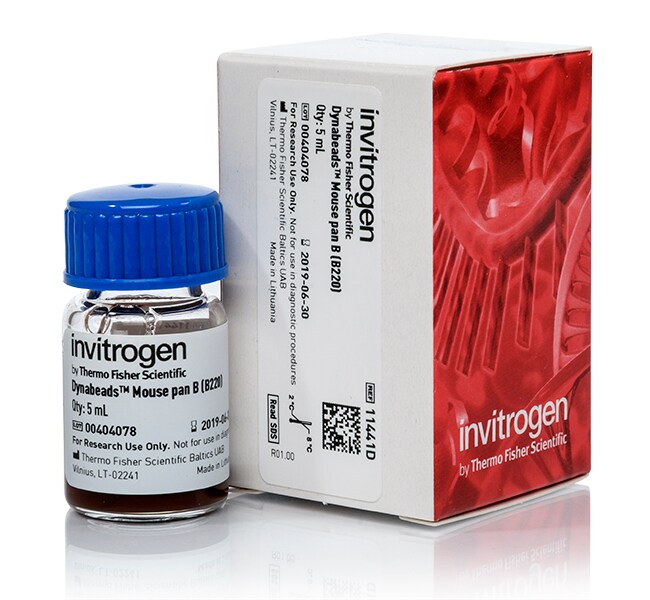
Dynabeads™ 小鼠 Pan B (B220)
Dynabeads™ 小鼠 pan B (B220) 是一种磁珠,可提供稳健的通用工具,用于直接从任何样品中分离或去除小鼠 T 细胞,包括组织酶切物,如脾脏或淋巴结、全血、骨髓和单核细胞了解更多信息
| 货号 | 数量 |
|---|---|
| 11441D | 5 mL |
货号 11441D
价格(CNY)
10,163.00
飞享价
Ends: 31-Dec-2026
14,460.00共减 4,297.00 (30%)
Each
数量:
5 mL
价格(CNY)
10,163.00
飞享价
Ends: 31-Dec-2026
14,460.00共减 4,297.00 (30%)
Each
Dynabeads™ 小鼠 pan B (B220) 是一种磁珠,可提供稳健的通用工具,用于直接从任何样品中分离或去除小鼠 T 细胞,包括组织酶切物,如脾脏或淋巴结、全血、骨髓和单核细胞 (MNC)。
•从任何样品中快速分离小鼠 T 细胞 – 无需色谱柱
• 阳性分离以用于分子下游检测或高效去除小鼠 B 细胞
回收的细胞具有出色的得率、纯度和活力
Dynabeads™ 小鼠 pan B (B220) 是均匀、具有超顺磁性的微珠(4.5 µm 直径),可从脾脏或淋巴结中轻松分离小鼠 B 细胞,但可能使用任何单细胞悬浮液。Dynabeads™ 小鼠 pan B 微珠包被有原代单克隆抗体,对 B220 膜抗原具有特异性。从 B 细胞分化的早期祖 B 阶段开始,在整个发育过程中 B220(也称为 CD45R)在所有 B 细胞上表达。在培养管中加入 Dynabeads™ 小鼠 pan B,其会在较短的孵育期中结合 B 细胞,然后用磁力架将微珠结合细胞与未结合细胞分离开来。这种快速且温和的分离方法不需要使用色谱柱,有助于确保分离的 B 细胞的高纯度、回收率和活力。
适用于下游分子检测的去除和阳性分离
由于用于分离的强大磁力架,Dynabeads™ 小鼠 pan B (B220) 可用于黏性样品,如来自组织、全血和骨髓的单细胞悬浮液,并可在约 30 分钟内有效去除小鼠 B 细胞。当用于阳性分离以供下游研究时,Dynabeads™ 小鼠 pan B 还可以高效回收高纯度的活细胞;例如,细胞被裂解但仍与微珠附着并进一步纯化核酸或蛋白。请注意,这些微珠不会释放活细胞。因此,如果您想要分离基于细胞应用的小鼠 B 细胞,或者需要使用流式细胞分析检查样品,则应使用 Dynabeads™ 小鼠 CD43(Untouched™ B 细胞)。
请从我公司的小鼠 B 细胞分离产品系列中选择适合您的产品。
仅供科研使用。不可用于人或动物的治疗或诊断。
•从任何样品中快速分离小鼠 T 细胞 – 无需色谱柱
• 阳性分离以用于分子下游检测或高效去除小鼠 B 细胞
回收的细胞具有出色的得率、纯度和活力
Dynabeads™ 小鼠 pan B (B220) 是均匀、具有超顺磁性的微珠(4.5 µm 直径),可从脾脏或淋巴结中轻松分离小鼠 B 细胞,但可能使用任何单细胞悬浮液。Dynabeads™ 小鼠 pan B 微珠包被有原代单克隆抗体,对 B220 膜抗原具有特异性。从 B 细胞分化的早期祖 B 阶段开始,在整个发育过程中 B220(也称为 CD45R)在所有 B 细胞上表达。在培养管中加入 Dynabeads™ 小鼠 pan B,其会在较短的孵育期中结合 B 细胞,然后用磁力架将微珠结合细胞与未结合细胞分离开来。这种快速且温和的分离方法不需要使用色谱柱,有助于确保分离的 B 细胞的高纯度、回收率和活力。
适用于下游分子检测的去除和阳性分离
由于用于分离的强大磁力架,Dynabeads™ 小鼠 pan B (B220) 可用于黏性样品,如来自组织、全血和骨髓的单细胞悬浮液,并可在约 30 分钟内有效去除小鼠 B 细胞。当用于阳性分离以供下游研究时,Dynabeads™ 小鼠 pan B 还可以高效回收高纯度的活细胞;例如,细胞被裂解但仍与微珠附着并进一步纯化核酸或蛋白。请注意,这些微珠不会释放活细胞。因此,如果您想要分离基于细胞应用的小鼠 B 细胞,或者需要使用流式细胞分析检查样品,则应使用 Dynabeads™ 小鼠 CD43(Untouched™ B 细胞)。
请从我公司的小鼠 B 细胞分离产品系列中选择适合您的产品。
仅供科研使用。不可用于人或动物的治疗或诊断。
仅供科研使用。不可用于诊断程序。
规格
细胞类型B 细胞
分离技术用于分子应用的去除、阳性分离
池数量处理总计 ∼2 x 10^9 个细胞
输出可行性>95%
产品线DYNAL,Dynabeads
纯度或质量等级研究级
数量5 mL
反应性小鼠
样品类型淋巴结,血液,脾脏
运输条件室温
原始材料细胞数量1 x 10^7 个细胞/分离
目标种属小鼠
直径(公制)4.5 μm
产品类型抗体包被微球
Unit SizeEach
内容与储存
本产品含:5 mL Dynabeads™ 小鼠 pan B (B220),包被抗 B220 单克隆抗体。
在 2-8°C 下储存
在 2-8°C 下储存
常见问题解答 (FAQ)
我的Dynabeads磁珠不能很好地吸附到磁力架上,对此你们有什么建议吗?
我想要分离较长的双链DNA片段,你们有什么产品可以推荐?
我能否使用Dynabeads磁珠分离单链DNA模板?
什么是磁化率?
我如何确定Dynabeads磁珠的偶联效率?
引用和文献 (5)
引用和文献
Abstract
IL-6 plays a unique role in initiating c-Maf expression during early stage of CD4 T cell activation.
Journal:J Immunol
PubMed ID:15728480
'The transcription factor c-Maf plays a critical and selective role in IL-4 gene transcription. Little is known about the mechanism that guides c-Maf regulation during early T cell activation. We report that IL-6 but not IL-4 or other cytokines, rapidly up-regulates c-Maf transcription, as early as 3 h after TCR
Molecular basis for the interaction of the hepatitis B virus core antigen with the surface immunoglobulin receptor on naive B cells.
Journal:J Virol
PubMed ID:11413303
'The nucleocapsid of the hepatitis B virus (HBV) is composed of 180 to 240 copies of the HBV core (HBc) protein. HBc antigen (HBcAg) capsids are extremely immunogenic and can activate naive B cells by cross-linking their surface receptors. The molecular basis for the interaction between HBcAg and naive B
Lymphocytes genetically modified to express tumor antigens target DCs in vivo and induce antitumor immunity.
Journal:J Clin Invest
PubMed ID:17885685
'The exploitation of the physiologic processing and presenting machinery of DCs by in vivo loading of tumor-associated antigens may improve the immunogenic potential and clinical efficacy of DC-based cancer vaccines. Here we show that lymphocytes genetically modified to express self/tumor antigens, acting as antigen carriers, efficiently target DCs in vivo
Development of autoimmunity in IL-14alpha-transgenic mice.
Journal:J Immunol
PubMed ID:17015757
Multiple genetic loci contribute to the development of systemic lupus erythematosus (SLE). In murine models for SLE, various genes on chromosome four have been implicated. IL-14 is a cytokine originally identified as a B cell growth factor. The il14 gene is located on chromosome 4. IL-14alpha is a cytokine encoded
Sle1ab mediates the aberrant activation of STAT3 and Ras-ERK signaling pathways in B lymphocytes.
Journal:J Immunol
PubMed ID:15661926
The Sle1ab genomic interval on murine chromosome 1 mediates the loss of immune tolerance to chromatin resulting in antinuclear Abs (ANA) production in the lupus-prone NZM2410 mouse. Global gene expression analysis was used to identify the molecular pathways that are dysregulated at the initiation of B lymphocyte autoimmunity in B6.Sle1ab