Search


引用和文献 (5)
Invitrogen™
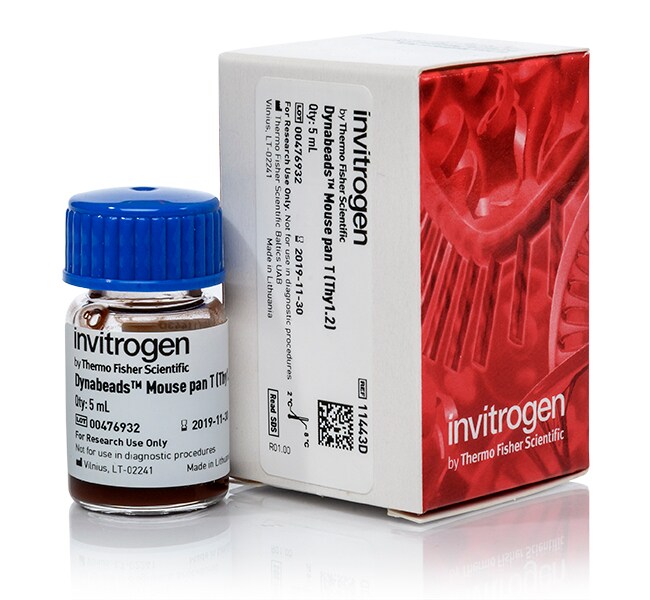
Dynabeads™ 小鼠 Pan T (Thy1.2)
Dynabeads™ 小鼠 pan T (Thy 1.2) 是一种磁珠,可提供稳健的通用工具,用于直接从任何样品中分离或去除小鼠 T 细胞,包括组织酶切物,如脾脏或淋巴结、全血了解更多信息
| 货号 | 数量 |
|---|---|
| 11443D | 5 mL |
货号 11443D
价格(CNY)
9,922.00
飞享价
Ends: 31-Dec-2026
14,116.00共减 4,194.00 (30%)
Each
数量:
5 mL
价格(CNY)
9,922.00
飞享价
Ends: 31-Dec-2026
14,116.00共减 4,194.00 (30%)
Each
Dynabeads™ 小鼠 pan T (Thy 1.2) 是一种磁珠,可提供稳健的通用工具,用于直接从任何样品中分离或去除小鼠 T 细胞,包括组织酶切物,如脾脏或淋巴结、全血、骨髓和单核细胞 (MNC)。
•从任何样品中快速分离小鼠 T 细胞 – 无需色谱柱
• 阳性分离以用于分子下游检测或高效去除小鼠 T 细胞
回收的细胞具有出色的得率、纯度和活力
Dynabeads™ 小鼠 pan T (Thy 1.2) 是均匀、具有超顺磁性的微珠(4.5 µm 直径),可从脾脏或淋巴结中轻松分离小鼠 T 细胞,但可能使用任何单细胞悬浮液。Dynabeads™ 小鼠 pan T 微珠包被有原代单克隆抗体,对在所有常见小鼠品系的外周 T 细胞、胸腺细胞和上皮内 T 淋巴细胞上表达的 Thy 1.2 膜抗原具有特异性。在培养管中加入 Dynabeads™ 小鼠 pan T,其会在较短的孵育期中结合 T 细胞,然后用磁力架将微珠结合细胞与未结合细胞分离开来。这种快速且温和的分离方法不需要使用色谱柱,有助于确保分离的 T 细胞的高纯度、回收率和活力。
适用于下游分子检测的去除和阳性分离
由于用于分离的强大磁力架,Dynabeads™ 小鼠 pan T (Thy 1.2) 可用于黏性样品,如来自组织、全血和骨髓的单细胞悬浮液,并可在约 30 分钟内有效去除小鼠 T 细胞。当用于阳性分离以供下游研究时,Dynabeads™ 小鼠 pan T 还可以高效回收高纯度的活细胞;例如,细胞被裂解但仍与微珠附着并进一步纯化核酸或蛋白。请注意,这些微珠不会释放完整的细胞,因此,如果您想要分离用于基于细胞的应用的小鼠 T 细胞,或者需要使用流式细胞分析检查样品,则应使用 Dynabeads™ FlowComp 小鼠 Pan T (CD90.2)(用于无微珠细胞)。
请从我公司的小鼠 T 细胞分离产品系列中选择适合您的产品。
仅供科研使用。不可用于人或动物的治疗或诊断。
•从任何样品中快速分离小鼠 T 细胞 – 无需色谱柱
• 阳性分离以用于分子下游检测或高效去除小鼠 T 细胞
回收的细胞具有出色的得率、纯度和活力
Dynabeads™ 小鼠 pan T (Thy 1.2) 是均匀、具有超顺磁性的微珠(4.5 µm 直径),可从脾脏或淋巴结中轻松分离小鼠 T 细胞,但可能使用任何单细胞悬浮液。Dynabeads™ 小鼠 pan T 微珠包被有原代单克隆抗体,对在所有常见小鼠品系的外周 T 细胞、胸腺细胞和上皮内 T 淋巴细胞上表达的 Thy 1.2 膜抗原具有特异性。在培养管中加入 Dynabeads™ 小鼠 pan T,其会在较短的孵育期中结合 T 细胞,然后用磁力架将微珠结合细胞与未结合细胞分离开来。这种快速且温和的分离方法不需要使用色谱柱,有助于确保分离的 T 细胞的高纯度、回收率和活力。
适用于下游分子检测的去除和阳性分离
由于用于分离的强大磁力架,Dynabeads™ 小鼠 pan T (Thy 1.2) 可用于黏性样品,如来自组织、全血和骨髓的单细胞悬浮液,并可在约 30 分钟内有效去除小鼠 T 细胞。当用于阳性分离以供下游研究时,Dynabeads™ 小鼠 pan T 还可以高效回收高纯度的活细胞;例如,细胞被裂解但仍与微珠附着并进一步纯化核酸或蛋白。请注意,这些微珠不会释放完整的细胞,因此,如果您想要分离用于基于细胞的应用的小鼠 T 细胞,或者需要使用流式细胞分析检查样品,则应使用 Dynabeads™ FlowComp 小鼠 Pan T (CD90.2)(用于无微珠细胞)。
请从我公司的小鼠 T 细胞分离产品系列中选择适合您的产品。
仅供科研使用。不可用于人或动物的治疗或诊断。
仅供科研使用。不可用于诊断程序。
规格
细胞类型T 细胞(全细胞群)
分离技术用于分子应用的去除、阳性分离
池数量处理总计 ∼2 x 10^9 个细胞
输出可行性>95%
产品线DYNAL,Dynabeads
纯度或质量等级研究级
数量5 mL
反应性小鼠
样品类型淋巴结,血液,脾脏
运输条件室温
原始材料细胞数量1 x 10^7 个细胞/分离
目标种属小鼠
直径(公制)4.5 μm
产品类型抗体包被微球
Unit SizeEach
内容与储存
本产品含:5 mL Dynabeads™ 小鼠 pan T,包被 Thy1.2 单克隆抗体。Thy1.2
抗原在较常使用的小鼠品系的小鼠外周 T 细胞、胸腺细胞和
上皮内 T 淋巴细胞上表达。
储存在 2-8°C 下
抗原在较常使用的小鼠品系的小鼠外周 T 细胞、胸腺细胞和
上皮内 T 淋巴细胞上表达。
储存在 2-8°C 下
常见问题解答 (FAQ)
我的Dynabeads磁珠不能很好地吸附到磁力架上,对此你们有什么建议吗?
我想要分离较长的双链DNA片段,你们有什么产品可以推荐?
我能否使用Dynabeads磁珠分离单链DNA模板?
什么是磁化率?
我如何确定Dynabeads磁珠的偶联效率?
引用和文献 (5)
引用和文献
Abstract
Myeloid C3 determines induction of humoral responses to peripheral herpes simplex virus infection.
Journal:J Immunol
PubMed ID:14607939
'The complement system, in addition to its role in innate immunity, is an important regulator of the B cell response. Complement exists predominantly in the circulation and although the primary source is hepatic, multiple additional cellular sources have been described that can contribute substantially to the complement pool. To date,
Engagement of B7 on effector T cells by regulatory T cells prevents autoimmune disease.
Journal:Proc Natl Acad Sci U S A
PubMed ID:15235129
'Although there is considerable evidence that a subpopulation of regulatory CD4(+)CD25+ T cells can suppress the response of autoreactive T cells, the underlying molecular mechanism is not understood. We find that transmission of a suppressive signal by CD4CD25+ regulatory cells requires engagement of the B7 molecule expressed on target T
Molecular basis for the interaction of the hepatitis B virus core antigen with the surface immunoglobulin receptor on naive B cells.
Journal:J Virol
PubMed ID:11413303
'The nucleocapsid of the hepatitis B virus (HBV) is composed of 180 to 240 copies of the HBV core (HBc) protein. HBc antigen (HBcAg) capsids are extremely immunogenic and can activate naive B cells by cross-linking their surface receptors. The molecular basis for the interaction between HBcAg and naive B
A sexual dimorphism in intrathymic sialylation survey is revealed by the trans-sialidase from Trypanosoma cruzi.
Journal:J Immunol
PubMed ID:15814675
Sialylation is emerging as an important issue in developing thymocytes and is considered among the most significant cell surface modifications, although its physiologic relevance is far from being completely understood. It is regulated by the concerted expression of sialyl transferases along thymocyte development. After in vivo administration of trans-sialidase, a
Immunotransplantation preferentially expands T-effector cells over T-regulatory cells and cures large lymphoma tumors.
Journal:Blood
PubMed ID:18812472
Ex vivo-expanded tumor-infiltrating lymphocytes infused into lymphodepleted recipients has clear antitumor efficacy. More practical sources of such antitumor lymphocytes would broaden the application of this approach. Previously, we described an in situ vaccination combining chemotherapy with intratumoral injection of CpG-enriched oligonucleotides, which induced T-cell immunity against established lymphoma. An ongoing