Search

Invitrogen™
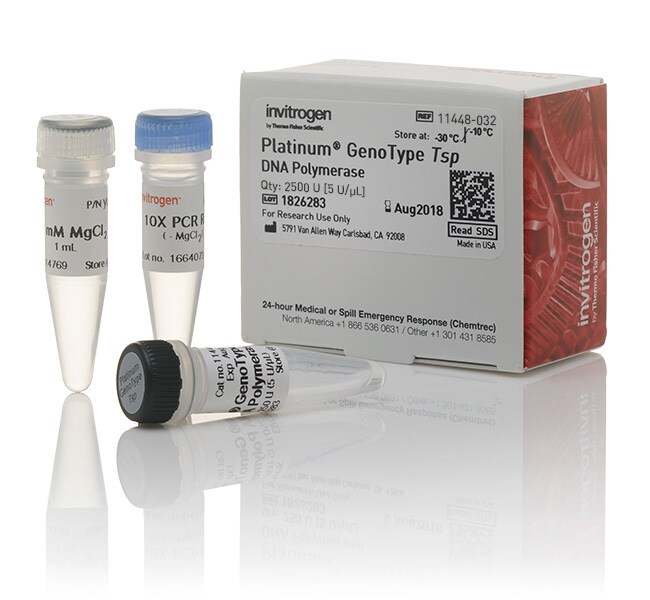
Platinum™ GenoType Tsp DNA 聚合酶
Platinum™ GenoType Tsp DNA 聚合酶专门为基于 PCR 的基因分型应用中二核苷酸重复序列位点的扩增而设计和进行质量认定。该酶与包含抗 Tsp DNA了解更多信息
Have Questions?
更改视图

| 货号 | 反应次数 |
|---|---|
| 11448032 又称 11448-032 | 2,000 次反应 |
| 11448024 | 400 次反应 |
货号 11448032
又称 11448-032
价格(CNY)
24,826.00
飞享价
Ends: 31-Dec-2026
33,101.00共减 8,275.00 (25%)
Each
反应次数:
2,000 次反应
价格(CNY)
24,826.00
飞享价
Ends: 31-Dec-2026
33,101.00共减 8,275.00 (25%)
Each
Platinum™ GenoType Tsp DNA 聚合酶专门为基于 PCR 的基因分型应用中二核苷酸重复序列位点的扩增而设计和进行质量认定。该酶与包含抗 Tsp DNA 聚合酶单克隆抗体的耐热抑制剂预先形成复合物,从而提供一种可提高 PCR 特异性、允许在室温下准备 PCR 反应体系的自动化“热启动”方法。Platinum™ GenoType Tsp DNA 聚合酶:
•表现出向 PCR 产物添加极少的非模板化核苷酸• 缺少 5´ 和 3´ 核酸外切酶活性
• 将片段扩增至 500 bp
应用
在消除非模板化核苷酸添加的应用中,二核苷酸重复位点扩增是可取的。
单位定义
在标准的 Taq DNA 聚合酶反应条件下的二核苷酸重复位点扩增中,一个单位的 Platinum™ GenoType Tsp DNA 聚合酶被确定为在功能上与一个单位的 Taq DNA 聚合酶等效。一单位 Tsp DNA 聚合酶近似2.5活性单位。在优化的反应条件下(74°C 时),一个活性单位会在30分钟内将 10 nmol 脱氧核苷酸掺入酸沉淀材料中。
•表现出向 PCR 产物添加极少的非模板化核苷酸• 缺少 5´ 和 3´ 核酸外切酶活性
• 将片段扩增至 500 bp
应用
在消除非模板化核苷酸添加的应用中,二核苷酸重复位点扩增是可取的。
单位定义
在标准的 Taq DNA 聚合酶反应条件下的二核苷酸重复位点扩增中,一个单位的 Platinum™ GenoType Tsp DNA 聚合酶被确定为在功能上与一个单位的 Taq DNA 聚合酶等效。一单位 Tsp DNA 聚合酶近似2.5活性单位。在优化的反应条件下(74°C 时),一个活性单位会在30分钟内将 10 nmol 脱氧核苷酸掺入酸沉淀材料中。
仅供科研使用。不可用于诊断程序。
规格
保真度(相对于 Taq)1 X
热启动内置热启动
反应次数2,000 次反应
突出端平末端
聚合酶Tsp 基因分型聚合酶
数量2500 单位
反应形式分离组分
运输条件湿冰或干冰
尺寸(最终产品)500 bp 或更小
容量500 μL
适用于(应用)Hot-start PCR
高 GC PCR 扩增效果低
反应速度标准
Unit SizeEach
内容与储存
目录:
• 1管 500 μL (5 Tsp U/μL)
• 10X PCR 缓冲液 (200mM Tris-HCl, pH 8.4, 500 mM KCl))
• 1瓶 50 mM MgCl2
-20°C 储存。妥善储存时,稳定性至少可保持6个月。
• 1管 500 μL (5 Tsp U/μL)
• 10X PCR 缓冲液 (200mM Tris-HCl, pH 8.4, 500 mM KCl))
• 1瓶 50 mM MgCl2
-20°C 储存。妥善储存时,稳定性至少可保持6个月。