Search


引用和文献 (11)
Gibco™
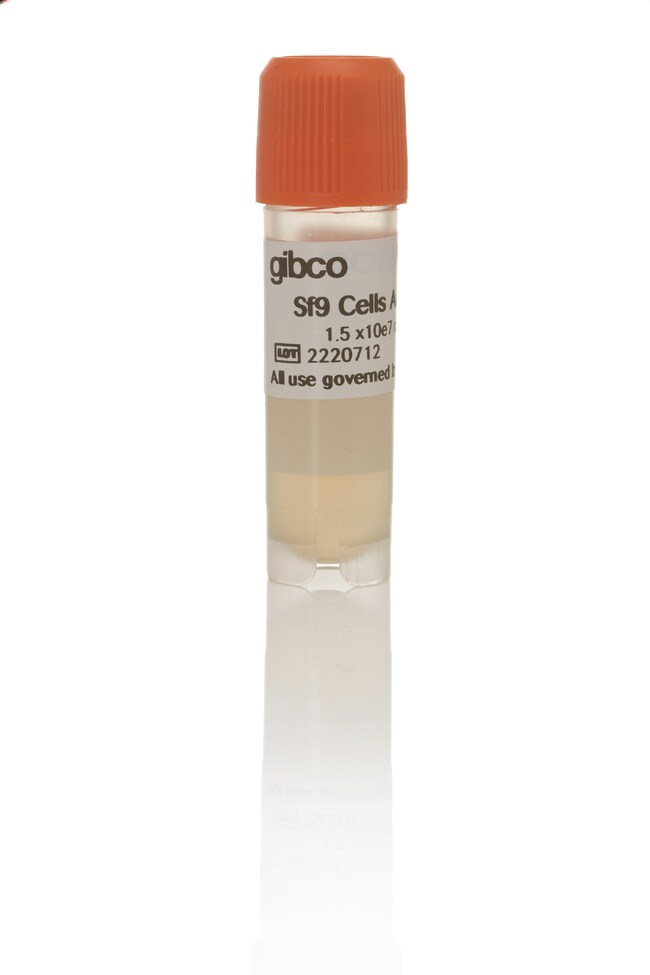
Sf-900™ II SFM 中的 Sf9 细胞
Gibco™ Sf9 细胞通常用于分离和增殖重组杆状病毒储备并生成重组蛋白。Gibco™ Sf9 细胞适应于在 Gibco™ Sf-900™ II SFM了解更多信息
| 货号 | 数量 |
|---|---|
| 11496015 | 1.5 mL |
货号 11496015
价格(CNY)
7,941.00
飞享价
Ends: 31-Dec-2026
9,381.00共减 1,440.00 (15%)
Each
数量:
1.5 mL
价格(CNY)
7,941.00
飞享价
Ends: 31-Dec-2026
9,381.00共减 1,440.00 (15%)
Each
Gibco™ Sf9 细胞通常用于分离和增殖重组杆状病毒储备并生成重组蛋白。Gibco™ Sf9 细胞适应于在 Gibco™ Sf-900™ II SFM 中进行无血清悬浮培养,可节省大量与培养适应相关的时间和费用。Gibco™ Sf9 细胞(冷冻在 Gibco™ Sf-900™ II SFM 中)的特点如下:
•多种表达系统的重组蛋白表达
• 贴壁或悬浮培养时生长良好
• 常规规格较小,可以生成均匀单层和斑块
• 低传代主细胞库的记录谱系
• 质量和性能检测
多种表达系统的重组蛋白表达
使用 BaculoDirect ™杆状病毒表达系统、Bac-to-Bac ™杆状病毒表达系统或 InsectDirect™ 表达系统可实现 Sf9 细胞的高水平蛋白质表达。
常规规格较小,可以生成均匀单层和斑块
Gibco™ Sf9 细胞体积小而圆,因此能生成一种纯净的均匀单层和斑块。其他细胞通常形成更加不规则的单层和斑块。
低传代主细胞库的记录谱系
Gibco™ Sf9 细胞(Sf-900™ II SFM 中)是由 USDA 昆虫病理学实验室的 Sf9 细胞制备而成的无血清悬浮培养物。最初的 Sf9 细胞由亲代 IPLBSF-21 (Sf21) 细胞系克隆而来,该亲代细胞系来源于草地夜蛾草地贪夜蛾蛹的卵巢组织。无血清主细胞库在传代 34 代时制备。
质量和性能检测
每批次 Gibco™ Sf9 细胞都经过测试,以确定冻存复苏后的细胞生长和存活率。此外,已对主种子库的细菌、酵母菌、支原体和病毒的污染进行了检测,并已通过同工酶和核型分析进行了表征。
产品使用
仅供研究使用。不可用于人或任何动物的治疗或诊断用途。 本品含有二甲亚砜(DMSO),这是一种有害试材。请在操作前浏览材料安全性数据表。请在操作前浏览材料安全性数据表。
•多种表达系统的重组蛋白表达
• 贴壁或悬浮培养时生长良好
• 常规规格较小,可以生成均匀单层和斑块
• 低传代主细胞库的记录谱系
• 质量和性能检测
多种表达系统的重组蛋白表达
使用 BaculoDirect ™杆状病毒表达系统、Bac-to-Bac ™杆状病毒表达系统或 InsectDirect™ 表达系统可实现 Sf9 细胞的高水平蛋白质表达。
常规规格较小,可以生成均匀单层和斑块
Gibco™ Sf9 细胞体积小而圆,因此能生成一种纯净的均匀单层和斑块。其他细胞通常形成更加不规则的单层和斑块。
低传代主细胞库的记录谱系
Gibco™ Sf9 细胞(Sf-900™ II SFM 中)是由 USDA 昆虫病理学实验室的 Sf9 细胞制备而成的无血清悬浮培养物。最初的 Sf9 细胞由亲代 IPLBSF-21 (Sf21) 细胞系克隆而来,该亲代细胞系来源于草地夜蛾草地贪夜蛾蛹的卵巢组织。无血清主细胞库在传代 34 代时制备。
质量和性能检测
每批次 Gibco™ Sf9 细胞都经过测试,以确定冻存复苏后的细胞生长和存活率。此外,已对主种子库的细菌、酵母菌、支原体和病毒的污染进行了检测,并已通过同工酶和核型分析进行了表征。
产品使用
仅供研究使用。不可用于人或任何动物的治疗或诊断用途。 本品含有二甲亚砜(DMSO),这是一种有害试材。请在操作前浏览材料安全性数据表。请在操作前浏览材料安全性数据表。
仅供科研使用。不可用于诊断程序。
规格
推荐培养基Sf-900 II SFM(无血清培养基)
产品类型昆虫细胞
数量1.5 mL
运输条件干冰
细胞系Sf9
细胞类型昆虫细胞
形式Liquid
种属S. frugiperda
Unit SizeEach
内容与储存
1 x 1.5 mL(1.0 x 10⁷ 个细胞/mL)
储存条件:液氮(气相)
储存条件:液氮(气相)
常见问题解答 (FAQ)
梭形的Sf9细胞是不健康的么?我应如何处理它们?
培育Sf9细胞几天后,培养物中出现的小颗粒是什么?我未使用Gibco Fungizone试剂,不过我使用了庆大霉素。发生了酵母污染么?
我上周将我的Sf9细胞分至1 x 10E5个细胞/mL的密度进行培养。不过,三天后它们只达到1 x 10E6个细胞/mL。这些细胞看起来健康,但倍增过程十分缓慢。这是发生了什么情况?
我悬浮培养了一些Sf9细胞。这些细胞看起来状态不佳。复苏后三天之内死亡了50%。它们是受到污染了么?
我希望传代我的Sf9细胞,但不知如何操作。你们有何建议?
引用和文献 (11)
引用和文献
Abstract
Cloning and characterization of PDK4 on 7q21.3 encoding a fourth pyruvate dehydrogenase kinase isoenzyme in human.
Journal:The Journal of biological chemistry
PubMed ID:8798399
Cell cycle-regulated phosphorylation of the Xenopus polo-like kinase Plx1.
Journal:J Biol Chem
PubMed ID:11994303
'Polo-like kinases (Plks) control multiple important events during M phase progression, but little is known about their activation during the cell cycle. The activities of both mammalian Plk1 and Xenopus Plx1 peak during M phase, and this activation has been attributed to phosphorylation. However, no phosphorylation sites have previously been
Variola virus immune evasion design: expression of a highly efficient inhibitor of human complement.
Journal:Proc Natl Acad Sci U S A
PubMed ID:12077314
'Variola virus, the most virulent member of the genus Orthopoxvirus, specifically infects humans and has no other animal reservoir. Variola causes the contagious disease smallpox, which has a 30-40% mortality rate. Conversely, the prototype orthopoxvirus, vaccinia, causes no disease in immunocompetent humans and was used in the global eradication of
Alternate interactions define the binding of peptides to the MHC molecule IA(b).
Journal:Proc Natl Acad Sci U S A
PubMed ID:12084926
'We have solved the crystal structure of the MHCII molecule, IA(b), containing an antigenic variant of the major IA(b)-binding peptide derived from the MHCII IEalpha chain. The four MHC pockets at p1, p4, p6, and p9 that usually bind peptide side chains are largely empty because of alanines in the
Identification and characterization of three members of the human metallocarboxypeptidase gene family.
Journal:J Biol Chem
PubMed ID:11836249
'Amino acid homology searches of the human genome revealed three members of the metallocarboxypeptidase (metallo-CP) family that had not been described in the literature in addition to the 14 known genes. One of these three, named CPA5, is present in a gene cluster with CPA1, CPA2, and CPA4 on chromosome