Search


引用和文献 (90)
Invitrogen™
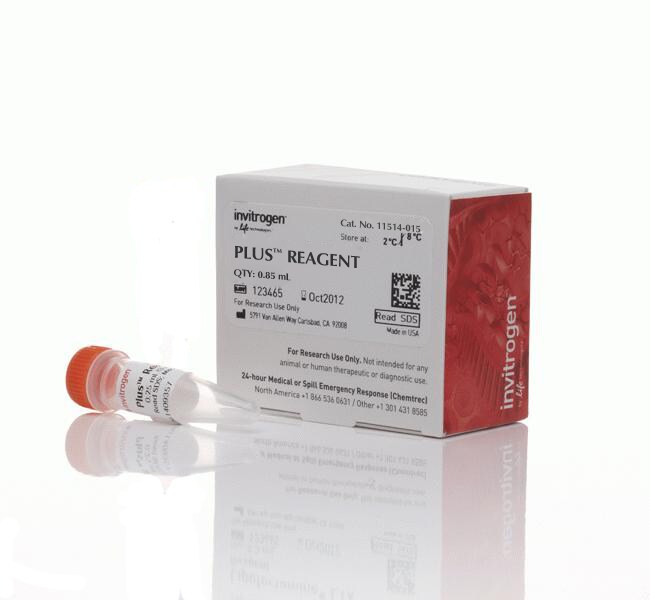
PLUS™ 试剂
PLUS™ 试剂与各种转染试剂(如 Lipofectamine™ 试剂)结合使用,以提高贴壁细胞系的转染效率。使用 PLUS™ 试剂一些客户发现,当使用 PLUS™了解更多信息
| 货号 | 数量 |
|---|---|
| 11514015 | 0.85 mL |
货号 11514015
价格(CNY)
4,953.00
Each
数量:
0.85 mL
价格(CNY)
4,953.00
Each
PLUS™ 试剂与各种转染试剂(如 Lipofectamine™ 试剂)结合使用,以提高贴壁细胞系的转染效率。
使用 PLUS™ 试剂
一些客户发现,当使用 PLUS™ 试剂时,只需较少的 DNA 浓度优化,即可实现较高的转染性能。与单用脂质相比,加用 PLUS™ 试剂还可减少约一半所需的 DNA 和脂质量。PLUS™ 试剂专门设计用于扩增可转染细胞类型的阵列。已证明 PLUS™ 试剂与 Lipofectamine™ 试剂配合使用时可改善 BHK-21、NIH 3T3 和其他细胞系的转染。
使用 PLUS™ 试剂
一些客户发现,当使用 PLUS™ 试剂时,只需较少的 DNA 浓度优化,即可实现较高的转染性能。与单用脂质相比,加用 PLUS™ 试剂还可减少约一半所需的 DNA 和脂质量。PLUS™ 试剂专门设计用于扩增可转染细胞类型的阵列。已证明 PLUS™ 试剂与 Lipofectamine™ 试剂配合使用时可改善 BHK-21、NIH 3T3 和其他细胞系的转染。
仅供科研使用。不可用于诊断程序。
规格
适用于(应用)转染
高通量能力不兼容高通量应用(手动)
产品线PLUS
产品类型试剂名称
数量0.85 mL
血清兼容性是
运输条件湿冰
细胞类型已建立的细胞系, 干细胞, 原代细胞, 难转染细胞
产品规格6孔板、12孔板、24孔板、48孔板、96孔板、培养瓶
样品类型质粒 DNA, RNAi 质粒 (shRNA, miR)
转染技术脂质转染
Unit SizeEach
内容与储存
含一样品瓶 (0.85 mL) PLUS™ 试剂。储存在 4°C 下。切勿冷冻。
常见问题解答 (FAQ)
我不慎将我的脂质体试剂留在了室温条件下,还能继续使用吗?
你们是否为内皮细胞的转染操作提供专门试剂?
PLUS试剂能够与Lipofectamine RNAiMAX联用么?
为什么需要在加入PLUS试剂之前用培养基稀释DNA?可以直接将它们混合在一起么?
PLUS试剂有何作用?
引用和文献 (90)
引用和文献
Abstract
c-Jun is a JNK-independent coactivator of the PU.1 transcription factor.
Journal:J Biol Chem
PubMed ID:9988737
The ETS domain transcription factor PU.1 is necessary for the development of monocytes and regulates, in particular, the expression of the monocyte-specific macrophage colony-stimulating factor (M-CSF) receptor, which is critical for monocytic cell survival, proliferation, and differentiation. The bZIP transcription factor c-Jun, which is part of the AP-1 transcription factor
A
Journal:J Biol Chem
PubMed ID:11973330
The large size (six membrane-spanning repeats in each of four domains) and asymmetric architecture of the voltage-dependent Na+ channel has hindered determination of its structure. With the goal of determining the minimum structure of the Na+ channel permeation pathway, we created two stable cell lines expressing the voltage-dependent rat skeletal
Vesicle-associated membrane protein-2/synaptobrevin binding to synaptotagmin I promotes O-glycosylation of synaptotagmin I.
Journal:J Biol Chem
PubMed ID:12048209
Synaptotagmin I (Syt I), an evolutionarily conserved integral membrane protein of synaptic vesicles, is now known to regulate Ca2+-dependent neurotransmitter release. Syt I protein should undergo several post-translational modifications before maturation and subsequent functioning on synaptic vesicles (e.g. N-glycosylation and fatty acylation in vertebrate Syt I), because the apparent molecular
Receptor-selective effects of endogenous RGS3 and RGS5 to regulate mitogen-activated protein kinase activation in rat vascular smooth muscle cells.
Journal:J Biol Chem
PubMed ID:12006602
Regulators of G protein signaling (RGS) proteins compose a highly diverse protein family best known for inhibition of G protein signaling by enhancing GTP hydrolysis by Galpha subunits. Little is known about the function of endogenous RGS proteins. In this study, we used synthetic ribozymes targeted to RGS2, RGS3, RGS5,
Extracellular Export of Sphingosine Kinase-1 Enzyme. SPHINGOSINE 1-PHOSPHATE GENERATION AND THE INDUCTION OF ANGIOGENIC VASCULAR MATURATION.
Journal:J Biol Chem
PubMed ID:11741921
The enzyme sphingosine kinase (SK) catalyzes the formation of sphingosine 1-phosphate (S1P), a bioactive lipid that acts extracellularly on G protein-coupled receptors of the S1P(1)/EDG-1 subfamily. Although S1P is formed in the cytosol of various cells, S1P release is not understood and is controversial because this lipid mediator is also