Search


引用和文献 (1)
Invitrogen™
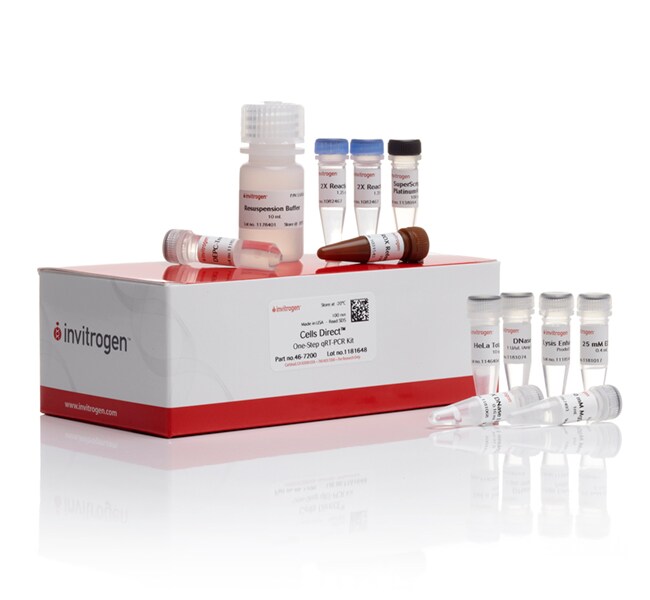
CellsDirect™ 一步法 qRT-PCR 试剂盒
CellsDirect™ 一步法 qRT-PCR 试剂盒可直接从细胞中获得高灵敏度和特异性的实时 qPCR 结果,无需 RNA 纯化步骤。CellsDirect™ 一步法了解更多信息
Have Questions?
更改视图

| 货号 | 反应次数 |
|---|---|
| 11753100 | 100 次反应 |
| 11753500 | 500 次反应 |
货号 11753100
价格(CNY)
8,529.00
Each
反应次数:
100 次反应
价格(CNY)
8,529.00
Each
CellsDirect™ 一步法 qRT-PCR 试剂盒可直接从细胞中获得高灵敏度和特异性的实时 qPCR 结果,无需 RNA 纯化步骤。
CellsDirect™ 一步法 qRT-PCR 试剂盒的特点包括:
•高效—节省大量时间、降低成本、提高通量
• 便利—酶混合物包括 SuperScript™ III 逆转录酶和 Platinum™ Taq DNA 聚合酶
• 灵敏度—没有单独的 RNA 分离步骤,可较大程度减少样品损失,提高灵敏度
• 检测范围宽—从单个细胞至 10,000 个细胞范围的样品检测靶标
• 多功能性—与激光捕获显微切割 (LCM) 收集的多种细胞系和样品兼容
简化工作流程
在传统的实时荧光定量 RT-PCR (qRT-PCR) 中,首先通过耗时的程序从细胞分离 RNA,该程序可导致材料损失。使用 CellsDirect™ 一步法 qRT-PCR 试剂盒,可以裂解细胞并直接将全部裂解物加入一步法 qRT-PCR 反应中,实现较少的处理和样品损失。
非常适合 qRT-PCR 应用
CellsDirect™ 技术经过验证,可用于涉及有限样品的基因表达研究。CellsDirect™ 一步法 qRT-PCR 试剂盒通过消除昂贵、耗时的 RNA 纯化步骤对于高通量应用特别有价值(参见图)。CellsDirect™ 一步法 qRT-PCR 试剂盒也可用于检测基因组 DNA 靶标。
CellsDirect™ 一步法 qRT-PCR 试剂盒可与水解探针(例如,TaqMan™ 或 LUX™ 荧光引物)配合使用。
注:该试剂盒包含一管单独的 ROX™ 参比染料。另外,还提供 2X 反应混合物中包含 ROX™ 参比染料的等效试剂盒 (11754-500)。
CellsDirect™ 一步法 qRT-PCR 试剂盒的特点包括:
•高效—节省大量时间、降低成本、提高通量
• 便利—酶混合物包括 SuperScript™ III 逆转录酶和 Platinum™ Taq DNA 聚合酶
• 灵敏度—没有单独的 RNA 分离步骤,可较大程度减少样品损失,提高灵敏度
• 检测范围宽—从单个细胞至 10,000 个细胞范围的样品检测靶标
• 多功能性—与激光捕获显微切割 (LCM) 收集的多种细胞系和样品兼容
简化工作流程
在传统的实时荧光定量 RT-PCR (qRT-PCR) 中,首先通过耗时的程序从细胞分离 RNA,该程序可导致材料损失。使用 CellsDirect™ 一步法 qRT-PCR 试剂盒,可以裂解细胞并直接将全部裂解物加入一步法 qRT-PCR 反应中,实现较少的处理和样品损失。
非常适合 qRT-PCR 应用
CellsDirect™ 技术经过验证,可用于涉及有限样品的基因表达研究。CellsDirect™ 一步法 qRT-PCR 试剂盒通过消除昂贵、耗时的 RNA 纯化步骤对于高通量应用特别有价值(参见图)。CellsDirect™ 一步法 qRT-PCR 试剂盒也可用于检测基因组 DNA 靶标。
CellsDirect™ 一步法 qRT-PCR 试剂盒可与水解探针(例如,TaqMan™ 或 LUX™ 荧光引物)配合使用。
注:该试剂盒包含一管单独的 ROX™ 参比染料。另外,还提供 2X 反应混合物中包含 ROX™ 参比染料的等效试剂盒 (11754-500)。
仅供科研使用。不可用于诊断程序。
规格
适用于(设备)7500 Fast 系统、7500 系统、BioRad iQ5、BioRad MyiQ、Corbett RotorGene、MJ Opticon、Stratagene Mx3000P、Stratagene Mx3005P、Stratagene Mx4000、BioRad iCycler iQ、Cepheid SmartCycler、MJ Chromo4、QuantStudio 3 和 5 系统、QuantStudio 6 和 7 Pro 系统、QuantStudio 7 Flex 系统、QuantStudio 12k Flex 系统、QuantStudio 6 Flex 系统
反应次数100 次反应
产品线CellsDirect、Platinum、SuperScript
数量100次反应
样品类型细胞
最大浓度2X
检测方法引物-探针
适用于(应用)RT-PCR
反应速度快速,标准
Unit SizeEach
内容与储存
•10 mL 重悬缓冲液
•1 mL 裂解增强剂
•500 µL DNase I(扩增级)(1 U/µL)
•160 µL 10X DNase I 缓冲液
•400 µL 25 mM EDTA
•100 µL SuperScript ™III RT/Platinum™Taq 混合物
•2 × 1.25 mL 2X 反应混合物
• 1 mL 50 mM MgSO4
•2 mL DEPC 处理水
•10 µL HeLa 总 RNA (10 ng/µL)
•100 µL ROX™ 参比染料(在 -20°C 下于暗处储存)
该试剂盒置于干冰上运输,并应将其储存在 -20°C 下
•1 mL 裂解增强剂
•500 µL DNase I(扩增级)(1 U/µL)
•160 µL 10X DNase I 缓冲液
•400 µL 25 mM EDTA
•100 µL SuperScript ™III RT/Platinum™Taq 混合物
•2 × 1.25 mL 2X 反应混合物
• 1 mL 50 mM MgSO4
•2 mL DEPC 处理水
•10 µL HeLa 总 RNA (10 ng/µL)
•100 µL ROX™ 参比染料(在 -20°C 下于暗处储存)
该试剂盒置于干冰上运输,并应将其储存在 -20°C 下
常见问题解答 (FAQ)
What can I do to improve the sensitivity of my qPCR assay?
How do I set the baseline for my qPCR experiment?
How do I set the threshold for my qPCR experiment?
I am not getting any amplification with my TaqMan Assay or SYBR Green primer set. What is causing this?
I am getting amplification in my no-template control (NTC) wells in my qPCR experiment. What is causing this?
引用和文献 (1)
引用和文献
Abstract
Comparison of reverse transcription-quantitative polymerase chain reaction methods and platforms for single cell gene expression analysis.
Journal:Anal Biochem
PubMed ID:22617801
Single cell gene expression analysis can provide insights into development and disease progression by profiling individual cellular responses as opposed to reporting the global average of a population. Reverse transcription-quantitative polymerase chain reaction (RT-qPCR) is the