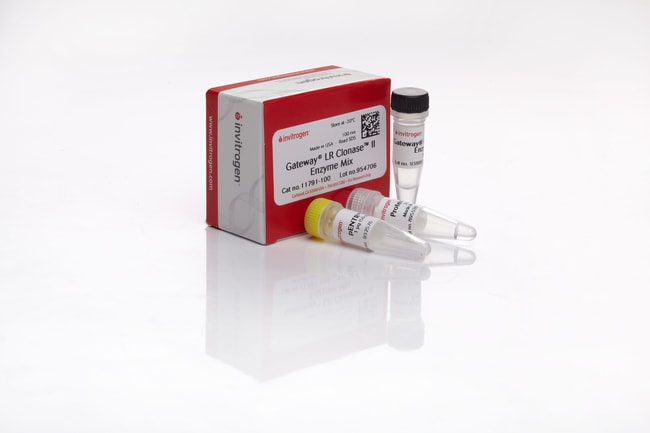
Gateway™ LR Clonase™ II Enzyme mix
Invitrogen17万+抗体限时买二赠一,靶点广,灵活用!
Gateway™ LR Clonase™ II Enzyme mix
Invitrogen™

Gateway™ LR Clonase™ II Enzyme mix

Gateway™ LR Clonase™ II enzyme mix catalyzes the in vitro recombination between an entry clone (containing a gene of interestRead more
Have Questions?
Change viewbuttonViewtableView
Catalog NumberQuantity
11791100100 Reactions
1179102020 Reactions
Catalog number 11791100
Price (CNY)
13,131.00
Online Exclusive
Ends: 31-Dec-2025
16,833.00
Save 3,702.00 (22%)
Each
Add to cart
Quantity:
100 Reactions
Price (CNY)
13,131.00
Online Exclusive
Ends: 31-Dec-2025
16,833.00
Save 3,702.00 (22%)
Each
Add to cart
Gateway™ LR Clonase™ II enzyme mix catalyzes the in vitro recombination between an entry clone (containing a gene of interest flanked by attL sites) and a destination vector (containing attR sites) to generate an expression clone. Gateway™ LR Clonase™ II contains enzymes and buffer in a single mix to enable convenient ten-microliter reaction set-up with fewer pipetting steps.
For Research Use Only. Not for use in diagnostic procedures.
Specifications
Compatible BufferEnzyme Buffer
Product TypeLR Clonase Enzyme Mix
Quantity100 Reactions
Shipping ConditionDry Ice
EnzymeLR Clonase
Product LineClonase™, Gateway™
Unit SizeEach
Contents & Storage
Gateway™ LR Clonase™ II enzyme mix includes proteinase K solution (2 μg/μL) and a positive control vector. Store at -20°C or -80°C. Guaranteed stable for 6 months when properly stored.

Frequently asked questions (FAQs)

I performed an LR reaction and got high background after transformation. Can you please offer some troubleshooting tips?

– Check whether the reaction was transformed into an E.coli strain containing the F' episome and the ccdA gene – use an E.coli strain that does not contain the F&339; episome, e.g. OmniMAX 2-T1R, TOP10.
– Deletion (full or partial) of the ccdB gene – propagate in media with 50-100 mg/mL ampicillin and 15-30 µg/mL chloramphenicol.
– Contamination from another resistant strain.
– Check whether proper amount of DNA was used in the reaction.

I performed an LR reaction and got two distinct types of colonies (large and small) after transformation. What could be the possible reasons?

– Plasmid was lost during culture due to large size or toxicity – try incubating at 30 degrees C; use Stbl2 E.coli to stabilize the plasmid.
– Deletions (full or partial) or point mutations in the ccdB gene – obtain a new Destination vector.
– Small colonies may be unreacted entry clone that co-transforms with the Expression clone – reduce the amount of Entry clone to 50 ng per 10 µL reaction; reduce the volume of sample used for transformation to 1 µL; for a Destination vector with ampicillin selection marker, increase the ampicillin concentration to 300 µg/mL.

I performed an LR reaction and got no colonies after transformation, and the recombination positive control was not successful. Can you please offer some suggestions?

– Check the competent cells with pUC19 transformation.
– Increase the amount plated.

I performed an LR reaction and got few or no colonies after transformation, whereas the transformation control gave colonies. Can you please offer some suggestions?

– Increase the incubation time up to 18 hours.
– Make sure to treat reactions with proteinase K before transformation.
– Check whether the correct antibiotic was used for selection.
– Check whether the att site sequences are correct.
– Check whether the correct Clonase enzyme was used and whether it was functional.
– Check whether the recommended amount of DNA was used in the reaction.
– Perform the positive control recombination with pENTR-Gus plasmid.
– If the Entry clone or Destination vector is too large (>10 kb), incubate the LR reaction overnight, linearize the Destination vector or the Entry clone or relax the Destination vector with topoisomerase I.

Can I create a single Entry vector for use with DEST vectors that have N-terminal tags and C-terminal tags?

No, since a stop codon would be necessary for an N-terminal tagged destination vector, whereas the presence of a stop codon would block expression of the C-terminal tag.