Search


引用和文献 (4)
Invitrogen™
ElectroMAX™ DH10B T1 噬菌体耐受感受态细胞
ElectroMAX DH10B T1 噬菌体耐受感受态细胞提供的转化效率在我们提供的任何产品中均达到极高水平,效率可超过 1 x 10¹⁰ cfu/μg 质粒 DNA了解更多信息
| 货号 | 数量 |
|---|---|
| 12033015 | 5 x 100μL |
货号 12033015
价格(CNY)
2,470.00
飞享价
Ends: 31-Dec-2026
3,088.00共减 618.00 (20%)
Each
数量:
5 x 100μL
价格(CNY)
2,470.00
飞享价
Ends: 31-Dec-2026
3,088.00共减 618.00 (20%)
Each
ElectroMAX DH10B T1 噬菌体耐受感受态细胞提供的转化效率在我们提供的任何产品中均达到极高水平,效率可超过 1 x 10¹⁰ cfu/μg 质粒 DNA。它们适用于需要高效转化的应用,包括 cDNA 和 gDNA 文库构建。ElectroMAX DH10B 细胞:
•使用有限的克隆产品尽可能提高转化体得率
•可高效克隆甲基化 DNA
•耐受 T1 和 T5 噬菌体
•在含有 X-Gal 或 Bluo-Gal 的平板上,通过 α-互补支持蓝白斑筛选
•为下游应用提供高得率质粒制剂
来自单一转化的噬菌体耐受代表性文库
DH10B 细胞中的 tonA 突变使其能够耐受噬菌体 T1 和 T5,从而保护有价值的文库免受污染。此外,甲基化依赖性限制系统(mcrA、mcrBC 和 mrr)中的突变使 ElectroMAX DH10B T1 噬菌体耐受细胞适用于构建原核和真核基因组 DNA 的基因组文库以及从真核基因组中高效地挽救质粒。ElectroMAX DH10B T1 噬菌体耐受细胞适用于构建基因库、使用质粒衍生载体生成 cDNA 文库以及用于 DNA 有限的情况。该细胞株还具有 Φ80lacZΔM15 基因型,允许在含有 X-Gal 或 Bluo-Gal 的平板上进行蓝白斑筛选。最后,endA1 突变使 DH10B 成为扩增质粒 DNA 以进行后续提取和纯化的绝佳载体。
基因型:F-mcrA Δ(mrr-hsdRMS-mcrBC) Φ80lacZΔM15 ΔlacX74 recA1 endA1 araD139Δ(ara, leu)7697 galU galK λ-rpsL nupG tonA
查找您需要的细胞株和规格
DH10B 细胞有电转感受态和化学感受态规格。我们的 ElectroMAX DH10B 细胞也适用于 cDNA 或 gDNA 文库构建,但不耐受 T1 和 T5 噬菌体感染。我们的 MegaX DH10B T1R Electrocomp 细胞具有极高转化效率(>3 x 10¹⁰ cfu/μg 质粒 DNA),还可提供耐受 T1 和 T5 噬菌体的优势。
•使用有限的克隆产品尽可能提高转化体得率
•可高效克隆甲基化 DNA
•耐受 T1 和 T5 噬菌体
•在含有 X-Gal 或 Bluo-Gal 的平板上,通过 α-互补支持蓝白斑筛选
•为下游应用提供高得率质粒制剂
来自单一转化的噬菌体耐受代表性文库
DH10B 细胞中的 tonA 突变使其能够耐受噬菌体 T1 和 T5,从而保护有价值的文库免受污染。此外,甲基化依赖性限制系统(mcrA、mcrBC 和 mrr)中的突变使 ElectroMAX DH10B T1 噬菌体耐受细胞适用于构建原核和真核基因组 DNA 的基因组文库以及从真核基因组中高效地挽救质粒。ElectroMAX DH10B T1 噬菌体耐受细胞适用于构建基因库、使用质粒衍生载体生成 cDNA 文库以及用于 DNA 有限的情况。该细胞株还具有 Φ80lacZΔM15 基因型,允许在含有 X-Gal 或 Bluo-Gal 的平板上进行蓝白斑筛选。最后,endA1 突变使 DH10B 成为扩增质粒 DNA 以进行后续提取和纯化的绝佳载体。
基因型:F-mcrA Δ(mrr-hsdRMS-mcrBC) Φ80lacZΔM15 ΔlacX74 recA1 endA1 araD139Δ(ara, leu)7697 galU galK λ-rpsL nupG tonA
查找您需要的细胞株和规格
DH10B 细胞有电转感受态和化学感受态规格。我们的 ElectroMAX DH10B 细胞也适用于 cDNA 或 gDNA 文库构建,但不耐受 T1 和 T5 噬菌体感染。我们的 MegaX DH10B T1R Electrocomp 细胞具有极高转化效率(>3 x 10¹⁰ cfu/μg 质粒 DNA),还可提供耐受 T1 和 T5 噬菌体的优势。
仅供科研使用。不可用于诊断程序。
规格
耐抗生素细菌Yes (Streptomycin)
蓝色/白色筛查是
是否可克隆甲基化 DNA是
克隆不稳定 DNA不适合克隆不稳定DNA
是否含 F' 附加体缺乏 F’附加体
高通量能力不兼容高通量应用(手动)
提高质粒质量是
质粒可用于 > 20 kb 质粒
制备无甲基化 DNA不适合制备未甲基化DNA
产品线DH10B, ElectroMAX
产品类型感受态细胞
数量5 x 100μL
减少克隆重组现象是
运输条件干冰
T1 噬菌体 - 抗性 (tonA)是
转化效率级别高效率 (> 10^9 cfu⁄μg)
产品规格One Shot
种属大肠杆菌
Unit SizeEach
内容与储存
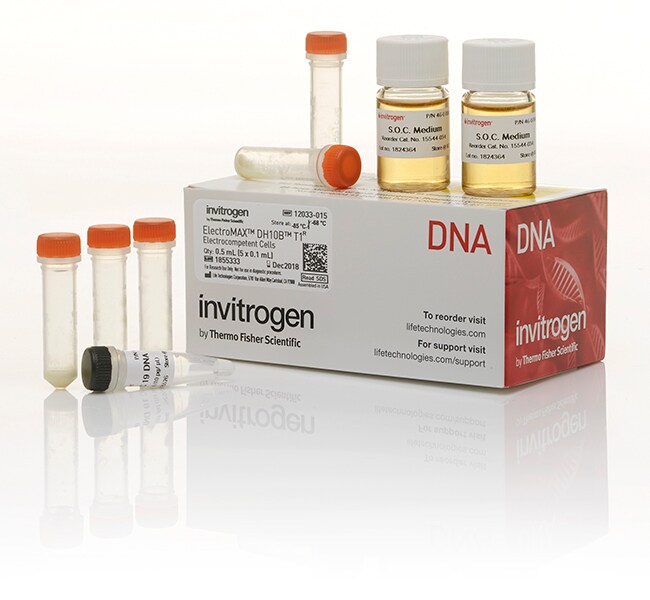
包含:
•ElectroMAX DH10B T1 噬菌体耐受细胞:5 样本瓶、每瓶 100 μL
•pUC19 DNA (10 pg/μL):1 个样品瓶,50μ L
• S.O.C.培养基:2 瓶,各 6 ml
感受态细胞在 -80°C 下储存。pUC19 DNA 在 -20°C 下储存。SOC 培养基在 4°C 或室温下储存。
•ElectroMAX DH10B T1 噬菌体耐受细胞:5 样本瓶、每瓶 100 μL
•pUC19 DNA (10 pg/μL):1 个样品瓶,50μ L
• S.O.C.培养基:2 瓶,各 6 ml
感受态细胞在 -80°C 下储存。pUC19 DNA 在 -20°C 下储存。SOC 培养基在 4°C 或室温下储存。
常见问题解答 (FAQ)
How do you recommend that I prepare my DNA for successful electroporation of E. coli?
When should DMSO, formamide, glycerol and other cosolvents be used in PCR?
引用和文献 (4)
引用和文献
Abstract
McrA and McrB restriction phenotypes of some E. coli strains and implications for gene cloning.
Journal:Nucleic Acids Res
PubMed ID:2831502
'The McrA and McrB (modified cytosine restriction) systems of E. coli interfere with incoming DNA containing methylcytosine. DNA from many organisms, including all mammalian and plant DNA, is expected to be sensitive, and this could interfere with cloning experiments. The McrA and B phenotypes of a few strains have been
Quantitative evaluation of Escherichia coli host strains for tolerance to cytosine methylation in plasmid and phage recombinants.
Journal:Nucleic Acids Res
PubMed ID:2657660
Many strains of E. coli K12 restrict DNA containing cytosine methylation such as that present in plant and animal genomes. Such restriction can severely inhibit the efficiency of cloning genomic DNAs. We have quantitatively evaluated a total of 39 E. coli strains for their tolerance to cytosine methylation in phage
Properties of the FhuA channel in the Escherichia coli outer membrane after deletion of FhuA portions within and outside the predicted gating loop.
Journal:J Bacteriol
PubMed ID:8955314
Escherichia coli transports Fe3+ as a ferrichrome complex through the outer membrane in an energy-dependent process mediated by the FhuA protein. A FhuA deletion derivative lacking residues 322 to 355 (FhuA delta322-355) forms a permanently open channel through which ferrichrome diffused. This finding led to the concept that the FhuA
Differential plasmid rescue from transgenic mouse DNAs into Escherichia coli methylation-restriction mutants.
Journal:Proc Natl Acad Sci U S A
PubMed ID:2162051
Plasmids comprising transgene insertions in four lines of transgenic mice have been retrieved by plasmid rescue into a set of Escherichia coli strains with mutations in different members of the methylation-dependent restriction system (MDRS). Statistical analysis of plasmid rescue frequencies has revealed that the MDRS loci detect differential modifications of