Search


引用和文献 (48)
Invitrogen™
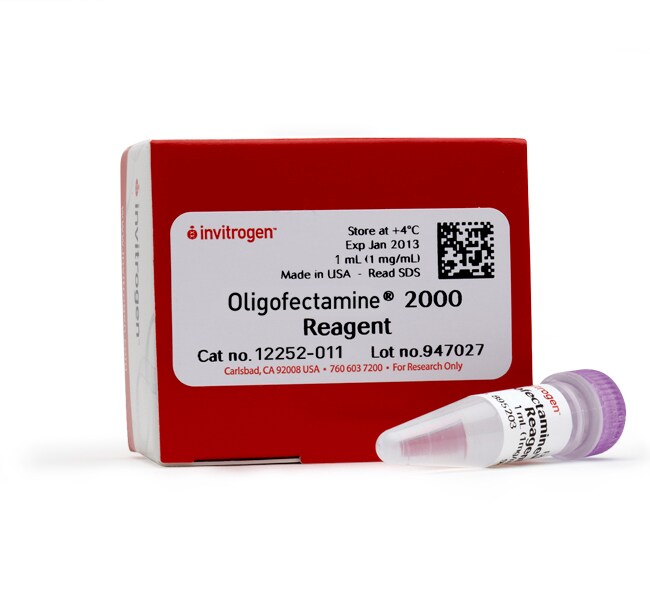
Oligofectamine™ 转染试剂
Oligofectamine™ 转染试剂是一种专有制剂,用于将寡核苷酸和短干扰 RNA (siRNA) 转染至真核细胞。Oligofectamine™ 转染试剂与寡核苷酸形成稳定复合物,允许以高度特异性但无毒的方式有效转染真核细胞。Oligofectamine™ 试剂适用于细胞核和细胞质靶点,并可转染多种细胞系,包括 CHO了解更多信息
| 货号 | 数量 |
|---|---|
| 12252011 | 1 mL |
货号 12252011
价格(CNY)
8,405.00
Each
数量:
1 mL
价格(CNY)
8,405.00
Each
Oligofectamine™ 转染试剂是一种专有制剂,用于将寡核苷酸和短干扰 RNA (siRNA) 转染至真核细胞。Oligofectamine™ 转染试剂与寡核苷酸形成稳定复合物,允许以高度特异性但无毒的方式有效转染真核细胞。Oligofectamine™ 试剂适用于细胞核和细胞质靶点,并可转染多种细胞系,包括 CHO、HEK-293、NIH 3T3 和 HeLa。
使用 Oligofectamine™ 转染试剂
Oligofectamine™ 试剂易于使用,因为它提供了简单快速的方案。只需稀释 Oligofectamine™ 试剂,与寡核苷酸混合,加入到细胞中即可。Oligofectamine™ 试剂需要纳摩尔量的反义寡核苷酸,将所需的有价值的寡核苷酸量减至原来的千分之一。这使其成为高通量应用的理想选择。此外,还已证明 Oligofectamine™ 试剂可用于 siRNA 转染。在 HeLa 细胞中进行 RNAi 敲低实验时,我们建议使用该试剂。有关更多信息,请访问 RNAi 中心。
使用 Oligofectamine™ 转染试剂
Oligofectamine™ 试剂易于使用,因为它提供了简单快速的方案。只需稀释 Oligofectamine™ 试剂,与寡核苷酸混合,加入到细胞中即可。Oligofectamine™ 试剂需要纳摩尔量的反义寡核苷酸,将所需的有价值的寡核苷酸量减至原来的千分之一。这使其成为高通量应用的理想选择。此外,还已证明 Oligofectamine™ 试剂可用于 siRNA 转染。在 HeLa 细胞中进行 RNAi 敲低实验时,我们建议使用该试剂。有关更多信息,请访问 RNAi 中心。
仅供科研使用。不可用于诊断程序。
规格
适用于(应用)转染
高通量能力兼容高通量应用
产品线Oligofectamine
产品类型转染试剂
数量1 mL
血清兼容性否
运输条件湿冰
细胞类型已建立的细胞系, 原代细胞, 难转染细胞
产品规格6孔板、12孔板、24孔板、48孔板、96孔板、培养瓶
样品类型合成 siRNA
转染技术脂质转染
Unit SizeEach
内容与储存
含一样品瓶 (1 mL) Oligofectamine™ 试剂。储存在 4°C 下。切勿冷冻。
常见问题解答 (FAQ)
我不慎将我的脂质体试剂留在了室温条件下,还能继续使用吗?
反向转染与正向转染之间区别是什么?我该如何选择?
转染过程中的培养基可使用抗生素么?
在脂质体转染过程中必须使用无血清的培养基么?
我应使用何种反应管来配制脂质体:DNA复合物?
引用和文献 (48)
引用和文献
Abstract
A high-throughput, cell-based screening method for siRNA and small molecule inhibitors of mTORC1 signaling using the In Cell Western technique.
Journal:Assay Drug Dev Technol
PubMed ID:20085456
'The mTORC1 pathway is a central regulator of cell growth, and defective mTORC1 regulation plays a causative role in a variety of human diseases, including cancer, tumor syndromes such as the tuberous sclerosis complex (TSC) and lymphangioleiomyomatosis (LAM), and metabolic diseases such as diabetes and obesity. Given the importance of
Processing of Pro-atrial Natriuretic Peptide by Corin in Cardiac Myocytes.
Journal:J Biol Chem
PubMed ID:11884416
'Corin is a type II transmembrane serine protease abundantly expressed in the heart. In a previous study using transfected 293 cells, we showed that corin converted pro-atrial natriuretic peptide (pro-ANP) to atrial natriuretic peptide (ANP), suggesting that corin is likely the pro-ANP convertase. Because other serine proteases such as thrombin
Systems survey of endocytosis by multiparametric image analysis.
Journal:Nature
PubMed ID:20190736
'Endocytosis is a complex process fulfilling many cellular and developmental functions. Understanding how it is regulated and integrated with other cellular processes requires a comprehensive analysis of its molecular constituents and general design principles. Here, we developed a new strategy to phenotypically profile the human genome with respect to transferrin
N-glycans are direct determinants of CFTR folding and stability in secretory and endocytic membrane traffic.
Journal:J Cell Biol
PubMed ID:19307599
'N-glycosylation, a common cotranslational modification, is thought to be critical for plasma membrane expression of glycoproteins by enhancing protein folding, trafficking, and stability through targeting them to the ER folding cycles via lectin-like chaperones. In this study, we show that N-glycans, specifically core glycans, enhance the productive folding and conformational
Disinhibition of neurotrophin-induced dorsal root ganglion cell neurite outgrowth on CNS myelin by siRNA-mediated knockdown of NgR, p75(NTR) and Rho-A.
Journal:Mol Cell Neurosci
PubMed ID:15737741
'The presence of multiple axon growth inhibitors may partly explain why central nervous system axons are generally incapable of regenerating after injury. Using RNA interference (RNAi) in dorsal root ganglia neurons (DRGN), we demonstrate siRNA-mediated silencing of components of the inhibitory signalling cascade, including p75(NTR), NgR and Rho-A mRNA, of