Search


引用和文献 (3)
Gibco™
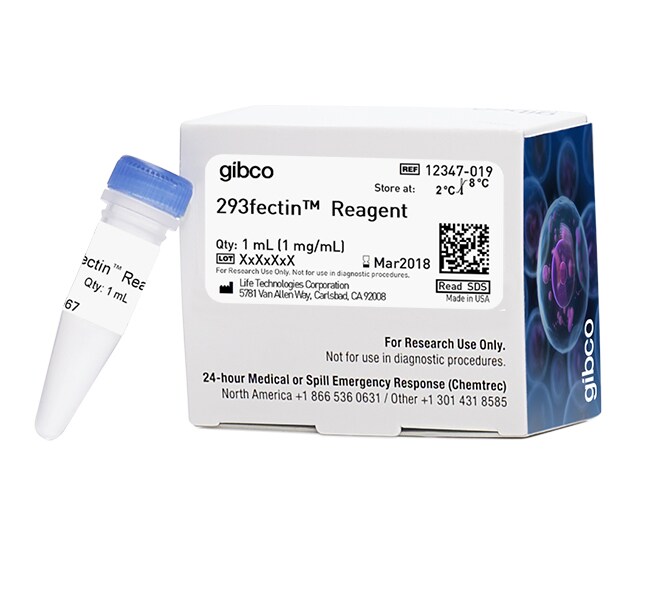
293fectin™ 转染试剂
293fectin™ Transfection Reagent is a proprietary, cationic lipid-based formulation for transfecting DNA into eukaryotic cells.
Have Questions?
更改视图

| 货号 | 数量 |
|---|---|
| 12347019 | 1 mL |
| 12347500 又称 12347-500 | 15 mL |
| 12347750 又称 12347-750 | 10 x 15 mL |
货号 12347019
价格(CNY)
7,986.00
Each
数量:
1 mL
价格(CNY)
7,986.00
Each
293fectin™ Transfection Reagent is a proprietary, cationic lipid-based formulation for transfecting DNA into eukaryotic cells. This reagent is optimized for transfecting suspension 293 human embryonic kidney cells (e.g., FreeStyle™ 293-F cells, Cat. No. R790-07) in defined, serum-free FreeStyle™ 293 Expression Medium (12338-018), and is intended for use with the FreeStyle™ 293 Expression System (K9000-01).
293fectin™ Transfection Reagent provides the following advantages:
- Demonstrates high transfection efficiency in suspension 293 cells and is also suitable for transfecting adherent 293 cells
- Suspension FreeStyle™ 293-F cells may be transfected in FreeStyle™ 293 Expression Medium; no medium change is required
- Add 293fectin™ reagent complexes directly to cells in culture medium
- No need to remove complexes or change or add medium following transfection
293fectin™ 转染试剂是一种专利的基于阳离子脂质体的配方,用于将 DNA 转染至真核细胞。此试剂经过优化可用于转染悬浮 293 人胚胎肾细胞(例如 FreeStyle™ 293-F 细胞,货号 R790-07;成分明确)、无血清 FreeStyle ™293 表达培养基(货号 12338-018),预期用于与 FreeStyle ™293 表达系统(货号 K9000-01)配合使用。293fectin™ 转染试剂具有以下优势:
•表明悬浮 293 细胞具有高转染效率,也适合转染贴壁 293 细胞
•混悬 FreeStyle™ 293-F 细胞可能在 FreeStyle™ 293 表达培养基中转染;无需更换培养基
• 293fectin™ 试剂复合物可直接加入培养基中的细胞中
•无需在转染后去除复合体或更换或添加培养基
•表明悬浮 293 细胞具有高转染效率,也适合转染贴壁 293 细胞
•混悬 FreeStyle™ 293-F 细胞可能在 FreeStyle™ 293 表达培养基中转染;无需更换培养基
• 293fectin™ 试剂复合物可直接加入培养基中的细胞中
•无需在转染后去除复合体或更换或添加培养基
仅供科研使用。不可用于诊断程序。
规格
适用于(应用)转染
高通量能力不兼容高通量应用(手动)
产品线293fectin
产品类型转染试剂
数量1 mL
血清兼容性是
细胞类型已建立的细胞系
样品类型质粒 DNA
转染技术脂质转染
Unit SizeEach
内容与储存
每单位包含一小瓶试剂。在 +4°C 下储存。储存恰当的情况下,293fectin™ 在可保证稳定 6 个月。
常见问题解答 (FAQ)
FreeStyle Max试剂相对于293fectin转染试剂的优势是什么?
我不慎将我的脂质体试剂留在了室温条件下,还能继续使用吗?
反向转染与正向转染之间区别是什么?我该如何选择?
转染过程中的培养基可使用抗生素么?
在脂质体转染过程中必须使用无血清的培养基么?
引用和文献 (3)
引用和文献
Abstract
Molecular dissection of the alpha-dystroglycan- and integrin-binding sites within the globular domain of human laminin-10.
Journal:J Biol Chem
PubMed ID:14701821
'The adhesive interactions of cells with laminins are mediated by integrins and non-integrin-type receptors such as alpha-dystroglycan and syndecans. Laminins bind to these receptors at the C-terminal globular domain of their alpha chains, but the regions recognized by these receptors have not been mapped precisely. In this study, we sought
Binding of anthrax toxin to its receptor is similar to alpha integrin-ligand interactions.
Journal:J Biol Chem
PubMed ID:14507921
The secreted protein toxin produced by Bacillus anthracis contributes to virulence of this pathogen and can cause many of the symptoms seen during an anthrax infection, including shock and sudden death. The cell-binding component of anthrax toxin, protective antigen, mediates entry of the toxin into cells by first binding directly
T cell immunoglobulin mucin-3 crystal structure reveals a galectin-9-independent ligand-binding surface.
Journal:Immunity
PubMed ID:17363302
The T cell immunoglobulin mucin (Tim) family of receptors regulates effector CD4(+) T cell functions and is implicated in autoimmune and allergic diseases. Tim-3 induces immunological tolerance, and engagement of the Tim-3 immunoglobulin variable (IgV) domain by galectin-9 is important for appropriate termination of T helper 1-immune responses. The 2