Search


引用和文献 (6)
Invitrogen™
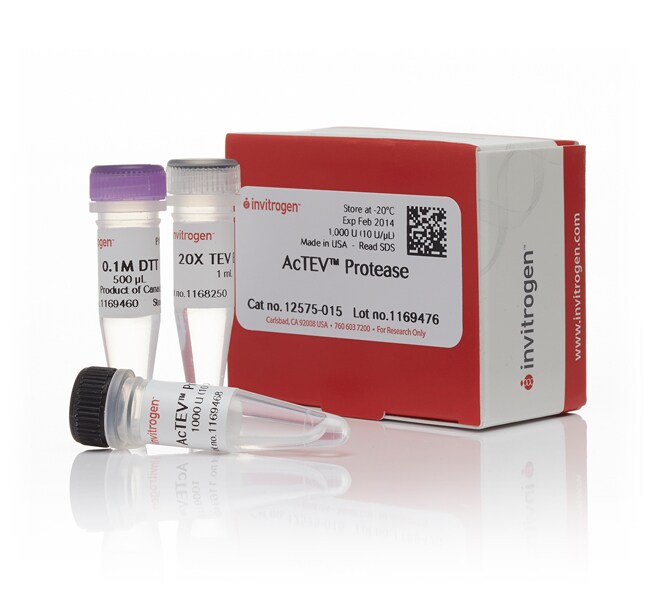
AcTEV™ 蛋白酶
AcTEV™ 蛋白酶可特异性识别一个七氨基酸序列(Glu-Asn-Leu-Tyr-Phe-Gln-Gly,在 Gln 与 Gly 之间切割),使其可用于从融合蛋白中去除亲和标签。AcTEV™ 蛋白酶是改进版本的烟草蚀刻病毒了解更多信息
Have Questions?
更改视图

| 货号 | 数量 |
|---|---|
| 12575015 | 1000 U |
| 12575023 | 10,000 U |
货号 12575015
价格(CNY)
5,704.00
Each
数量:
1000 U
价格(CNY)
5,704.00
Each
AcTEV™ 蛋白酶可特异性识别一个七氨基酸序列(Glu-Asn-Leu-Tyr-Phe-Gln-Gly,在 Gln 与 Gly 之间切割),使其可用于从融合蛋白中去除亲和标签。AcTEV™ 蛋白酶是改进版本的烟草蚀刻病毒 (TEV) 蛋白酶,具有高度位点特异性、高度活性且显著比天然 TEV 蛋白酶更稳定,从而增强了长期活性。AcTEV™ 蛋白酶的特点:
•高度特异性切割活性
• 增强酶稳定性,从而增强长期蛋白酶活性(参见图)
•在宽温度范围(+4°C 至 30°C)和 pH 值范围(6.0 至 8.5)内具有活性
•识别六组氨酸序列,有助于将其从酶切蛋白样品中去除
• 单条带纯度大于 85%,没有非特异性蛋白酶污染
应用
用 AcTEV™ 蛋白酶孵育,从融合标签中释放目标蛋白。这是从重组蛋白中去除溶解度、分泌、检测和纯化标签的有效方法。
酶规格
从表达 AcTEV™ 蛋白酶基因的大肠杆菌中纯化。
单位定义
一单位 AcTEV™ 蛋白酶可在 1 h 内于 30°C 下切割 85% 的 3 µg 对照底物。
单位反应条件
50 mM Tris-HCl(pH 值 8.0)、0.5 mM EDTA、1 mM DTT、3 µg 对照底物和 1 单位酶/30 µL,30°C 下 1 h。AcTEV™ 蛋白酶经过功能检测,不存在任何非特异性蛋白酶活性。
•高度特异性切割活性
• 增强酶稳定性,从而增强长期蛋白酶活性(参见图)
•在宽温度范围(+4°C 至 30°C)和 pH 值范围(6.0 至 8.5)内具有活性
•识别六组氨酸序列,有助于将其从酶切蛋白样品中去除
• 单条带纯度大于 85%,没有非特异性蛋白酶污染
应用
用 AcTEV™ 蛋白酶孵育,从融合标签中释放目标蛋白。这是从重组蛋白中去除溶解度、分泌、检测和纯化标签的有效方法。
酶规格
从表达 AcTEV™ 蛋白酶基因的大肠杆菌中纯化。
单位定义
一单位 AcTEV™ 蛋白酶可在 1 h 内于 30°C 下切割 85% 的 3 µg 对照底物。
单位反应条件
50 mM Tris-HCl(pH 值 8.0)、0.5 mM EDTA、1 mM DTT、3 µg 对照底物和 1 单位酶/30 µL,30°C 下 1 h。AcTEV™ 蛋白酶经过功能检测,不存在任何非特异性蛋白酶活性。
仅供科研使用。不可用于诊断程序。
规格
兼容缓冲液TEV 缓冲液
产品类型蛋白酶
数量1000 U
运输条件干冰
最大浓度1,000 单位
酶TEV 蛋白酶
最佳反应温度+4°C 至 +30°C
产品线AcTEV
Unit SizeEach
内容与储存
随 AcTEV™ 蛋白酶一起提供的有一样品瓶 20X TEV 缓冲液 [1 M Tris-HCl(pH 值 8.0)、10 mM EDTA] 和一样品瓶 100 mM DTT。
在 -20°C 下储存。妥善储存时,可保证稳定储存 1 年。
在 -20°C 下储存。妥善储存时,可保证稳定储存 1 年。
常见问题解答 (FAQ)
Why does AcTEV Protease require DTT?
What is the cleavage recognition site for AcTEV Protease?
What products do you offer for enzymatic cleavage of fusion tags from recombinant proteins?
引用和文献 (6)
引用和文献
Abstract
Structure and function of an irreversible agonist-ß(2) adrenoceptor complex.
Journal:Nature
PubMed ID:21228876
'G-protein-coupled receptors (GPCRs) are eukaryotic integral membrane proteins that modulate biological function by initiating cellular signalling in response to chemically diverse agonists. Despite recent progress in the structural biology of GPCRs, the molecular basis for agonist binding and allosteric modulation of these proteins is poorly understood. Structural knowledge of agonist-bound
Quantitative reactivity profiling predicts functional cysteines in proteomes.
Journal:Nature
PubMed ID:21085121
'Cysteine is the most intrinsically nucleophilic amino acid in proteins, where its reactivity is tuned to perform diverse biochemical functions. The absence of a consensus sequence that defines functional cysteines in proteins has hindered their discovery and characterization. Here we describe a proteomics method to profile quantitatively the intrinsic reactivity
Widespread bidirectional promoters are the major source of cryptic transcripts in yeast.
Journal:Nature
PubMed ID:19169244
'Pervasive and hidden transcription is widespread in eukaryotes, but its global level, the mechanisms from which it originates and its functional significance are unclear. Cryptic unstable transcripts (CUTs) were recently described as a principal class of RNA polymerase II transcripts in Saccharomyces cerevisiae. These transcripts are targeted for degradation immediately
Non-muscle myosin IIA is a functional entry receptor for herpes simplex virus-1.
Journal:Nature
PubMed ID:20944748
Herpes simplex virus-1 (HSV-1), the prototype of the a-herpesvirus family, causes life-long infections in humans. Although generally associated with various mucocutaneous diseases, HSV-1 is also involved in lethal encephalitis. HSV-1 entry into host cells requires cellular receptors for both envelope glycoproteins B (gB) and D (gD). However, the gB receptors
Hexameric assembly of the proteasomal ATPases is templated through their C termini.
Journal:Nature
PubMed ID:19412160
Substrates of the proteasome are recognized and unfolded by the regulatory particle, and then translocated into the core particle (CP) to be degraded. A hetero-hexameric ATPase ring, containing subunits Rpt1-6, is situated within the base subassembly of the regulatory particle. The ATPase ring sits atop the CP, with the Rpt